
News Brief
Carol Venolia, Publisher/Editor
If “progressive construction” can be defined as pushing the tools and techniques of conventional builders in the direction of less environmental destruction, then Building With Nature’s material goes beyond progressive, into the forefront of visionary thinking about construction. This bimonthly newsletter, now... Read moreFeature
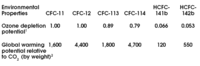
Ozone depletion and global warming are two of our most serious environmental problems—and foam insulation materials containing CFCs (chlorofluorocarbons) contribute significantly to both of these problems. The environmentally concerned builder or designer should make it a highest priority to avoid them. Even many of the non-CFC alternatives... Read more
Op-Ed
Introducing the first issue of our newsletter.
Buildings have a tremendous impact on the environment. In North America, buildings and the building industry account for about 30% of carbon dioxide emissions, 35-40% of ozone depletion, 20-30% of municipal solid waste, vast quantities of natural resource consumption, and dramatic loss of open space each... Read more
Feature
Susan Maxman is the first AIA president to make sustainable design a priority.
Q.Where would you say architects as a group stand on environmental issues?
A.Architects tend to be reactive rather than proactive. It is important that we take the lead on these environmental issues. The architecture schools in particular tend to be conservative. They just aren’t... Read more
News Brief
The American Institute of Architects convention in Boston this past June was the setting for a changing of the guard in the American architectural establishment. The Institute’s first woman president took the reins, the Committee on the Environment became its largest and fastest growing committee, and the first installments of the Environmental... Read more
Feature
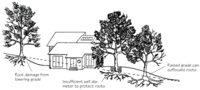
Carefully stake the building site and driveway, remove trees that are within the excavation area or too close, then erect a fence to keep heavy equipment off fragile soils and away from nearby trees.
Protecting trees and the local ecosystem when building on previously unbuilt land is a vitally important—yet often overlooked—part of environmentally responsible construction. Healthy trees and shrubs can reduce a home’s environmental impact and directly benefit homeowners in a number of ways:
•Enhancing comfort by shielding the house... Read more
Forum topic
Good morning SALs! Nicole's survey on restrooms inspired me to post a survey of my own.
I’ve been trying to stay useful lately. I've been posting new writing on the industry, much of it complimentary, over on Roberts’ Green Letter. (Yesterday I posted the mission statement, explained via brand-new-puppy pics.)
I have a 1-minute... Read more
Forum topic
Hi All
I'm wondering if any of you know how to track the GWP for materials that do not have an EPD? I'm trying to do a carbon comparison on batteries but neither one has an EPD that I can find. Thanks for any guidance you may have.
Forum topic
Hi All,
I introduced BE+ CONNECTS at the Greenbuild Show & Tell and I wanted to follow-up. For those who weren't there, we've tried to create a solution to people asking, “I want to build Net Zero and I don’t know who to call….”
Check out 5 Thinks to know about BE+ CONNECTS here: https://mailchi.mp/builtenvironmentplus/... Read more
Forum topic
At our SAL call today, folks were talking about how there was just too much to read about DEI. This is the best short summary I have read about the problems of incorporating it into the organizations where we work. It's much easier to talk the talk than to walk the walk because it takes time and accountability.
Product Guide
Exterior shade or screening devices are generally much more effective at reducing solar heat gain than their interior counterparts.
BuildingGreen-Approved Shading
BuildingGreen approves exterior window and glazing attachments that reduce solar heat gain and glare or redirect daylight, providing important energy benefits while... Read more
Forum topic
Hello, I'm wondering if anyone out in the network has experience with the following:
>Low carbon concete mixes for polished concrete slabs: we're hearing concerns from our concrete supplier that using a low carbon mix design for a polished concrete slab will cause pitting. What experience do others have?
>Low carbon concrete... Read more
Forum topic
My name is Boyd and I’m the newest member of the BuildingGreen Peer Networks team. I’m joining BG after a long line of jobs in the service industry. I’ve worked everywhere from breweries to adventure sports companies and I’ve loved every job along the way. I was drawn to BG because of my history of meeting people and fostering connections and... Read more
Forum topic
With the current push for improved window performance to meet energy codes and Passive House, room side low-e coatings can significantly improve window U-values. However, back in 2018 Payette did this excellent study that showed that while room side low-e coatings improved window U-value and increased the interior radiant temperature, the... Read more
Quiz
Welcome to the quiz portion of Introduction to WELL Certification: On-Demand Webcast.
Learning Objectives
Upon completing this course, participants will be able to:
1. Identify the Seven Concepts within WELL.
2. Describe the differences between WELL and other frameworks such as LEED & Fitwel.
3. List... Read more
Forum topic
Hello everyone,
We have a higher ed client in New Jersey that is interested in learning more about the 179D tax credit and would like to speak to someone who can help answer questions and offer guidance. If you have experience that you can offer, or you can provide some contacts - ideally with higher ed experience - who would be willing... Read more
Quiz
It may take hundreds or thousands of years to return to pre-industrial-age levels of atmospheric carbon dioxide, but the loss of animal and plant species that is occurring today is, practically speaking, irreversible. It will take millions of years for evolution to fill the ecological niches being vacated by extinctions and restore healthy... Read more


