
News Brief
The American Institute of Architects (AIA) has elevated 134 members to its College of Fellows. Several of those honored with FAIA status in 2010 have also made significant contributions to the field of green building and design.
Bruce Coldham, principal at Coldham & Hartman in Amherst, Massachusetts
Michael Davis... Read more
Blog Post
News Brief
One year after the American Recovery and Reinvestment Act of 2009 awarded $5 billion to the U.S. Department of Energy’s (DOE) Weatherization Assistance Program, just $368 million of it has been spent by states on weatherization projects. A report recently released by the DOE Office of the Inspector General characterized these findings as “... Read more
News Brief
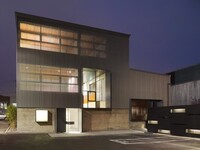
Zerofootprint has announced the five winners of its international Re-Skinning Awards, which recognize retrofits in five building categories that result in extraordinary environmental performance (see BuildingGreen.com July 2009). Entries were judged on the quality of re-skinning (changing the building envelope), overall energy efficiency,... Read more
Case Study
Colors ‘n Curves: A new bank headquarters in Frankfurt may well be the world's most energy-efficient office tower.
By Ulf Meyer
Shrouded in shades of many colors, it is a building that claims to be green. And so it is. It is not often that a midsize bank building has good reason to make that claim, but the new 400,000-square-foot, $85 million expansion of the headquarters for the KfW Bank in Frankfurt, designed by Sauerbruch Hutton... Read more
Blog Post
By way of context, most glazing is... Read more
Blog Post
News Analysis
Op-Ed
In response to your article “Chemistry for Designers: Understanding Hazards in Building Products,” (see EBN Mar. 2010) the American Chemistry Council (ACC) would like to emphasize that architects, designers, builders, and consumers deserve to have confidence that the products they choose, when used for their intended purposes, are safe. Because... Read more
News Analysis
The Master Painters Institute (MPI) recently added to its Green Performance paint standards, GPS-1 and GPS-2, with the addition of the Extreme Green (X-Green) standard.
For years MPI has been known for its coating performance requirements, which test for viscosity, drying time, hiding power, scrubbability, and other factors, and cover a... Read moreNews Brief
In December 2009, the U.S. Environmental Protection Agency (EPA) declared greenhouse gases a threat to humans, thus bringing them under the regulatory authority of the agency under the Clean Air Act (see
EBN Jan. 2010). EPA had planned to begin regulating greenhouse gases from large stationary sources (those that emit more than 25,000... Read more
News Brief
The U.S. Environmental Protection Agency (EPA) and the National Renewable Energy Laboratory (NREL) are looking at some of the nation’s 15 million acres (6 mil-lion hectares) of contaminated or potentially contaminated land (“brownfields”) for siting renewable energy installations. Under EPA’s “Re-Powering America’s Land” program, which was... Read more
News Analysis
A partnership among three federal agencies, announced in 2009, is already helping local and regional governments develop sustainability plans, transportation options, and affordable housing; the program may get a large financial boost in the 2011 federal budget. The Partnership for Sustainable Communities brings together the U.S. Department of... Read more
Feature
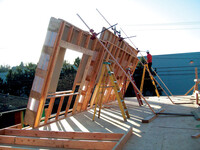
News Analysis
SAGE Electrochromics, maker of SageGlass, a dynamic glazing technology (reviewed in
EBN June 2006), has been awarded a $72 million loan guarantee from the U.S. Department of Energy (DOE).
Combined with a $31 million Advanced Energy Manufacturing Tax Credit it received earlier this year, the company will move forward with more than $... Read moreNews Brief

News Analysis
With the words “water crisis” working their way into the common vocabulary, innovative strategies for conserving, reusing, and treating water are developing more quickly than ever—and some have hit a regulatory ceiling. The Green Plumbing and Mechanical Code Supplement, released in February 2010 by the International Association of Plumbing and... Read more
Product Review
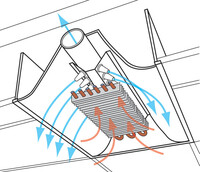
Passive chilled beams operate through... Read more
Blog Post
Our April EBN feature article--"Passive House Arrives in North America: Could it Revolutionize the Way We Build?"--went online today. This was a fun article to research and write, because it put me in touch with my low-energy building roots. Until digging into the history of Wolfgang Feist's German Passivhaus standard, I hadn't realized that... Read more
Explainer
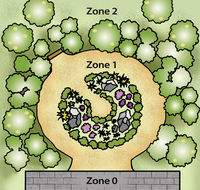
Permaculture promotes food production and nurtures ecological systems in both rural and urban environments.
Permaculture—a compound of the words “permanent” and “agriculture”—is a design approach that integrates human communities and agricultural systems by mimicking complex ecological relationships. Permaculture focuses on the interrelation and placement of plants, animals, buildings, and infrastructure in the landscape, emphasizing food production... Read more


