
News Analysis
Anderson has set the company on the path toward sustainability. Awakened only within the past two years to... Read more
News Brief
by Sim Van der Ryn and Stuart Cowan. Island Press, Washington, D.C., 1996. 200 pages; hardcover $40.00; paperback $19.95.
Coauthors Van der Ryn and Cowan define ecological design as design that “minimizes environmentally destructive impacts by integrating itself with living processes.” Ecology, they argue, should be the basis of design; it... Read moreNews Brief
A bill to create the National Institute for the Environment (see
EBN
Vol. 4, No. 5) has finally been introduced in the current Congress by Representative Jim Saxton (R-NJ) and twenty cosponsors. The Institute is widely supported by business leaders, scientists, and environmentalists.
Product Review
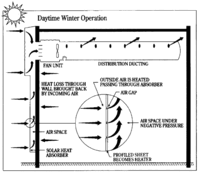
transpired solar collector, Solarwall has initially been targeted... Read more
News Analysis

A government program to promote high-performance commercial buildings in Canada now has three buildings under construction. In two of these cases, program administrators were surprised to discover that their stringent criteria are being met using only conventional technologies, with little or no increase in building costs. They credit this... Read more
News Brief
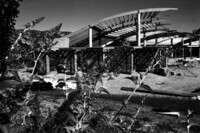
Real Goods’ new “Solar Living Center” in Hopland, California will demonstrate the philosophies of energy independence and living in harmony with nature that the company preaches. Real Goods hired Sym Van der Ryn’s... Read more
News Analysis
Two small stands within a government-managed forestry operation in central British Columbia were certified in November 1995 by the Silva Forest Foundation. The 25- to 30-hectare (60- to 75-acre) stands in the Vernon Forest District are part of a larger area run by the Ministry of Forests Small Business Programme, which is collecting and sorting... Read more
News Brief
At a workshop sponsored by Environment Canada’s Winnipeg, Manitoba office, participants decided to establish the Used Building Materials Association as a networking forum and common voice for the salvage and reuse industry. With a core group of twelve American and Canadian nonprofit and for-profit salvage and reuse organizations, the... Read more
Feature
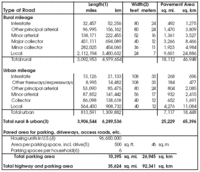
If our goal is to reduce the overall environmental impact of our building projects, we must begin paying more attention to the role automobiles play in these projects. Even the most environmentally responsible house—for example, an energy-independent, passive-solar house, built of salvaged and recycled materials, with graywater separation—will... Read more
News Brief
published by Thousand Words, P.O. Box 9034, Berkeley, CA 94709; 510/883-0433, otg@ontheground.com (e-mail). $32 per year for four issues. Length varies: 32-36 pages.
On the Ground is a large-format, quarterly journal on community, landscape design, and the environment that premiered in the Fall of... Read more
Product Review
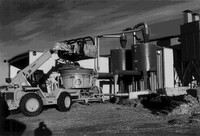
The company uses Norwegian manufacturing equipment to produce 4’ x 8’ (1200 mm x 2400 mm) panels in 1⁄4” (6 mm) and 1⁄8” (3 mm) thicknesses. Thicker, 1⁄2” (13 mm) panels were initially produced as well, but... Read more
News Brief
Environmental Committee, Denver Chapter, AIA, and Colorado Chapter, ADPSR. 1995. Loose-leaf (without binder) or diskette (PC or Macintosh), $29.95. Order from: AIA Denver/SDRG, 1562 15th Street, Denver, CO, 80202; 303/446-2266, 303/446-0066 (fax).
Greatly improved from last year’s first edition, this... Read more
Product Review
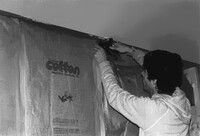
As you might imagine, information about new building products comes into the
EBN office all the time. When a new product strikes our fancy, we extract what information we can from manufacturers, we play with samples (often mutilating them in the process), we talk with any users we can track... Read more
News Brief
The Woodworker’s Alliance for Rainforest Protection (WARP), a leading promoter of lesser-known species and other lumber from environmentally preferable sources, is changing its name to the “Good Wood Alliance.” Reasons for the change included a recognition that the environmental issues addressed are not limited to rainforests and that not all... Read more
News Brief
The Rainforest Action Network (RAN) has a new “Wood Reduction Clearinghouse” to disseminate information on ways to reduce waste and find environmentally sound alternatives to wood. Reducing wood use in construction is a primary goal of the service. Contact Dana Harmon at RAN, 450 Sansome Suite 700, San Francisco, CA 94111; 415/398-4404, 415/... Read more
News Analysis
With the Internet distribution this past August of a draft synthesis report by the three Working Groups of the Intergovernmental Panel on Climate Change (IPCC), suddenly global warming is back in the news. The report concludes that “the observed increase [in global temperature] over the last century (0.3°C–0.6°C... Read more
News Brief
Steven Winter Associates, Inc., of Norwalk, Connecticut, has been awarded a grant through the U.S. Department of Energy’s 1995 Small Business Innovative Research program to design advanced modular townhouses for urban infill sites. The company has been charged with designing townhouses that employ renewable energy and energy conservation... Read more
Explainer
now being manufactured in Perrytown, Texas, can be used in place of both framing and drywall in partition walls. At $19 each for 4’ by 8’ (1200 mm by 2400 mm) panels, they are very competitive with conventional stud framing within a reasonable shipping distance from the plant. The panels... Read more
Op-Ed
I very much appreciate your recognition of the need for and efforts to identify priorities for “green building” (whatever that is). Such priorities can either be defined implicitly by the buildings a “green designer” creates or by some systematic process based on a hierarchy of environmental problems. Your... Read more
Product Review
... Read more


