
News Analysis
Builders and designers committed to energy- and resource-efficient construction strategies have long struggled with building codes that mandate conventional practice, even when alternatives might be more sensible. A new addition to the Lake County, Illinois building code offers one solution to this problem—in a complete, take-it-or-leave-it... Read more
News Brief
Motorists in Germany can now save on their auto insurance rates if they use public transportation. As reported in the February 23rd issue of
Global Environmental Change Report the German insurance company Rheinland (Neuss) has begun offering a 10% discount for policyowners who hold annual passes for the national railway system or for a... Read more
Op-Ed
Thank you for the review you gave WWPA’s
Eco-Profile of Lumber Produced in the Western United States: Life Cycle Inventory of WWPA Western Lumber. Your comments on the study were both thorough and fair.
There are two issues addressed in the review which I feel deserve further comment. The first regards the possible error contained in... Read moreNews Brief
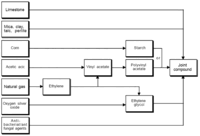
Joseph Demkin, editor. The American Institute of Architects. Published annually by John Wiley & Sons, 1996. Three-ring-bound. $150 + $2.50 for handling. Call 800/225-5945 to order.
The newEnvironmental Resource Guide (ERG) uses an effective combination of text and graphics to convey the environmental implications of building... Read more
News Brief
Willammette Industries, Inc. has just retooled a particleboard mill in Eugene, Oregon to produce a higher-quality medium-density fiberboard (MDF) using at least 50% recycled wood. The mill will use wood waste from construction sites, pallets, and packing crates.
Op-Ed
I read your lead article “Transportation Planning” in the January/February 1996 issue with great interest. A couple of years ago I and seven others entered and won the Grand Prize for a competition entitled “The Electric Vehicle and the American Community.” The programme was to imagine life in some date in the future when electric vehicles... Read more
News Brief
100 pages; $5.00 covers postage & handling. Available from the American Forest & Paper Association, 1111 19th Street, NW, Suite 800, Washington, DC 20036.
This new, publication provides useful—though somewhat limited—information on where to recycle wood products. Organized on a state-by-state basis, the directory includes about 600... Read moreProduct Review
Cork has been used as a flooring material for more than one hundred years. Cork flooring is durable, it provides acoustical and thermal insulation, it cushions the foot, it is resistant to moisture damage and decay, it is fairly easy to clean, and it is harvested from trees in a sustainable manner. Though imported and thus energy-intensive to... Read more
News Brief
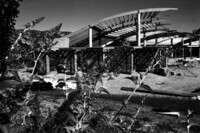
Real Goods’ new “Solar Living Center” in Hopland, California will demonstrate the philosophies of energy independence and living in harmony with nature that the company preaches. Real Goods hired Sym Van der Ryn’s... Read more
News Analysis
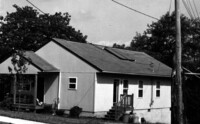
Americus, Georgia-based Habitat for Humanity International is well-known for its coordination of locally based affordable housing projects. Working largely with donated materials and volunteer labor, Habitat (with its many local affiliates) is now one of the nation’s twenty largest homebuilders. Minimizing environmental impact has not... Read more
News Brief
The San Francisco Institute of Architecture (SFIA) has just announced a new Master’s Degree program in Ecological Design. A professional certificate is also available, and the program is not limited to students of architecture. Enrollment is open for the Spring 1996 semester, which begins February 26. Contact the SFIA Information Office, Box... Read more
Op-Ed
Your article “What’s New in Construction Waste Management” moved me to write—and to finally subscribe. I’ve been sharing a subscription with someone else, but now I feel I can’t wait for the
EBN to come my way. So be it if I’m being environmentally incorrect by ordering my own copy. Or is it? What is
EBN’s position on that?
... Read moreNews Brief
At a workshop sponsored by Environment Canada’s Winnipeg, Manitoba office, participants decided to establish the Used Building Materials Association as a networking forum and common voice for the salvage and reuse industry. With a core group of twelve American and Canadian nonprofit and for-profit salvage and reuse organizations, the... Read more
News Analysis
The distinction of being the first government body to officially adopt a straw-bale construction code goes to the Napa County (California) Board of Supervisors. The Board adopted the voluntary guidelines in California’s new law, based on Assembly Bill 1314. The guidelines still require an engineer’s stamp on all plans, however, as does every... Read more
News Brief
A bill to create the National Institute for the Environment (see
EBN
Vol. 4, No. 5) has finally been introduced in the current Congress by Representative Jim Saxton (R-NJ) and twenty cosponsors. The Institute is widely supported by business leaders, scientists, and environmentalists.
News Analysis
A workshop on the linking and prioritizing of environmental criteria in building assessments was held this past November in Toronto. Workshop organizers had hoped that the participants would help figure out ways to prioritize environmental criteria so that practitioners in the building industry can focus the most energy and attention where they... Read more
Product Review
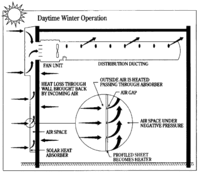
transpired solar collector, Solarwall has initially been targeted... Read more
News Brief
by Scientific Certification Systems, Inc., August 1995. Published by Western Wood Products Association, Yeon Building, 522 SW Fifth Avenue, Portland, OR 97204-2122; 503/224-3930, 503/224-3934 (fax). Spiral bound, 28 pages (not including appendices), $125.
The closer one looks at anything in nature, the more there is to look at. This fact may... Read moreNews Brief
Submissions are being accepted until February 15 for the 1996 Quality Building Conference Design Competition. New to this year’s competition is an Unbuilt Projects/Proposals category. Contact JoAnn Lawrence at the Northeast Sustainable Energy Association (NESEA), 50 Miles Street, Greenfield, Massachusetts 01301, 413/774-6051, 413/774-6053 (fax... Read more
Op-Ed
Thanks for your article on “Establishing Priorities.”
Under saving energy, the first item: “In buildings with skin dominated loads,” incorporate high R-values. What about buildings with greater internal loads? Does it follow to use less insulation? Make it less airtight? I have a high school where the general contractor is saying, “How come... Read more

