
Feature Short

Innovations go far deeper than a stunning, biomimetic roof. The Atlanta Falcons’ new stadium aims to bring green building to the masses.
Media coverage of the new Atlanta Stadium has focused on its unique retractable roof, a dramatic and ambitious design by renowned sports architect Bill Johnson, now of HOK (check out this breathtaking fly-through).
Underneath that roof, the tons of concrete used in the structure will probably have as much impact on its... Read more
Feature Short
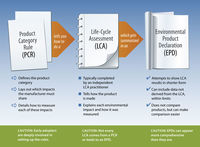
PCRs are the instruction manuals behind EPDs. They’re supposed to provide foolproof rules for conducting LCAs, but they can also be the system’s fatal flaw.
Product category rules (PCRs) are meant to be objective, defining documents that serve as the guidelines for life-cycle assessments (LCAs), which in turn inform environmental product declarations (EPDs). They help promote fairness by ensuring that all the products of the same type are measured with the same yardstick.
... Read more
Feature
Environmental product declarations are taking off, but can they actually fly? Experts share the ups and downs of this promising but imperfect transparency tool.
I’ve been using an app to track my runs and bike rides for a couple of years now. I joined for the mapping and mileage features, but it also shows me how many calories I’ve burned. This means I get to expend an extra calorie or two every workout because the number makes me sigh and roll my eyes.
That’s... Read more
Feature Short

More EPDs are appearing as a result of LEED v4, even as problems with data quality get worked out on the fly.
To some technical experts, the current upsurge in publication of environmental product declarations (EPDs) is too chaotic. For Brendan Owens, P.E., chief of engineering at the U.S. Green Building Council (USGBC), it’s a dream that’s just barely starting to come true.
There’s one thing everyone can agree on: EPDs... Read more
Feature Short
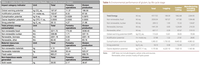
Don’t expect the turf battles over sustainability of structural systems to be settled anytime soon by EPDs.
Structural products are given a lot of scrutiny because of their potentially significant environmental problems—in particular, cement’s high CO2 output, steel’s high embodied energy, and wood’s ecological impact.
Manufacturers have different ways of mitigating these impacts, and all of these materials have complicated... Read more
Feature Short

Sure, you can just check a box for LEED v4. But the data can also inform your project, if you use it wisely.
This short video primer, produced in partnership with Arup, shows designers how to read environmental product declarations (EPDs). But what do you do with the data once you have it?
We asked leading designers to share how they use EPDs in their practice. Answers fell into four main categories... Read more
News Brief
One set of rules, called a PCR, now governs environmental reporting for all cladding products, regardless of whether they are wood, vinyl, or metal.
Cladding is the latest product category for which a general industry product category rule (PCR) has been set, joining others like concrete and flat glass. PCRs designate the rules for life-cycle assessment calculations if they are to be used for environmental product declarations (EPDs).
This cladding PCR is of particular interest... Read more
News Brief

Chemicals that are benign on their own may turn malignant in combination with others circulating in the environment, researchers warn.
Even as scientists and the chemical industry are playing catch-up on studying the health impacts of thousands of chemicals, researchers are talking about a new concern: the effect of apparently “safe” chemicals mixing in dangerous combinations.
Even if certain chemicals are generally considered... Read more
News Brief
The International Code Council has announced that its International Green Construction Code (IgCC) will cease to be an independently developed building code and will instead draw on ASHRAE 189.1... Read more
News Brief
Health linkages to a variety of chemicals common in buildings, including endocrine disruptors, add to a growing list of concerns.
Sons born to professional cleaners, hairdressers, and lab workers were 68% more likely to develop hypospadias, the condition of having the opening of the urethra on the underside of the penis rather than the tip. The condition can be surgically repaired, but either way, those affected can suffer ongoing urinary and sexual... Read more
News Analysis
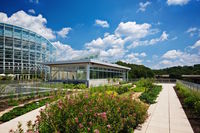
The landscaping equivalent of LEED has joined the ranks of programs falling under GBCI’s green certification portfolio.
Explaining the significance of the acquisition of the Sustainable Sites Initiative (SITES) by Green Business Certification Inc. (GBCI), GBCI’s CEO Rick Fedrizzi said, “Landscaping knits together the fabric of our communities.” GBCI has itself been sewing a patchwork quilt of certification systems, with recent acquisitions or... Read more
Product Review
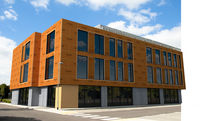
The Securock ExoAir 430 system combines USG’s gypsum sheathing with a factory-applied air-and-water barrier from Tremco for jobsite quality control.
Proper air-barrier installation requires careful application and attention to detail, and controlling the quality of liquid membranes and sealants applied to gypsum sheathing onsite can be particularly challenging. To simplify the process, USG and Tremco have teamed up to offer the Securock ExoAir 430 building envelope system... Read more
Product Review

ThyssenKrupp is documenting its footprint and optimizing ingredients for some of the most complex and costly building systems: elevators.
Update: The article now reflects that conveying equipment can contribute toward certain Materials & Resources credits in LEED v4.
Most manufacturers of even the simplest of building products are not yet on board with the rising demand for transparency. ThyssenKrupp Elevator... Read more
Explainer
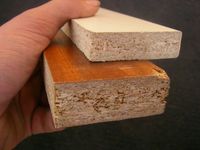
Formaldehyde emissions from composite wood products will soon be strictly regulated in the U.S., but questions remain.
Formaldehyde is a naturally occurring and ubiquitous VOC—we even produce tiny amounts in our own bodies—but exposure to higher-than-normal levels of formaldehyde can trigger dangerous reactions, including asthma. As an industrial chemical, the substance is known to cause nasopharyngeal cancer, though very rarely. Some studies... Read more
Feature

Researchers reveal simple ways to empower occupants to reduce energy, water, and waste. It all starts with good design.
Sign, sign, everywhere a sign
Blockin’ out the scenery, breakin’ my mind
Do this, don’t do that. Can’t you read the sign?
–Five Man Electrical Band
You’ve completed your models, installed low-flow toilets, and collected your LEED points. Yay! But for some reason, a... Read more
News Analysis

Project teams appear to function better, and their buildings end up greener, under collaborative project delivery.
Experts have long advised that an integrated design process is needed to take us to the next level of green design, but so far there’s been sparse analysis tying it directly to better performance outcomes. The number of case studies available is still small, but three recent U.S. General Services Administration (GSA) buildings... Read more
News Analysis
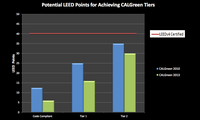
Little more than a building permit is now needed to document six LEED credits if your project is subject to California code requirements.
A lot of cumbersome LEED documentation can now be bypassed for projects in California, according to new rules from the U.S. Green Building Council (USGBC). Designed to lure more projects into LEED certification and to recognize the high benchmark set by California codes, the ruling says three prerequisites and three credits... Read more
News Analysis
The board has until the end of 2016 to complete its search for the leader’s replacement.
Rick Fedrizzi, CEO and founding chairman of the U.S. Green Building Council (USGBC), will step down at the end of 2016, the organization announced today.
The move signals the end of an era for the group, of which Fedrizzi has been the charismatic public face since 2004, and the USGBC board of directors... Read more
News Brief

A high GRESB score could mark a good real estate or equity investment, according to researchers.
The University of Cambridge is giving out some free investment advice: real estate investment trusts (REITS) with higher sustainability ratings perform better than their peers, when adjusted for risk.
These publicly traded portfolios of large-scale properties typically offer high yields with long-term... Read more


