News Brief

A Minnesota state agency is currently reviewing 293 sites where it thinks vapor intrusion from soil might be putting people at risk—but its not radon they’re concerned about; it is industrial solvents dumped... Read more
Op-Ed
News Analysis
News Brief
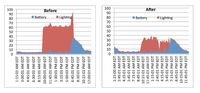
The audit, which was conducted for New Zealand’s Energy Efficiency... Read more
Product Review
News Brief
Greenwash Action, a joint initiative of the Sierra Club and Greenpeace, is gearing up to defend LEED and campaign for changes to Green Globes—the green building rating system that the organization claims has been complicit in a greenwashing scheme.... Read more
News Brief
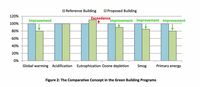
Two free resources are now available to help demystify life-cycle assessment (LCA) for different audiences.
The “Athena Guide to Whole-Building LCA in Green Building Programs” is intended to help designers... Read more
News Brief
News Brief
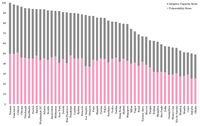
In the interest of analyzing the best cities for long-term real estate investment, the international property group Grosvenor recently ranked the resilience of 50 cities across the world. Toronto,... Read more
News Brief
Existing buildings represent our greatest opportunity to conserve energy and water, and the EBie awards, in their third year, aim to make that hard work just a little more glamorous. Urban Green Council has announced its... Read more
Explainer
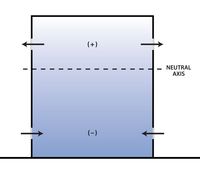
Air movement in and through buildings caused by pressure differentials has important effects on performance and safety.
No one can tell me,
Nobody knows,
Where the wind comes from,
Where the wind goes.
— A.A. Milne
When water pressure goes wrong in a building, you’ll find out quickly: a pipe bursts, stuff gets wet, plumbing fixtures stop working.
On the other hand, air pressure inside and outside of buildings—and... Read more
News Brief

The same body that reviews LEED project documentation will be the third-party certifier for the forthcoming health standard called WELL.
The International Well Building Institute (IWBI), creator of the WELL building standard, has announced a partnership with the Green Building Certification Institute (GBCI), the body that certifies LEED buildings and accredits LEED professionals. According to a joint press release, the collaboration will help streamline dual certification to... Read more
News Analysis

Federal government projects take three of the top honors for 2014 in the AIA Committee on the Environment (COTE) awards, which combine sustainability with design excellence.
The 2014 American Institute of Architects (AIA) COTE Top Ten Green Projects were selected in the most competitive program ever, with more than 80 submissions—not including those submitting for the “Top Ten Plus” award for ongoing high performance from a past Top Ten winner.
Among the big winners in this year’s awards is the U.S... Read more
Feature
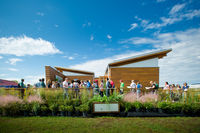
These emerging water strategies are finding momentum and filling the need to address efficiency and resilience on multiple scales.
As a result of the severe drought in California, St. Helena City Council announced mandatory water rationing for its homes effective January 2014. It imposed a limit of 65 gallons per person per day—one-third of the average water consumption in the state—with a $374 charge for every 748 gallons above the limit to take effect in a few... Read more
Blog Post
The United Nations’ IPCC is leading an international effort to understand climate change, and efforts like the Kyoto Protocol have grown out of that background work. But are we getting closer to solving... Read more
Blog Post
I love reading Lew Harriman’s stuff; he is a good writer and building scientist. Take, for example, Preventing Mold by Keeping New Construction Dry. It’s a straightforward yet compelling... Read more
Blog Post
Nearly all of our methods for generating electricity involve water consumption—some a lot, some not as much. Producing electricity with hydropower is the most water-intensive method, owing to evaporation from reservoirs.... Read more
Blog Post
Saving energy isn’t only about using less electricity and fuel; it’s about saving water.
In this weekly blog, I’ve focused a lot of attention on the energy-saving measures at our new home—from the innovative insulation materials we used to the air-source heat pump heating system and our top-efficiency heat-recovery ventilator. What I haven’t said much about are the measures we’ve taken to reduce water use and why... Read more
Explainer
The Living Building Challenge and other programs that include “red lists” of substances to avoid are based on the principle of hazard avoidance. The idea is attractive in its logic.... Read more
News Analysis