
News Analysis
Net-zero-energy commercial buildings are becoming more mainstream and don’t need to cost more, according to a recent report from the New Buildings Institute (NBI). The report compiles a list of 21 verified zero-energy buildings (ZEBs) and 78 zero-energy-capable buildings (ZECs) in the U.S. and Canada in order to discover what features the... Read more
News Brief
President Barack Obama has issued a memorandum directing federal agencies to significantly increase procurement of biobased products. The memorandum aims to drive innovation and rural job creation by ensuring the government executes the 2002 BioPreferred program in supporting farm-sourced products (see “USDA Biobased Label Identifies Farm-Grown... Read more
Explainer
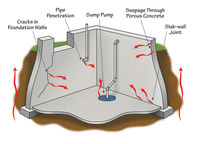
It’s easy not to think about radon. It’s a colorless, odorless gas that we can’t detect without special equipment, and it has no immediate effects. That doesn’t mean we shouldn’t be worried.
Radon is considered the second leading cause of lung cancer in the U.S., after smoking, causing an estimated 20,000 deaths per year,... Read more
Product Review
Despite their drawbacks in terms of energy performance (see “Rethinking the All-Glass Building,” EBN July 2010), for many owners and designers curtainwall systems are an integral part of the design aesthetic for buildings large and small. Fortunately, curtainwall systems with higher thermal efficiencies, condensation resistance, and durability... Read more
News Brief

A new report from the American Council for an Energy-Efficient Economy, “Results from Recent Real-Time Feedback Studies,” summarizes the findings of nine large-scale pilot studies testing the effects of real-time feedback on electricity consumption.
To evaluate methods of engaging residential customers in reducing their energy usage,... Read more
Feature

Harvesting daylight is a popular way to save energy and promote productivity. But getting it wrong is all too easy—and can have the opposite effects.
We can live and work in artificially lit buildings, but that doesn’t make it a good idea. Daylight connects us with the outdoors, provides an essential nutrient, and makes our interior spaces glow with natural beauty. Exposure to bright daylight, even indoors, has been shown to relieve sleep disorders and may contribute to general... Read more
News Brief
If you’ve ever wondered just what a product guaranteeing “up to 50% savings” will deliver, you have something in common with the U.S. Federal Trade Commission (FTC). FTC has reached a settlement with five manufacturers of replacement windows, part of a larger effort to rein in deceptive claims in environmental marketing.
The companies... Read more
Product Review
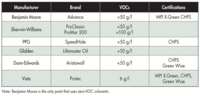
Waterborne alkyd paints offer the durability, cleanability, and scratch resistance of conventional alkyd paints without toxic solvents and cleaners, high VOC levels, or disposal problems.
A new class of paint is emerging, rising to both performance and environmental challenges: waterborne alkyd paints.
Regular alkyd paints (also known as oil-based or solvent-borne paints) form a hard, glossy surface that is easy to clean and resists scratching, water, and chemicals. Used primarily for trim, doors, cabinets, furniture,... Read more
News Brief
The U.S. Environmental Protection Agency (EPA) has released a final rule aimed at reducing toxic emissions from PVC manufacturing facilities. PVC is used in everything from pipes to vinyl siding to latex paint, and its manufacture produces vinyl chloride, a potent human carcinogen that particularly affects children.
In a shift from... Read more
Blog Post
Blog Post
Blog Post
Let's get one thing clear: the issue of energy spent importing stuff from China is a red herring. The distance from ports in California to China is about twice the width of the continental U.S., but ocean freighters are about 7.5 times more energy-... Read more
News Brief
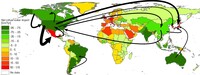
The U.S. is 20% dependent on “virtual” water, a large part of it from China, according to a new study from the University of Twente in the Netherlands.
“The Water Footprint of Humanity” (PDF) examines global water-use patterns from 1996 to 2005 and calculates countries’ overall and per capita footprints based on the volume of... Read more
Blog Post
I've been working for the past couple weeks on a report on windows--the latest in BuildingGreen's series of special reports on green building (the last one covering insulation). This focus has reminded me just... Read more
Blog Post
News Analysis

Reducing greenhouse gas emissions—climate change mitigation—has defined much of the sustainable design approach, but a new report calls for a sharper focus on adapting our buildings to future climate extremes as climate change becomes a reality. The report, from the U.S. Green Building Council (USGBC) and the University of Michigan,... Read more
News Analysis

A new study out of the University of Colorado–Boulder suggests that LEED buildings are more likely to place construction workers in danger than are their conventional counterparts. While the results of the new study, to be published in April 2012 in the Journal of Construction Engineering and Management, are getting a skeptical view... Read more
Blog Post
Life-cycle assessment, environmental product declarations, and corporate social responsibility reporting are a great start. But can we talk about health?
Here at BuildingGreen, we're pretty excited about the rise of the product transparency movement (as you may have noticed from recent coverage in January's EBN and our related blog series) but... Read more
Blog Post
Virtually ubiquitous in our buildings, gypsum board is widely seen as an innocuous building material.... Read more
Blog Post
Wait a minute. Weren't we criticizing Eleek and its cast aluminum hardware in this blog a few weeks ago? We were--and that sparked a dialogue with one... Read more


