
Feature
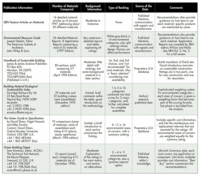
Choosing the right materials for a building is no easy task under any circumstances. Just meeting the conventional criteria, such as performance, cost, and aesthetics, can be a challenge; the addition of an environmental agenda further complicates the picture. The good news is that more tools and resources are becoming available to help... Read more
News Brief
by Alex Wilson and John Morrill. ACEEE, Washington, DC, 1996. Paperback, 267 pages. $7.95 in stores ($11.95 postpaid from ACEEE, 2140 Shattuck Avenue, #202, Berkeley, CA 94704; 510/549-9914).
With publication of the new 5th Edition of this little book, over 100,000 copies are now in print! TheConsumer Guide to Home Energy Savings,... Read more
News Analysis
The American Society of Heating, Refrigeration, and Air-Conditioning Engineers (ASHRAE) doesn’t write building codes, but some of the group’s standards carry as much weight as codes. That is the case with ASHRAE Standard 62 on ventilation for acceptable indoor air quality. This standard is recognized in legal circles as the “standard-of-care”... Read more
News Brief
has learned that Sierra Pine, Ltd. of Rocklin, California, is negotiating to purchase the U.S. operations of Medite Corporation, a manufacturer of formaldehyde-free medium-density fiberboard (MDF). It has been rumored for months that Medite was on the block, and
Panel World reported in their November 1996 issue that Medite’s... Read more
Op-Ed
The article on the Sustainable Technology Center (Vol. 5, No. 5) missed the true performance of this market-rate commercial complex in its first year. The two buildings at the Center saved 82% on utility costs for water, sewage, electricity, and heating compared to the performance of the Center if built conventionally in Friday Harbor. Using... Read more
News Analysis
Building products giant Louisiana-Pacific Corporation (L-P) is purchasing GreenStone Industries, Inc., the top producer of cellulose insulation in the country. GreenStone was virtually unknown in the industry until several years ago, when it went public and began purchasing cellulose manufacturers. GreenStone now operates seven manufacturing... Read more
News Brief
Mobil Corp. has sold its Composite Products Division to Trex Company, LLC, a corporation formed by four company managers. One of the new owners, Andrew Ferrari, Vice President of Sales and Marketing, told
EBN that the company direction will not change. A fifth production line at the company’s Winchester, Virginia, plant operates around... Read more
Feature
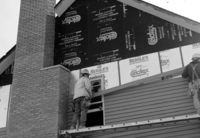
The search is on for an American home. The goal is a home with the look and feel of a traditional suburban house, which the buying public demands, yet one that is at least twice as efficient in its use of energy and other resources. And, it must cost no more than the competition—less, if possible.
Spurred by government grants,... Read moreNews Brief
Due to high demand, the Real Goods Institute for Solar Living in Hopland, California, has expanded its educational program offerings to year-round. A number of the offerings are related specifically to sustainable building, though the emphasis is on owner-builders. Programs include “Sustainable Building and Eco Design,” “Solar Electric Systems... Read more
News Analysis
The American Forest & Paper Association (AF&PA) has come under fire for its Sustainable Forestry Initiative because it does not include independent certification of forestry practices (see
EBN
Vol. 4, No. 3). The association’s just-issued first annual progress report on the Initiative, however, illustrates the delicate... Read more
News Brief
The September 2, 1996 issue of
Plastics News reports that the Center for Plastics Recycling Research at Rutgers University is shutting down due to budget cuts. This center has been instrumental in much of the research behind applications for recycled plastic lumber and recycled plastic marine pilings. The article describes the closing... Read more
Case Study

The Prairie Crossing project, described below, was well underway as a leading-edge development before the Building Science Consortium was formed to redirect some of its strategies. The other two projects profiled below are unrelated to... Read more
News Brief
The New York State Energy Research and Development Authority (NYSERDA) has $1 million available to co-fund research and development work relating to high-efficiency lighting products. The maximum award per project is $250,000, and all projects should include a New York State manufacturer. Proposals are due by December 31st. For information... Read more
News Brief
Annette Osso, Project Manager; David A. Gottfried, Managing Editor. 1996. Public Technology, Inc., 1301 Pennsylvania Avenue, NW, Washing-ton, D.C. 20004; 202/626-2441; 202/626-2498 (fax); osso@pti.nw.dc.us (e-mail). Also available from the U.S. Green Building Council, 290 Alhambra #11, San Francisco, CA 94123; 415/543-3001; 415/957-5890 (fax);... Read more
Op-Ed
is pleased to announce the addition of architect Chris Liddle to our staff. Chris has experience in passive solar and sustainable design, as well as accessible design. His initial responsibilities at
EBN will focus on increasing circulation.
News Analysis
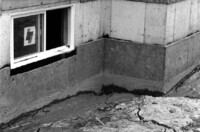
An “emergency” amendment to the Ontario Building Code, which took effect on August 20, 1996, eliminates the requirement for full-height foundation insulation. The measure rolls back the code to what it was from 1990 to 1993—requiring foundation insulation only to a depth of two feet (0.6 m) below grade—the same as other building codes in Canada... Read more
Product Review
News Brief
New York City’s Tiffany Street Pier, one of the largest plastic lumber structures, was damaged by lightning recently, according to the October 14, 1996 issue of
Plastics News. About one-third of the plastic lumber deck and the gazebo were melted. Most of the plastic hardened in place, albeit in a deformed state. City officials are quite... Read more
Op-Ed
I’d like to clarify some of the statements made in your construction detail “Using Air to Build Rammed Earth Walls” (Vol. 5, No. 5).
The promise inherent in TERRA Group and David Easton’s PISE™ wall-building system is the ability to go beyond the limited volume market of custom homes and owner-builders, and to become a feasible alternative... Read moreNews Analysis
Designers of the high-profile Audubon Headquarters in New York City, together with National Audubon Society scientists, took great pains to minimize the use of toxic and environmentally damaging building materials. Among the choices they made in renovating the 100-year-old building was to use undyed, 100% wool carpet throughout the space... Read more


