
News Analysis
Three new committees have been established within the France-based International Union of Testing and Research Laboratories for Materials and Structures (RILEM). Together with one committee established previously, these three aim to assess international standards for reporting on environmental... Read more
Case Study
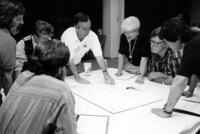
After all, the project has been featured in dozens of mainstream publications and a half-dozen books. John Knott, the visionary C.E.O. of Island... Read more
Product Review
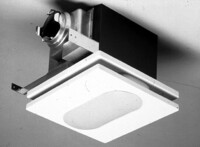
EBN
Vol. 5, No. 5), has just introduced a line of fans combined with compact fluorescent lights.
The new WhisperLite series of 70-, 90-, and 110-cfm (33, 42, and 52 l/s) are... Read more
News Analysis
The Building Research Establishment Environmental Assessment Method (BREEAM) developed in the U.K. is now available in Canada. BREEAM is a voluntary rating system that assesses the energy and environmental performance of commercial buildings. The program has been available since 1993 in the U.K. and since... Read more
News Analysis
CORRECTIONS for the “Resources on Environmental Impacts of Materials” table on page 11 of our last issue:
The Green Guide to Specification is published by:GTI Specialist Publishers
6 Hithercroft Court
Lupton Road
Wallingford, OXON OX10 9BT, U.K.
+44 1 4091 826401 (fax)
And we... Read moreNews Brief
The International Specular Reflector Association has broadened its scope and changed its name to the
Energy Efficient Lighting Association. According to David Brown, president of the two-year-old organization, “ISRA goals have been achieved—reflectors are now recognized as an effective tool to help achieve energy-efficient... Read more
News Brief
Sustainable Building:
by David Anink, Cheil Boonstra, and John Mak.
1996, James & James (Science Publishers) Limited.
Paperback, 175 pages, $40.
With their National Green Plan, the Dutch have long been leaders in their environmental thinking, and this book shows that the same applies to their... Read more
News Brief
The technical staff has been notified, and will try to correct this problem.
If you have a question or comment, please send
us feedback
News Analysis
The technical staff has been notified, and will try to correct this problem.
If you have a question or comment, please send
us feedback
News Brief
George Brewster
, a long-time advocate for environmental responsibility in the developer community, has been selected as executive director of the California Center for Land Recycling (CCLR), a new project of the Trust for Public Land. CCLR’s goal is to facilitate the redevelopment of brownfields. Brewster is cofounder of BayGroup... Read more
Product Review
Some 500 million tons (450 million tonnes) of concrete are used each year in the United States. Most of that is poured into forms or molds, which are removed to expose the hardened concrete. To help get the forms off, they are usually coated with a petroleum-based form-release agent. Light-bodied, low-... Read more
News Brief
The Good Wood Alliance, 289 College Street, Burlington, VT 05401; 802/862-4448, 802/658-4443 (fax); warp@together.net (e-mail), www.goodwood.org. 30 pages, $15 postpaid (free to Alliance members).
Since its founding in 1989, the Woodworkers Alliance for Rainforest Protection (WARP) has established itself as a... Read more
News Brief
The technical staff has been notified, and will try to correct this problem.
If you have a question or comment, please send
us feedback
News Brief
The
United Nations Environmental Programme (UNEP) is now working on promoting the use of environmentally sustainable practices, products, and technologies in building systems within the U.N. Among other initiatives, a pilot demonstration project involving the greening of UNEP’s Regional Office for North America is now underway. A... Read more
Case Study
Lean and Green for a Municipal Office Building
Many commercial buildings that have received attention over the past few years for environmental features are beautiful, high-end corporate buildings, or attractive demonstration buildings for utility companies or environmental organizations. The Ridgehaven Building... Read more
News Brief
The technical staff has been notified, and will try to correct this problem.
If you have a question or comment, please send
us feedback
News Brief
A scientific panel convened by the
National Research Council, an arm of the National Academy of Sciences, reports that after surveying hundreds of studies, it found no clear and convincing evidence that exposure in the home to electric and magnetic fields (EMFs) causes any human disease. The panel determined that research... Read more
News Analysis
The technical staff has been notified, and will try to correct this problem.
If you have a question or comment, please send
us feedback
News Brief
In the Old World, humans and animals have been adapting to each other for a long time, so it should come as no surprise that the owl habitat protected by new local regulations in Britain is of human construction. According to the Autumn 1996 issue of
Building for a Future, the North Cornwall and Derbyshire Dales District Councils now... Read more
Op-Ed
With this first issue of 1997 we’re excited to announce a number of changes that will, we hope, provide you with more of what you like in
EBN, and in a more accessible format. Most important, you will now receive
EBN ten times each year instead of six. That’s right, we’ll be publishing monthly, except for... Read more


