
News Brief
100 pages; $5.00 covers postage & handling. Available from the American Forest & Paper Association, 1111 19th Street, NW, Suite 800, Washington, DC 20036.
This new, publication provides useful—though somewhat limited—information on where to recycle wood products. Organized on a state-by-state basis, the directory includes about 600... Read moreNews Analysis

The Natural Step held the first of many planned one-day workshops this February in Denver, Colorado and in Marion, Massachusetts to acquaint business leaders with this innovative movement that is quickly gaining steam in Europe. The... Read more
News Brief
Wood and paper recycling could be used to achieve 10-20% of the U.S. carbon reduction goal, according to scientists at the USDA Forest Products Laboratory in Madison, Wisconsin. Recycling wood and paper reduces net carbon emissions by reducing timber harvesting, which in turn increases the amount of carbon sequestered by living trees, and by... Read more
News Brief
Tree Talk, Inc., PO Box 426, Burlington, Vermont 05402; 802/863-6789, 802/863-4344 (fax), wow@together.net (e-mail). CD-ROM Pro version: $99; CD-ROM standard version: $29.95; Compact (floppy disk) version: $19.95.
When we first reviewedWoods of the World (WoW) in July 1994, it had lots of useful information but also lots of gaps, and... Read more
News Analysis
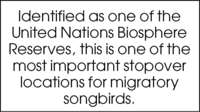
Northampton County, Virginia lies on the southern tip of the Delmarva Peninsula on the Eastern Shore (between Chesapeake Bay and the Atlantic Ocean). The tiny, rural county extends roughly 30 miles in length and averages just three miles wide. Dependent largely on agriculture, the county is struggling economically and its population of 13,000—... Read more
News Brief
is cosponsor of the upcoming conference Use of Recycled Wood and Paper in Building Applications, which will be held on September 9-11, 1996 in Madison, Wisconsin. The conference should be the best forum to date for the exchange of information relating to use of recycled wood and paper in building applications. For information, see the... Read more
News Analysis
The distinction of being the first government body to officially adopt a straw-bale construction code goes to the Napa County (California) Board of Supervisors. The Board adopted the voluntary guidelines in California’s new law, based on Assembly Bill 1314. The guidelines still require an engineer’s stamp on all plans, however, as does every... Read more
News Brief
A bill to create the National Institute for the Environment (see
EBN
Vol. 4, No. 5) has finally been introduced in the current Congress by Representative Jim Saxton (R-NJ) and twenty cosponsors. The Institute is widely supported by business leaders, scientists, and environmentalists.
News Analysis
A workshop on the linking and prioritizing of environmental criteria in building assessments was held this past November in Toronto. Workshop organizers had hoped that the participants would help figure out ways to prioritize environmental criteria so that practitioners in the building industry can focus the most energy and attention where they... Read more
Product Review
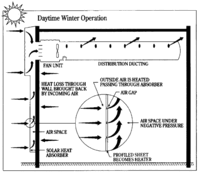
transpired solar collector, Solarwall has initially been targeted... Read more
News Brief
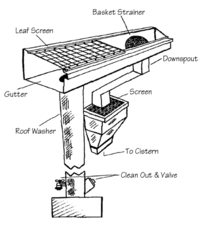
by Scientific Certification Systems, Inc., August 1995. Published by Western Wood Products Association, Yeon Building, 522 SW Fifth Avenue, Portland, OR 97204-2122; 503/224-3930, 503/224-3934 (fax). Spiral bound, 28 pages (not including appendices), $125.
The closer one looks at anything in nature, the more there is to look at. This fact may... Read moreNews Brief
Submissions are being accepted until February 15 for the 1996 Quality Building Conference Design Competition. New to this year’s competition is an Unbuilt Projects/Proposals category. Contact JoAnn Lawrence at the Northeast Sustainable Energy Association (NESEA), 50 Miles Street, Greenfield, Massachusetts 01301, 413/774-6051, 413/774-6053 (fax... Read more
Op-Ed
Your article “What’s New in Construction Waste Management” moved me to write—and to finally subscribe. I’ve been sharing a subscription with someone else, but now I feel I can’t wait for the
EBN to come my way. So be it if I’m being environmentally incorrect by ordering my own copy. Or is it? What is
EBN’s position on that?
... Read moreNews Analysis
Anderson has set the company on the path toward sustainability. Awakened only within the past two years to... Read more
News Brief
On October 31st of last year, new fluorescent lamp standards took effect that eliminate some of the most widely used lamps in commercial buildings. Under the Energy Policy Act of 1992, the old standby T-12, cool-white, F40 lamp can no longer be manufactured or imported into the U.S. Lamps must now have a minimum color rendering index (CRI)—a... Read more
News Brief
Real Goods has decided that it will no longer sponsor the National Tour of Independent Homes and is looking for another organization to take over the event. During its first three years, the Tour has been a big success, with 25,000 people having visited hundreds of homes and seeing first-hand the potential of renewables. Organizations... Read more
News Analysis

A government program to promote high-performance commercial buildings in Canada now has three buildings under construction. In two of these cases, program administrators were surprised to discover that their stringent criteria are being met using only conventional technologies, with little or no increase in building costs. They credit this... Read more
News Brief
A campus for the new Dreamworks Studio at Playa Vista, formed last year by Steven Spielberg, Jeffrey Katzenberg, and David Geffen, will soon be under construction. Environmental consultant John Picard of E Squared is responsible for bringing an ecological design awareness to the project and coordinating design of the communications systems for... Read more
News Analysis
Two small stands within a government-managed forestry operation in central British Columbia were certified in November 1995 by the Silva Forest Foundation. The 25- to 30-hectare (60- to 75-acre) stands in the Vernon Forest District are part of a larger area run by the Ministry of Forests Small Business Programme, which is collecting and sorting... Read more
News Brief
by Sim Van der Ryn and Stuart Cowan. Island Press, Washington, D.C., 1996. 200 pages; hardcover $40.00; paperback $19.95.
Coauthors Van der Ryn and Cowan define ecological design as design that “minimizes environmentally destructive impacts by integrating itself with living processes.” Ecology, they argue, should be the basis of design; it... Read more

