
News Brief
As of September 1, 2005, all of Potlatch Corporation’s 1.5 million acres (600,00 ha) of forestland, located in Idaho, Arkansas, Oregon, and Minnesota, has earned certification according to Forest Stewardship Council (FSC) standards. The certification of 319,000 acres (130,000 ha) in Minnesota, along with chain-of-custody certification of a... Read more
News Brief
Green engineering firm Keen Engineering has signed a letter of intent to join the professional design and consulting firm Stantec. “Joining Stantec will accelerate our vision of being a top-tier integrated building design firm promoting sustainable development,” says Keen president and CEO Kevin Hydes. According to Stantec president and CEO... Read more
News Brief
News Analysis

News Brief
News Brief
In July 2005 the Illinois Commerce Commission adopted Governor Rod Blagojevich’s sustainable energy plan, including a renewable portfolio standard (RPS) requiring the state’s electric utilities to meet 2% of their electricity needs with renewable sources by the end of 2006. The requirement will increase by 1% each year until it reaches 8% in... Read more
News Analysis
Johnson Controls, Inc., an industry leader in control systems for heating, cooling, and ventilation equipment, and York International Corporation, a leading manufacturer of heating and cooling equipment, announced in August 2005 that Johnson Controls would acquire York. “The transaction will enable us to become a single source of integrated... Read more
News Brief
ASTM International has published the
Standard Guide for the General Principles of Sustainability Relative to Building (E2432). “It is expected that the Guide will be referenced and used by federal, state, and local governments, architects, and others seeking to solidify and/or justify the tripartite—environmental, economic, and social—... Read more
Op-Ed
News Brief
Oregon Governor Ted Kulongoski signed a bill in September 2005 that expands tax credits for solar energy systems. The bill, which takes effect November 4 and expires in 2016, allows for tax credits of $3.00 per watt of installed solar electric output capacity. The credit is capped at half the cost of the installed system, up to $6,000.... Read more
News Brief
Jane Silverstein Ries, FASLA, the ASLA Medal, the highest honor the organization bestows upon individuals, “for her lifetime achievements and contributions to the profession, the welfare of the public, and the environment.” Ries began her 56-year career in 1933 as the first female... Read more
News Brief
California’s Million Solar Roofs bill, which would have led to the addition of 3,000 megawatts of solar panels on one million roofs, including half of all new homes, died in assembly in September 2005. The bill would have made California the world’s third largest solar energy producer, behind Japan and Germany. After passing the Senate by a... Read more
Product Review
News Brief
Green Built Home™, a voluntary green building program of the Wisconsin Environmental Initiative, in partnership with the Madison Area Builders Association, has been partnering with Habitat for Humanity of Dane County to certify all new Habitat homes as Green Built Homes. For 2005, all new Habitat homes will earn at least 112 points in the Green... Read more
News Brief
News Brief

Lights Out NY, a voluntary program designed to reduce the number of migrating birds killed by flying into city windows at night.
Lights Out NY encourages... Read more
News Brief
from Architectural Computer Services, Inc. (Arcom, producers of The American Institute of Architects’ Masterspec®), www.arcomnet.com, 800-424-5080. Softcover book and CD-ROM, 2004, 250 pages, $240.
As anyone who has tried knows all too well, incorporating all the requirements for a LEED® project into the construction documents is no... Read more
News Analysis
Nyle Special Products, LLC, has suspended production of the Cold-Climate Heat Pump™ (CCHP) amid skirmishing between the manufacturer, its former general manager, and the developer of the technology. Duane Hallowell resigned as general manager of Nyle in February to form Hallowell International, LLC, which acquired the manufacturing rights to a... Read more
News Brief
Air Quality Sciences, Inc., has developed a series of techniques to test product
assemblies, as opposed to individual products, in controlled environmental chambers. Examples of these assemblies include paint and wallboard; carpet, adhesive, and subfloor; and laminate, adhesive, and particleboard. “Sometimes emissions may be reduced,”... Read more
Feature
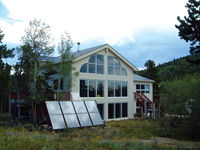
Despite the buzz about zero-energy buildings, just what zero-energy means and how to achieve it remain confusing at best. This article sorts out the confusion and sheds light on some of the stumbling blocks along the path to zero-energy.
Zero-energy has become a buzzword of the green building movement, used in advertising slogans, conference presentations, and technical papers. Despite the excitement over the phrase, however, we lack a common understanding of just what zero-energy means. And despite proclaimed achievability, few if any buildings can demonstrate that they in... Read more


