
Product Review

ThyssenKrupp is documenting its footprint and optimizing ingredients for some of the most complex and costly building systems: elevators.
Update: The article now reflects that conveying equipment can contribute toward certain Materials & Resources credits in LEED v4.
Most manufacturers of even the simplest of building products are not yet on board with the rising demand for transparency. ThyssenKrupp Elevator... Read more
Feature

Researchers reveal simple ways to empower occupants to reduce energy, water, and waste. It all starts with good design.
Sign, sign, everywhere a sign
Blockin’ out the scenery, breakin’ my mind
Do this, don’t do that. Can’t you read the sign?
–Five Man Electrical Band
You’ve completed your models, installed low-flow toilets, and collected your LEED points. Yay! But for some reason, a... Read more
News Analysis
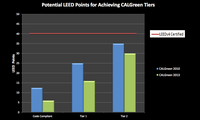
Little more than a building permit is now needed to document six LEED credits if your project is subject to California code requirements.
A lot of cumbersome LEED documentation can now be bypassed for projects in California, according to new rules from the U.S. Green Building Council (USGBC). Designed to lure more projects into LEED certification and to recognize the high benchmark set by California codes, the ruling says three prerequisites and three credits... Read more
News Analysis

Project teams appear to function better, and their buildings end up greener, under collaborative project delivery.
Experts have long advised that an integrated design process is needed to take us to the next level of green design, but so far there’s been sparse analysis tying it directly to better performance outcomes. The number of case studies available is still small, but three recent U.S. General Services Administration (GSA) buildings... Read more
News Brief

A high GRESB score could mark a good real estate or equity investment, according to researchers.
The University of Cambridge is giving out some free investment advice: real estate investment trusts (REITS) with higher sustainability ratings perform better than their peers, when adjusted for risk.
These publicly traded portfolios of large-scale properties typically offer high yields with long-term... Read more
News Analysis
The board has until the end of 2016 to complete its search for the leader’s replacement.
Rick Fedrizzi, CEO and founding chairman of the U.S. Green Building Council (USGBC), will step down at the end of 2016, the organization announced today.
The move signals the end of an era for the group, of which Fedrizzi has been the charismatic public face since 2004, and the USGBC board of directors... Read more
News Analysis

Not everyone was satisfied with the 2014 environmental building criteria conditions from the NAAB. Here’s what’s happening now.
Forty-three architecture professionals gathered at a retreat in the mountains of Utah for the National Architectural Accrediting Board’s (NAAB) 2014 accreditation review conference (ARC). The goal: to debate and decide upon the most important guidelines for schools of architecture accredited by NAAB.
... Read more
News Brief

With its free Mindful Materials label, HKS Architects offers a quick reference for finding green products on library shelves.
Your firm’s resource library might be a go-to source for aesthetic inspiration, but how much of its content is really green? Some firms have sustainability filters for what can make it onto the shelves, but still, connecting samples with green certifications can be a challenge.
Enter HKS Architects and... Read more
News Brief

The pressures of prefabrication encourage an integrative process and on-time project delivery, though transportation and culture remain issues.
Although prefabrication completely changes the traditional construction process, there hasn’t been a lot of hard data on its benefits. A new survey conducted by the National Institute of Building Science (NIBS) indicates that off-site construction can reduce construction time and improve deadline performance enough to... Read more
News Brief
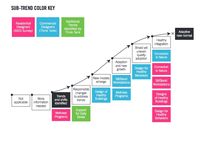
ASID’s Outlook Report ranks health and wellness first and sustainability third in most-influential industry trends.
Energy efficiency is the new normal, designing for health and wellness is on the uptake curve, and resilient design is poised to make inroads, according to the 2015/2016 Outlook and State-of-the-Industry Report from the American Society of Interior Designers (ASID), which was released at NeoCon 2015.
“... Read more
News Analysis
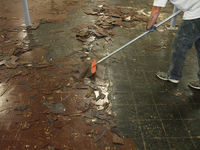
Recycled PVC inside vinyl floor tiles often contains lead and other additives from rubber-covered wiring, according to researchers.
Lead has a long history of being used as a stabilizer for polyvinyl chloride (PVC) products, though it has been phased out and is now only occasionally used to add durability in wire insulation. But lead and other serious toxic substances might still appear in “cleaner” PVC materials because wire jackets are commingled into the... Read more
Product Review
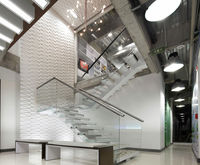
Inhabit and WallArt offer decorative three-dimensional wall panels made from bagasse, or sugarcane waste fiber, and with no chemical binders or flame retardants.
Three-dimensional wall panels, or sculptural wall panels, provide a look and feel that two-dimensional coatings, panels, and wallpapers can’t match. With patterns that look similar to natural formations, such as dunes, waves, or ripples on water, they can bring a sense of biophilia and movement to an otherwise blank... Read more
News Brief
Biophilia and biomimicry captivate the mind and senses, but are they economically viable? A report from Terrapin Bright Green says yes.
Success stories in “bioinspired” products have captivated the imagination: a low-toxicity composite wood binder imitating a compound used by mussels, self-cleaning surfaces that mimic the lotus flower, and more. But can such innovations transcend small-scale tinkering and have a bigger impact? Yes, says Terrapin Bright Green,... Read more
Explainer

Harmful chemicals are more difficult to quantify than carbon emissions but are equally destructive. Now you can track manufacturers’ chemical footprints.
Carbon emissions and water use have giant-sized foot icons to represent their impact, but hazardous chemicals haven’t, until now. The Chemical Footprinting Project (CFP) is one effort to help manufacturers measure their toxic impacts and make this information available to the public.
Clean Production... Read more
News Analysis
Buildings will be able to display a standard label showing energy use under a new program from the International Living Future Institute.
Finding a building’s energy use can be surprisingly hard. Putting it in context with data from other buildings is even harder, as we detailed in Measuring Energy Use in Buildings.
The organization that created the Living Building Challenge as well as the Declare and Just labels is jumping into the fray.... Read more
News Brief

EPA has shifted its labeling of chemically safer products and expanded to include Fragrance-Free in its criteria.
Green cleaning products with ingredients approved by the Design for the Environment (DfE) program will now bear a new label that reads “Safer Choice” rather than “Design for the Environment, U.S. EPA.” The move is designed to make the products as well as the program’s purpose easier for purchasers to identify.
... Read moreFeature
A radical new paradigm is on the way for engaging with projects after they’re “completed”—and clients couldn’t be happier.
A Harvard researcher carrying a sample through a brand new high-performance lab hip-checks a button on the wall and hurriedly walks through a sliding door. Realizing she’s forgotten something, the researcher abruptly turns around—and walks smack into the glass. Apparently this happens a lot.
Has the IQ... Read more
News Brief
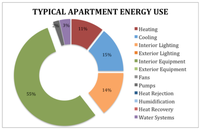
The payback on investing in occupant engagement is hard to pin down, but a program at Denver Housing’s Thomas Connole affordable housing building might help to change that. Though final numbers for reduced energy use aren’t yet in, analysis of an occupant engagement program there to date boasts a participation rate of 35%, and... Read more


