
Championing the
Changemakers
BuildingGreen champions the changemakers in sustainable design and building, with trusted insight, unparalleled education, and communities that are transforming the industry.
Log in to your profile

Image: Piranka

Explainer

Rainscreens don't just keep the rain out: they also encourage drying in case water does manage to get in.
If you have ever gone camping, you have probably used a simple rainscreen—a tent fly. While there are many ways for a tent to get wet inside, a fly at least keeps rain out; it can do so because the frame keeps the fly separate from the tent fabric.
A rainscreen system for a building works similarly, keeping the cladding separate from... Read more
News Analysis
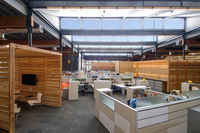
Open workspaces are increasingly popular, and thoughtful design can help ease the transition
Open workspace designs have clear environmental benefits stemming from easier access to daylighting and more efficient use of space. A survey of more than 200 organizations recently conducted by financial services firm Jones Lang LaSalle (JLL) and Ethisphere Institute, a business ethics think tank, found that open workspaces are... Read more
Feature
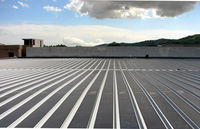
There are big differences in environmental impacts of commercial roofing materials, but the biggest variable may be service life.
The ideal roof system would have a long service life, keeping overall life-cycle costs and environmental impact down. It would contribute to the energy efficiency of the building, keeping you comfortable year-round without wasting energy. It would use low-impact, recyclable, low-toxicity materials, so you don’t shelter yourself at the... Read more
Blog Post
Johnson Controls made a big announcement today about what many are viewing as a game-changer in the emerging "smart buildings" market. If I am understanding it correctly, their new tool, called Panoptix, is an cross-platform network... Read more
Blog Post
Well, it was a long drive--with a special stop at a test bed facility in Syracuse that I'm going to share with you in a few minutes--but the BuildingGreen team all made it to Toronto last night. We're awfully... Read more
Blog Post
Greenbuild is still a little quiet, but BuildingGreen staff are already super busy.
... Read moreBlog Post
Yes, they are suggesting that we should purposefully eat insects as food, and that there are good ethical, environmental, nutritional, and culinary reasons for doing so.
The Large Blue Butterfly, found in Europe, lays its eggs on a marsh gentian leaf. Its larva (a caterpillar) hatches and falls to the ground and emits a scent that smells to certain species of ant just like its own larvae. The ants carry the caterpillar back to their nest, where they not only care for it as one of their own, but as one... Read more
Blog Post
The "grid" part of the equation is the network that conveys electricity from plants to consumers and the "smart" part means computerizing the electric utility grid.
I had the honor of being within a few feet of a barn owl this weekend at the wildlife festival at the Southern Vermont Natural History Museum. Kept alive after being injured years ago and now a frequent visitor to classrooms and museums, this bird of prey was perched on the arm of a handler, who wore thick falconry gloves.
... Read more
Blog Post
Blog Post
Blog Post
News Brief

The U.S. Green Building Council (USGBC) has secured the land it needs to build a promised new orphanage and children’s center in Port au Prince, Haiti. The effort would replace an orphanage operated by nonprofit Fondation Enfant Jesus that was destroyed in the January 2010 earthquake from which Haiti is still recovering. Fondation Enfant Jesus... Read more
Blog Post
Blog Post
Research concludes that although the burning of natural gas emits far less carbon dioxide than coal, a greater reliance on natural gas would fail to significantly slow down climate change.
Blog Post
Blog Post
Taking a look at the environmental effects of wind turbines
Correction: The author has posted a comment (see below) clarifying the likely width of the ridgeline road associated with this project.
One of my favorite pieces of Vermont trivia has been that the tallest manmade structure in the state is the Bennington Battle Monument, at 306 feet tall--and construction of it was completed in... Read more
Blog Post
Blog Post
Wood athletic floors, while unparalleled for all types of play, are typically finished with solvent-based polyurethane coatings that... Read more
Blog Post
BuildingGreen is pleased to announce the launch of the 2030 Challenge for Products Information Hub. Launched by Architecture 2030 in February 2011, the 2030 Challenge for Products is a call to action to reduce not only the operational energy of buildings but also the embodied energy of the products that go into them. While operational... Read more
News Brief

Environmental groups and public health advocates were stunned last week when President Obama announced he would not fulfill his promise to revise smog regulations. The American Lung Association (ALA) responded with its own promise to resume a lawsuit against the administration for failing to regulate dangerous ozone at levels... Read more


