
Championing the
Changemakers
BuildingGreen champions the changemakers in sustainable design and building, with trusted insight, unparalleled education, and communities that are transforming the industry.
Log in to your profile

Image: Piranka

Case Study
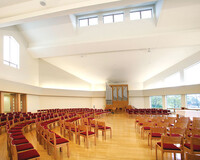
The rolling hills of southern Wisconsin are now home to the two highest-rated LEED-Platinum buildings in the country. The Holy Wisdom Monastery in Madison, Wisconsin, home to the Benedictine Women of Madison, recently earned a LEED score of 63 (out of a possible 69) points, surpassing the nearby Aldo Leopold Legacy Center (61 points), to... Read more
News Brief
The U.S. Environmental Protection Agency (EPA) has joined the U.S. Food and Drug Administration (FDA) in looking closely at the health and environmental effects of bisphenol A (BPA), a known endocrine disruptor. Although the largest risk for human exposure to BPA is through canned food products, the chemical is also used in the manufacture of... Read more
Product Review
Op-Ed
The 40th anniversary of Earth Day came and went a week ago with relatively little fanfare. We are focused on other things: high unemployment, a moribund economy, and residual sniveling over health insurance reform. But 40 years is an important milestone.
I was the Earth Day coordinator at my junior high school in Wayne, Pennsylvania, 40... Read more
Explainer
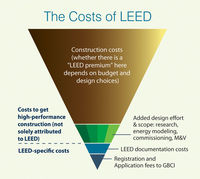
How much does LEED certification cost in commercial construction? Earning LEED certification involves several types of costs, and you have to consider each separately to get an accurate picture.
How much does LEED certification cost in commercial construction? Earning LEED certification involves several types of costs, and you have to consider each separately to get an accurate picture.
Let’s envision the cost of LEED as an inverted pyramid with four levels from bottom to top. The bottom level is both the smallest (in size and... Read more
Op-Ed
Energy consultant Andy Shapiro questions the energy benefits of active chilled beams; engineer Peter Rumsey responds.
I read with some concern the enthusiastic article about active chilled beams (EBN Apr. 2010). When I looked into these for a lab I was informally reviewing, they required outside ventilation air to deliver heating and cooling at unoccupied times in the building—when ventilation air often is not required at all, unless you have an air system... Read more
News Brief
According to a recent study published in Environmental Health Perspectives, nanoparticles can cross the human placenta. Often thought of as a barrier that can protect a developing fetus from the mother’s exposure to environmental pollutants, the placenta was found to be permeable to nanoscale particles of polystyrene.
In the study, placentas... Read moreNews Analysis
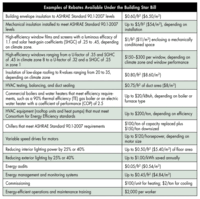
The Building Star program, currently being considered by Congress, would create rebates and tax incentives for retrofitting commercial buildings.
On March 4, 2010, Senators Jeff Merkley of Oregon and Mark Pryor of Arkansas introduced legislation to create the Building Star program, which would offer incentives and rebates for energy efficiency improvements to commercial buildings. The creators of the bill argue that it would create 150,000 jobs with $6 billion in federal investment, and... Read more
News Brief

Feature

Proponents of integrated design say that it results in higher-performing buildings at lower costs than the conventional design process. But real world obstacles can derail or limit integration. We offer tips from experts to keep things on track.
What happens when project teams buck the conventional, linear design and construction process in favor of an integrated approach? According to proponents of integrated design, they produce buildings with higher environmental performance at lower costs. Integrated design gets more design team members around the table, inviting... Read more
Blog Post
News Brief
A recent report from the Solar Energy Industries Association (SEIA) shows significant growth in overall U.S. solar electric capacity for 2009, with the industry climbing a total of 37%.
SEIA cites residential and utility market demand, declining technology prices, and related policy advances as the primary drivers behind the increase,... Read more
News Brief
UPDATE May 10, 2010:The deadline for proposals to participate in the partnership program has been extended to May 14, 2010, at 3 p.m. EDT.The U.S. Department of Energy (DOE) has announced a new initiative to reduce energy use in new and existing buildings across the commercial building sector and is currently accepting applications for... Read more
News Analysis
Two pieces of federal legislation introduced in April 2010 would, if passed, radically update the 1976 Toxic Substances Control Act (TSCA), the federal law giving the U.S. Environmental Protection Agency (EPA) the authority to regulate new and existing chemicals that may pose an environmental or health risk.
Action is warranted,... Read more
Blog Post
The American Recovery and... Read more
Blog Post
Americans spend a lot of... Read more
Blog Post
News Brief
After a long wait, the U.S. Green Building Council (USGBC) has opened a second public comment period for its LEED for Healthcare rating system.
The new LEED for Healthcare draft includes changes to almost every one of its 62 credits and prerequisites, although most of the changes are minor and are about aligning LEED for Healthcare with... Read more
Blog Post
False-flush is a fairly common occurrence with sensor-activated... Read more
Blog Post
The goal of this report was to get a handle on the ways in which LEED credits can be achieved.
We've just released a neat new report on what it costs to achieve specific LEED credits. Based on the current LEED-NC 2009 rating system, "The Cost of LEED" draws on the experience of veteran cost estimators to provide prices for specific measures a project team would consider. The report helps a team understand the implications of... Read more


