
Championing the
Changemakers
BuildingGreen champions the changemakers in sustainable design and building, with trusted insight, unparalleled education, and communities that are transforming the industry.
Log in to your profile

Image: Piranka

Product Review
An ironic side effect of cleaning up the water in America’s harbors over the last two decades has been an increase in the population of marine borers. These small animals bore into and destroy any submerged wood and are undeterred by chemical wood treatments. As a result, ports are forced to replace their pilings... Read more
News Analysis

The company has retained Christine Hammer of Sustainable Design Resources on a half-time basis to serve as... Read more
News Brief
According to the E Source newsletter
E News, replacing vertical-axis, coin-operated washers with horizontal-axis models reduced energy use by 73 percent in a multifamily property in Seattle, Washington. The metered test, performed by Seattle City Light and Seattle Water, confirms expectations of the energy-saving potential of horizontal... Read more
Op-Ed
Newt Gingrich’s “Contract with America” contains some admirable goals, including attacking the budget deficit, streamlining government, and cutting red tape. Hidden in the fine print, however, lurks a radical—and dangerous—anti-environment agenda. On examining the package, one can only conclude that the new leadership either doesn’t believe... Read more
News Analysis
The Northern Forest Lands Council released its final report,
Finding Common Ground: Conserving the Northern Forest, in September 1994. Following the sale of timberlands in Maine, New Hampshire, Vermont, and New York to land speculators and developers in the 1980s, Congress appropriated funding to study... Read more
News Brief
The Harmony resort on Maho Bay in the U.S. Virgin Islands National Park won the 1994 Grand Award for Environmental Technology from
Popular Science magazine. The resort’s cabins are fully solar-powered and energy-independent, and were built with a minimum of disturbance to the site using many recycled materials. An interactive computer... Read more
News Brief
by Michael J. Crosbie. The American Institute of Architects Press, Washington, D.C., 1994. Hardcover, 192 pages, $39.95.
Contrary to its subtitle,
Green Architecture is more a gallery of environmentally sensitive design than a guide. This elegant, large-format book contains photos and... Read more
Feature
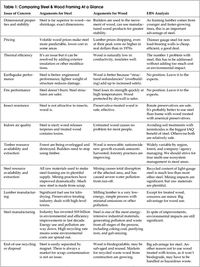
Decisions about insulation are among the most important you will make relative to the environmental impact of buildings. Because insulation reduces the energy consumption, it provides ongoing environmental benefits throughout a building’s life. However, not all insulation materials are equal environmentally.
In assessing the... Read more
News Brief
by Peter Katz. McGraw-Hill, Inc., New York, 1994. Hardcover, 288 pages, $49.95.
The New Urbanism is one of the most important books to have appeared on what is emerging as a new paradigm in land-use planning and community design. Sometimes referred to as “neotraditional town planning,” this school of... Read more
News Brief
Tree Talk has lowered the price of the
Woods of the World computer database to $149. The CD-ROM-based database was reviewed in EBN (
Vol. 3, No. 4) and is continually being improved, according to Berne Broudy of Tree Talk.
News Brief
Gridcore Systems International dedicated the world’s first full-scale production facility for Gridcore on November 1, 1994, in Long Beach, California. The plant, which has been in production since April, employs 30 workers and produces a structural building panel out of recycled fiber—primarily cardboard, newsprint, and urban wood waste (see... Read more
News Brief
The U.S. Environmental Protection Agency has completed a nationwide county-by-county survey of radon in buildings and produced a map showing relative risk. The study found the highest radon levels in the western mountain states, upper Midwest, Appalachian Mountain states, and Maine. The Southeast across to Texas and Pacific Northwest... Read more
Product Review
The aptly named privy works exactly like the company’s well-known composting toilets that convert human wastes into a nutritive... Read more
News Analysis
Whether we should import raw logs from Siberian forests has sparked a hot debate among environmentalists and the wood products industry. Russia is hoping to boost its weak economy by exporting raw logs from Siberia’s vast forests. Some U.S. wood products companies see this as a way to make up for the loss in... Read more
News Brief
The wood industry has launched a major advertising campaign aimed at promoting environmental advantages of wood as a building or manufacturing material. The Wood Works™ campaign promotes wood as a renewable resource that is energy efficient and results in little pollution during processing. With a budget of nearly $300,000, the campaign is... Read more
Op-Ed
Fortunately, I can tell them we are not as pessimistic in... Read more
News Brief
A calendar describing the history and importance of the once-vast longleaf pine forests in the southeastern United States has been put together by Carol Goodwin and Julie Moore in Gainesville, Florida.
Longleaf Legacies is a well-illustrated, informational calendar designed to help the user understand the ecology of this species, the... Read more
News Brief
The National Audubon Society headquarters building in New York City was received the Governor’s Award for Energy Excellence this past October. The building was originally constructed in the 1890s, and an extensive renovation by Audubon was completed in 1992. Today, the building is a showcase of environmentally responsible commercial building... Read more
News Analysis
It is now possible for environmentally concerned architects and builders to specify and buy framing lumber, white cedar shingles, and hardwood flooring that have been independently certified to be from well-managed forests. The Seven Islands Land Company, headquartered in Bangor, Maine, has just... Read more
News Brief
for the Sky
Bioclimatic Skyscrapers by Ken Yeang, 1994. Artemis London Limited, England (North American distribution by Scovill Petterson Inc., 141 Fifth Ave. New York, NY 10010; 212/673-6090, 212/673-6603–fax). 150 pages, $39.95.
An ecological skyscraper may seem like an oxymoron, but Ken Yeang hasn’t... Read more