
Championing the
Changemakers
BuildingGreen champions the changemakers in sustainable design and building, with trusted insight, unparalleled education, and communities that are transforming the industry.
Log in to your profile

Image: Piranka

News Brief
Richard L. Crowther, Butterworth Architecture, 80 Montvale Ave., Stoneham, MA 02180; 617/438-8464 (800/366-2665 for orders). 1992, $39.95.
Richard Crowther is clearly committed to understanding and practicing “ecologic architecture” in every way possible. The scope and breadth of material in this book is remarkable... Read more
News Analysis

Op-Ed
In recent months we've seen increasing signs that timber interests and environmentalists are beginning to talk. After years of finger-pointing and scapegoating, some serious, constructive communication is long overdue. In the words of Tim Lovlien, a voice of reason from Boise Cascade, “anytime you open the forum to discuss the issue, it’s... Read more
News Analysis
On November 25th, international delegates in Copenhagen, Denmark, completed negotiations on a second major revision to the Montreal Protocol for the phaseout of ozone-depleting substances. Under the Copenhagen Amendments, the schedule for eliminating CFCs is moved up to January 1, 1996, four years ahead of the schedule... Read more
News Analysis
Representatives of the timber industry and environmental groups are hopeful that a Pacific Northwest timber summit, promised by Clinton during his campaign, will settle issues that have long polarized loggers and environmentalists in efforts to protect jobs and old-growth forests. The summit is expected in March or April.
... Read more
News Brief
Andrew St. John, Editor. Boston Society of Architects, 52 Broad St., Boston, MA 02109; 617/951-1433 x221, 617/951-0845 (fax), $25.
The Sourcebook for Sustainable Design is a true labor of love. It is the first attempt we know of at a comprehensive listing of products and materials that are useful,... Read more
News Analysis
While expanded polystyrene (EPS) is the only type of rigid foam insulation that is currently made with neither CFCs nor HCFCs, it has one environmental drawback: pentane emissions during manufacturing. EPS is produced by expanding styrene beads using pentane gas, a hydrocarbon that contributes to... Read more
Op-Ed
Product Review
Non-exposed Wood
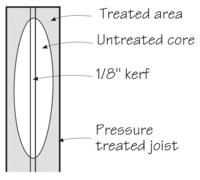
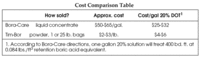
Boron has long been recognized as an effective and very safe pesticide in wood. In part, it effectiveness comes from its ability to diffuse freely throughout the wood, thus protecting even the center of large timbers, which are not affected by pressure treating. Unfortunately, the diffusability... Read more
News Analysis
The 1992 Energy Policy Act, signed into law in October, sets maximum water use standards for most plumbing products manufactured after January 1, 1994. Most toilets will be limited to 1.6 gallons per flush (a higher limit of 3.5 gpf will apply to most commercial toilets). Kitchen and... Read more
News Analysis
NRG Barriers, Inc. of Saco, Maine, has become the first polyisocyanurate foam insulation manufacturer to totally phase out CFC-11 use in a complete product line. As of January 1, 1993, 100% of NRG’s commercial roofing insulation products will be produced with HCFC-141b, according to Technical... Read more
Feature
Steve reflects on his work and the field of environmentally sustainable building in this interview with Alex Wilson.
Steve Loken has been building houses and enjoying the Montana wilderness for fifteen years. In the mid-’80s, Steve began to see a conflict. The forests he so enjoyed were disappearing, the houses going up were getting bigger and bigger, and the lumber they had available to them was getting worse and worse. Out of that realization grew the idea... Read more
News Brief
By Dorothy Mackenzie; Rizzoli International Publications, Inc., 300 Park Avenue South, New York, NY 10010. 176 pages, hardcover. $35.
Design for the Environment by Dorothy Mackenzie is a gallery of environmental design solutions, mostly from Europe. The book covers an extremely broad range of topics, including building design,... Read more
News Analysis
The Toronto City Council has just approved in principal a proposal to coordinate a massive energy and water conservation program. Viewed as a way to create jobs for the city’s ailing construction sector, the plan calls for investments averaging $14,000 per unit on 75% of the city’s 280,000... Read more
Explainer
Product Review
Trus Joist MacMillan, makers of the Silent Floor™ framing system, have just introduced a rim joist made especially for use with that system. The new product is made from a new type of manufactured lumber called Timberstrand LSL™ (Laminated Strand Lumber), which is basically a next-generation, high-end... Read more
News Brief
By Jim Broadstreet; Loompanics Unlimited, Box 1197, Port Townsend, WA 98368. 162 pages, hardcover, $19.95.
Building With Junk is an excellent guide for owner/builders who are trying to build an affordable and interesting home for themselves using recycled or used materials. It provides ideas for sources of scrounged materials, methods... Read more
News Analysis
Sustainably harvested wood resources just took a giant leap forward with the first certified sustainably produced plywood. Springfield Forest Products of Springfield, Oregon, and Trus Joist MacMillan provided materials for the roof of an environmental prototype store in Lawrence, Kansas. The store... Read more
News Brief

News Analysis
In what could become an exciting new trend for environmentally conscious remodelers, Neworld Bank of Massachusetts has announced a reduced-rate loan available to homeowners in the state for “green” home improvements. The improvements covered include:
•energy-efficiency retrofits of insulation,... Read more


