
News Brief
2002 ASHRAE Technology Awards
Simple schematic of the Cornell University lake-source cooling project.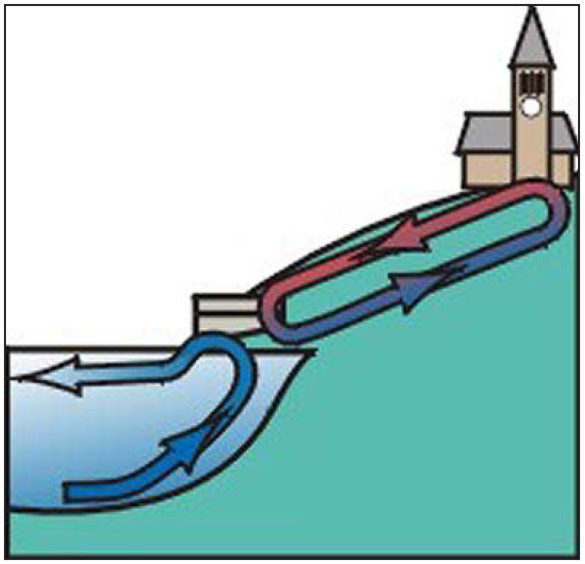
Cornell’s engineers created a system that eliminates chillers entirely from its central cooling plant. Instead, a new facility on the shore of Cayuga Lake draws 39°F (4°C) water from 250’ (76 m) below the lake’s surface, and runs it through a heat exchanger to cool water in a separate loop that cools campus buildings. While this enormous project cost more than simply replacing and refurbishing the system’s old CFC-based chillers, it is paying for itself by saving over 20 million kWh per year, which translates to avoiding the annual burning of 19 million pounds (8.6 million kg) of coal. This system is expected to last longer than a series of chillers, and it has the capacity—20,000 tons (70,000 kW) of cooling—to meet an anticipated expansion in demand. Ecologists from the University, State, and local organizations studied the project extensively at the planning stage to determine if there might be any adverse effect on the lake, and during its operation water conditions are monitored at eight different locations. Details are online at www.utilities.cornell.edu/utl_ldlsc.html.
The second winning project was designed by KJWW Engineering Consultants in Rock Island, Illinois with Warren Lloyd, P.E. as project manager. This project uses a 12-acre (5 ha) artificial lake as a heat sink (and source) for heat pumps throughout the 120-acre [50 ha] campus of the Great River Medical Center in West Burlington, Iowa. Water piped through coils near the bottom of the 12’-deep (3.7 m) lake is delivered to over 800 individual heat pumps serving various spaces in the medical facility with a total cooling capacity of 1,500 tons (5,300 kW). In addition to providing a thermal sink for the mechanical system, the lake serves as a stormwater retention basin and provides irrigation water to the campus. The facility reportedly uses 31% less energy than comparable facilities of this size and type. The awards will be presented during the Society’s 2002 Winter Meeting, to be held January 12–16, in Atlantic City, New Jersey.
Published January 1, 2002 Permalink Citation
(2002, January 1). 2002 ASHRAE Technology Awards. Retrieved from https://www.buildinggreen.com/newsbrief/2002-ashrae-technology-awards



Add new comment
To post a comment, you need to register for a BuildingGreen Basic membership (free) or login to your existing profile.