
News Brief
Beautiful Maps of Dying Places
These hotspots are the richest and most threatened biologically diverse regions on earth, according to the Atlas.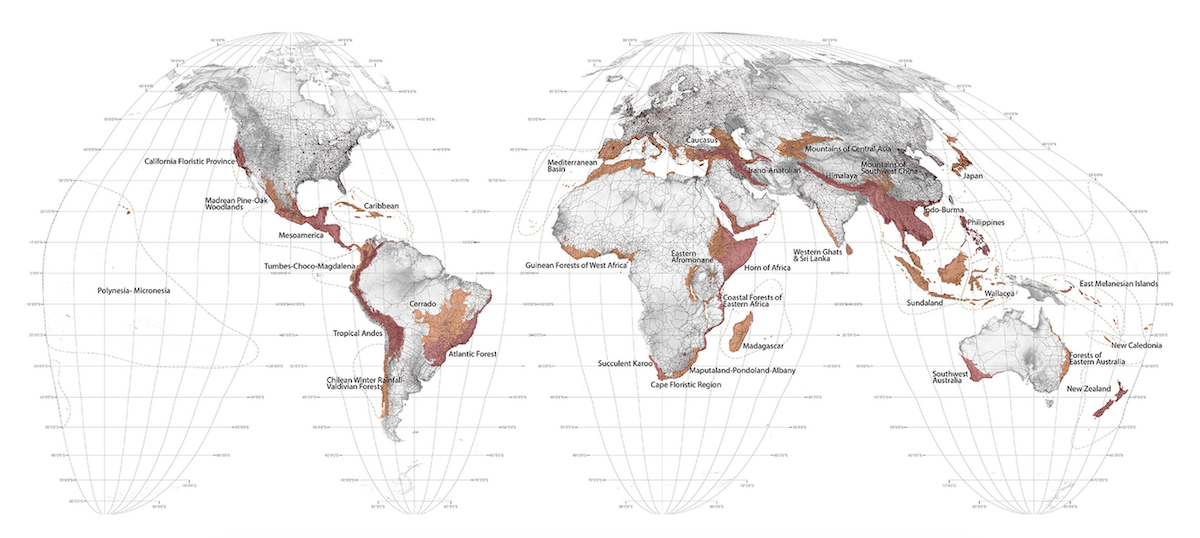
The focus of the project, according to its website, is “the remaining habitat in the world’s 36 biodiversity hotspots.” These hotspots—defined as “the richest and most threatened biologically diverse regions on earth”—are analyzed in multiple ways, including through “conflict maps” showing the encroachment of human civilization on sensitive ecosystems around the world. For example, a conflict map for the North American Coastal Plain region highlights sprawl and its disruption of threatened-species habitat in cities from New York to Miami to Monterrey, California. “We will not live well or even survive that long in a world that is not biodiverse and able to provide the ‘ecosystem services’ we have until recently taken for granted,” notes an essay on the site.
The project features 44 world maps as well, which illustrate everything from “megastructures,” like canals and pipelines, to threatened mammals and health of waters. There is even a “meat map” of grazing lands for cattle, as well as a map of croplands. The project also features “datascapes” visualizing such things as the ecological footprint of the U.S. and carbon sequestration by forests worldwide.
Although the provocative title projects a pessimistic message, there is room for hope, another essay on the site maintains: “For the first time in history, humans are attempting, on a planetary scale, to reconstruct the landscapes they have hitherto ravaged.” Using the Atlas for the End of the World as a starting place, the minds behind the project intend to move forward with further research and “establish a knowledge-sharing network of demonstration design projects across the hotspots.”
For more information:
Published December 10, 2018 Permalink Citation
Melton, P. (2018, December 10). Beautiful Maps of Dying Places. Retrieved from https://www.buildinggreen.com/newsbrief/beautiful-maps-dying-places



Add new comment
To post a comment, you need to register for a BuildingGreen Basic membership (free) or login to your existing profile.