
News Brief
Buildings of Earth and Straw
Buildings of
Earth and Straw:
by Bruce King, P.E.
1996, Ecological Design Press, Sausalito, California (distributed by Chelsea Green Publishing Company, White River Junction, Vermont). Paperback, 170 pages, $25.
This 3,500 ft2 (325 m2) strawbale residence in the Santa Cruz Mountains by DSA Architect of Berkeley, California, includes a two-story entrance hall, an art gallery, and a central courtyard overlooking the Pacific Ocean. Domestic hot water and auxiliary space heating are provided by a combined solar thermal system; a photovoltaic system supplies electricity.
Photo: Daniel SmithWith his lighthearted touch and clear prose, structural engineer Bruce King offers an introduction to the field of structural engineering, followed by a rudimentary analysis of earth and straw as structural materials. While experienced engineers will doubtless be frustrated by the lack of firm data, King has done a great service by simply collecting the wisdom accumulated from the past decade’s experience with these materials.
In the section on earthen construction, King explains that earth walls stabilized with Portland cement cure much more slowly than concrete, so the standard 28-day curing time for tests is inadequate. From firsthand experience he notes the difficulty of obtaining soils of consistent composition. Although he mentions that earthen walls sometimes have only clay as a binder, his engineering analysis is limited to cement-reinforced earth. Both rammed-earth and earth shot through gunnite equipment (gunearth) are discussed.
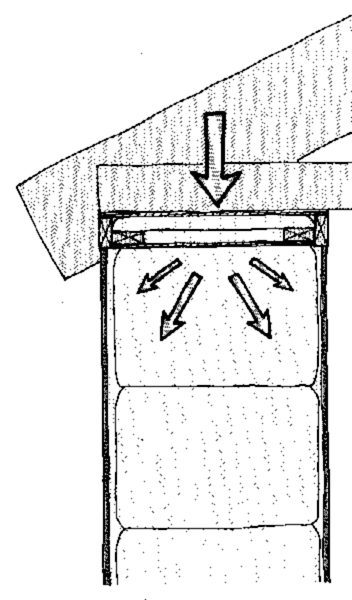
For load-bearing plastered straw-bale walls, King illustrates how the rigid plaster will inevitably end up carrying the load.
This fact makes it critical to have a strong bond between the plaster and the bales, so that the thin plaster isn’t free to buckle under the weight. King also describes how resilient bales are and suggests that if it weren’t for all the other rigid and brittle materials in a building, bales would be an ideal structural material. Along these lines, he notes: “The only other materials that can be compressed to half of their height and still be in the elastic range are steel springs and the family of rubber compounds. Maybe someone will start making seismic vibration isolators from bales, for they seem to have all the right qualities.”
Appropriately,
Buildings of Earth and Straw pays a great deal of attention to earthquake loads. It is perhaps too neglectful of cold-weather construction, however, as a foundation detail suggested for a bale wall fails to account for frost-heaves, and an appendix on manufactured straw panels describes them as good thermal insulators—although none of the medium-density panels covered in the appendix are listed at more than R-2 per inch (RSI-14 per meter).
Anyone designing an earth or straw building should have this book. While it is not meant to replace any of the excellent how-to texts on these systems that have recently been published, it does greatly extend the engineering discussions included in those texts. And it should go a long way towards bridging the gap—from both directions—between enthusiastic owner-builders of unconventional homes and the authorities whose approval they must have.
Published February 1, 1997 Permalink Citation
(1997, February 1). Buildings of Earth and Straw. Retrieved from https://www.buildinggreen.com/newsbrief/buildings-earth-and-straw



Add new comment
To post a comment, you need to register for a BuildingGreen Basic membership (free) or login to your existing profile.