
News Brief
Designing Low-Energy Buildings with Energy-10, version 1.5
Produced by the National Renewable Energy Lab (NREL), Lawrence Berkeley Laboratory, and Berkeley Solar Group, with financial support from the U.S. Department of Energy. Distribution, training, and technical support provided by Sustainable Buildings Industry Council, 1331 H Street NW, Suite 1000, Washington, DC 20005; 202-628-7400 ext. 210;
www.SBICouncil.org. $250 for Energy-10 software together with Passive Solar Strategies handbook. Free to registered users of earlier versions. Windows 98 or newer operating systems with at least 64 MB of RAM recommended.
Not Mac or Linux compatible.
Energy and Cost Summary
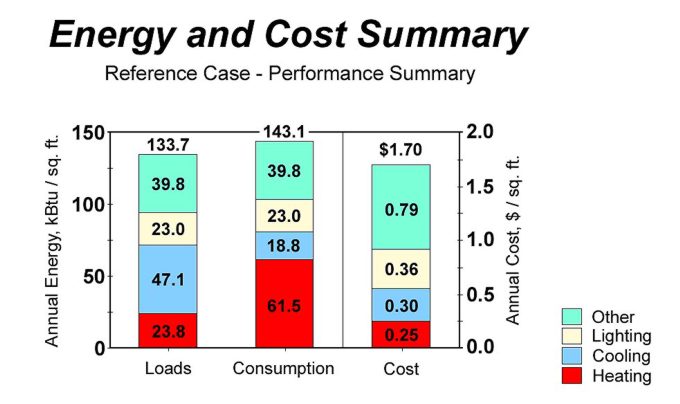
Sample output from Energy-10 version 1.5
HVAC Sizing Summary

Sample output from Energy-10 version 1.5
Energy-10, the first full update of the software since 1999. This release reinforces
Energy-10’s position as the best energy modeling tool for simple buildings, especially for use by architects who don’t need to model sophisticated mechanical systems. The program is especially useful for its ability to provide feedback on energy performance in the early stages of design, based on a large set of default assumptions that users can change as the design crystallizes. While the “10” moniker indicates 10,000 ft2 (930 m2) as a building size limitation for
Energy-10, the actual limitation is only in the fact that the software can handle no more than two HVAC zones.
Energy-10 is set up to compare base-case and improved building designs, based on a series of potential measures, such as increased insulation levels, more efficient lighting, and shading of glazed areas. With version 1.5, the graphical output capabilities, which were already impressive, have been greatly enhanced. It is now possible to illustrate, both in energy cost and energy usage, the effect of various design changes, either individually or as a package. The new version 1.5 makes it easier to save various design “schemes” for exploring what-if scenarios. It also allows custom libraries of material or assembly properties to be saved with a project file, rather than in the program’s general library of data. Finally, it adds powerful life-cycle costing tools that project the effect of design changes into the future with net-present value and internal rate-of-return data presented both numerically and graphically.
While version 1.5 improves
Energy-10’s peak load reporting and equipment sizing capabilities, it is not set up to model complex mechanical systems. “
Energy-10 is designed to support architectural design decision making, which is a benefit because it can help optimize the building envelope,” reports Greg Franta, FAIA, principal of ENSAR Group and a long-time
Energy-10 user. For large, complicated buildings, or to design complex mechanical systems, DOE-2.1 is the tool of choice, with or without user-friendly interfaces such as VisualDOE from Eley Associates in San Francisco. The new
EnergyPlus modeling engine is poised to replace
DOE-2 over time, while programs from HVAC equipment manufacturers, such as
Trace™ 700 from Trane or
HAP from Carrier are widely used to size mechanical equipment and document code compliance.
Not immediately apparent to the user is the fact that
Energy-10 has been completely reengineered to take advantage of current Windows operating system capabilities. “It really is just fabulous—a lot of little bugs are worked out,” says Franta. One drawback to this update is that project files created with previous versions of
Energy-10 cannot be used in the new version.
Not included in version 1.5 are some photovoltaic modeling features that were included in an earlier limited-distribution version 1.4. That functionality is expected to be reintegrated with the next major update, version 2.0, currently planned for the fall of 2003. Other features expected with that release include a drawing-based input function called “Sketch” and special reports formulated to document compliance with energy and daylighting credits of the LEED™ Rating System.
– NM
Published September 1, 2002 Permalink Citation
(2002, September 1). Designing Low-Energy Buildings with Energy-10, version 1.5. Retrieved from https://www.buildinggreen.com/newsbrief/designing-low-energy-buildings-energy-10-version-15



Add new comment
To post a comment, you need to register for a BuildingGreen Basic membership (free) or login to your existing profile.