
News Brief
EcoHomes: The Environmental Rating for Homes
by the Center for Sustainable Construction of the Building Research Establishment (London, England), 2000; online at www.constructionplus.co.uk. Two softbound publications: BR 389 2000 (Program introduction), £25; BR 390 2000 (Materials guide), £35
Given all the U.S. activity in residential green building program development, it’s fascinating to learn about a rating program from across the Atlantic. The Building Research Establishment (BRE) has recently developed and implemented a national rating system for Great Britain called EcoHomes. Two publications are currently available that support the program: a 20-page introduction bearing the same title as the program; and a 40-page, LCA-based, building materials guide entitledThe Green Guide to Housing Specification. The target audience of the introductory document is the developer—it’s a program overview laying out the how and why of the EcoHomes assessment. The
Green Guide is designed for anyone to use in selecting building materials and common construction assemblies based on individual parameters or overall environmental performance.
The EcoHomes rating program is voluntary, emphasizes flexibility (there are no mandatory elements or prerequisites), and applies to entire housing developments—both new and existing. Individual
site features are assessed, while the
homes within a development are assessed as a package. EcoHomes is organized by seven environmental categories: energy, transport, pollution, materials, water, ecology and land use, and health and well-being. BRE-licensed assessors use a detailed workbook (available only to certified assessors) for each project to develop a BRE-certified rating ranging from “pass” to “excellent” (an EcoHomes rating prediction checklist comes with the introductory document and gives developers a quick check on how a development might fair in an assessment).
The EcoHomes initiative represents a third iteration, following less successful attempts at a market-driven residential environmental rating program. According to Nigel Howard, former director of BRE’s rating system programs and now vice-president of the U.S. Green Building Council, the backing and sponsorship of EcoHomes by such an influential organization as the National House-Building Council (NHBC) distinguishes EcoHomes from earlier approaches. (NHBC is an independent regulatory body that registers builders, inspects construction, and provides home-buyer warranties against failure.) Another important new feature of the EcoHomes program is that the cost of a certified assessment is both reduced and more easily spread across an entire development (versus a unit-by-unit approach).
Though neither publication is very long, both offer useful insight for U.S. green builders and architects to consider:
•A “Beyond EcoHomes” section that addresses important environmental considerations that could not yet be included in the program. These include carbon offsets, proximity to employment, and wildlife corridors.
• A discussion of EcoHomes’ relationship to another British housing program, Housing Quality Indicators (HQI), which includes durability. One of the ten elements of the HQI assessment is set up to use inputs directly from the EcoHomes assessment. (Curiously, the reverse is not true—durability parameters from the HQI system are not integral to the EcoHomes program.)
• A great Appendix in the
Green Guide that explains key elements of life-cycle assessment, including the critical step of normalization. (Under the EcoHomes approach to assessing the comparative environmental impact of various materials, impacts are normalized on a per-United-Kingdom-citizen basis).
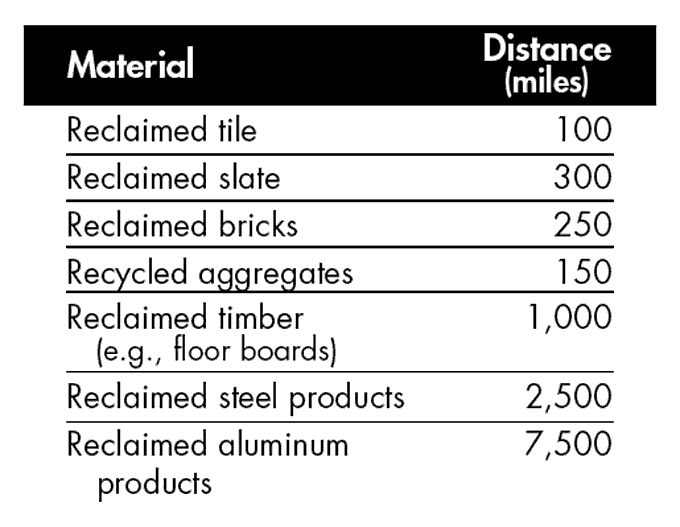
• A very simple, detailed, and relatively transparent portrayal of individual and overall LCA information, as well as building material ratings. An interesting example is the table below showing how far various reclaimed materials can be transported with net embodied energy gain.
Maximum transport distances for reclaimed materials
Green Guide and its information on the environmental impact of building materials useful. For those involved in green builder program development, a thorough study of both publications is sure to provide useful insight.
Published June 1, 2001 Permalink Citation
(2001, June 1). EcoHomes: The Environmental Rating for Homes. Retrieved from https://www.buildinggreen.com/newsbrief/ecohomes-environmental-rating-homes



Add new comment
To post a comment, you need to register for a BuildingGreen Basic membership (free) or login to your existing profile.