
News Brief
Green Development: Integrating Ecology and Real Estate
by Alex Wilson and staff of the Rocky Mountain Institute. John Wiley & Sons, 1998. 542 pages, hardcover, $54.95. May be ordered directly from the Rocky Mountain Institute (see next review for contact info).
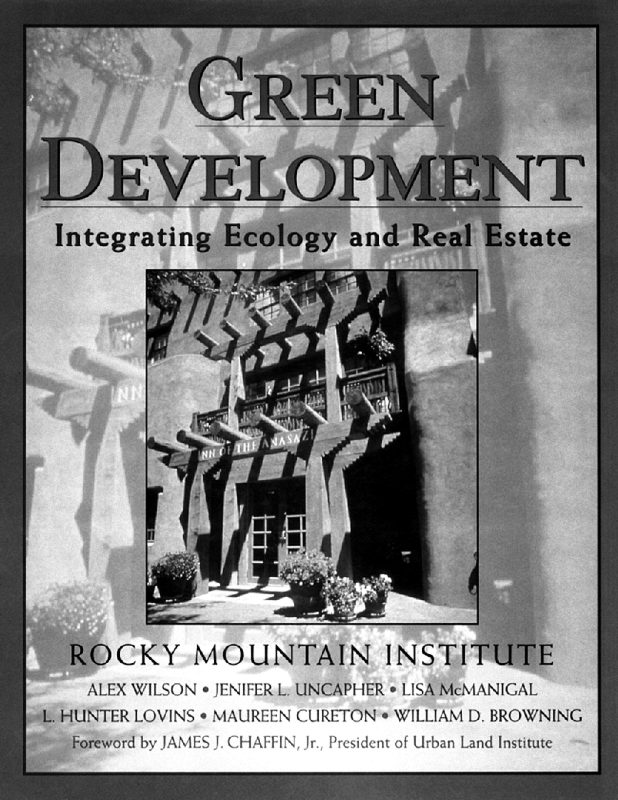
Now, collected in one place, are examples of developments that support and enhance the natural environment, and a step-by-step account of how to go about creating such developments. The focus of the Institute’s research, and the basis for this book, are actual built projects, and the text lets the projects speak for themselves.
Rather than presenting each project as a separate case study, the authors chose to organize the book into chapters reflecting the usual sequence of a development project. The case studies are invoked in small doses to illustrate and reinforce the ideas in each chapter.
The first three chapters set the stage by explaining the basic principles behind green development, what’s different about the process compared with standard developments, and the larger issues of land-use planning. This section outlines RMI’s “four process elements” of green development, which are used as guideposts throughout the text:
•whole systems thinking;
•front-loaded design;
•end-use/least-cost planning; and
•teamwork.
The following chapters get into the nitty-gritty of the development process, addressing market research, site planning and design, building design, approvals, financing, construction, and marketing. Of course, each of these chapters only skims the surface of its topic, but each does a good job of highlighting the differences between conventional and green development.
The last two chapters look to the future, first in terms of sustaining green development projects and their environmental benefits over the long term, and finally, with a vision of where green development might be headed in the future.
For readers who are interested in learning about a particular project, a handy Case Studies Index points to all the references for each of about 50 projects, and an appendix provides a more comprehensive overview, including financial performance information, for the 27 projects covered in most detail. For those who want to pursue it further, full contact information is provided for the owner or developer of each project. Other valuable appendices include a detailed bibliography, resource listings, a glossary, and checklists of green development strategies.
This is no coffee-table book—the photos are all in black and white and the layout is utilitarian. It is designed more like a textbook, and it will hopefully be used as such in real estate, planning, and architecture courses. The content is compelling enough, however, that it should also be popular with practitioners looking for inspiration and for ammunition with which to convince skeptics.
Published February 1, 1998 Permalink Citation
(1998, February 1). Green Development: Integrating Ecology and Real Estate. Retrieved from https://www.buildinggreen.com/newsbrief/green-development-integrating-ecology-and-real-estate



Add new comment
To post a comment, you need to register for a BuildingGreen Basic membership (free) or login to your existing profile.