
News Brief
RAIC Announces 2005 Awards of Excellence
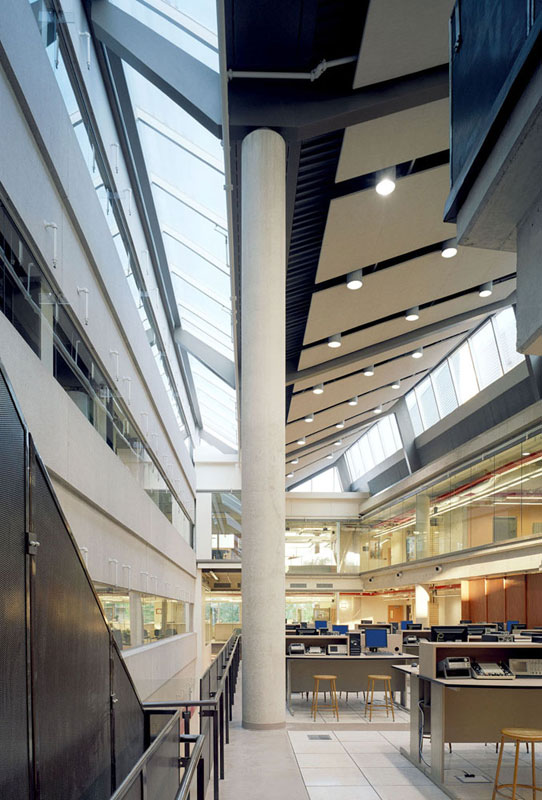
The Beamish-Munro Hall Integrated Learning Centre at Queen’s University in Kingston, Ontario, by B+H Architects.
Photo: RAICBusby Perkins+Will Architects Co. was awarded an
Architectural Firm Award. Every principal and associate at the firm is LEED accredited, and the firm has the largest portfolio of green projects in Canada, according to RAIC. “The firm’s dedication to reinvesting in the knowledge pool, generously sharing each discovery of a better way of building environmentally, is truly commendable,” noted the jury. For an example of the firm’s work, see the City of White Rock Operations Building case study in the BuildingGreen Suite.
All seven projects granted
Innovation in Architecture awards incorporate green strategies.
•
The Sustainable Condo, by Busby Perkins+Will Architects Co.: Designed to educate visitors about resource consumption, occupant health and well-being, and land-use considerations, this demonstration project showcases environmentally responsible products and building strategies.
•
The University of Ontario Institute of Technology (UOIT) in Durham Region, Ontario, by Diamond and Schmitt Architects: Intended to be one of the greenest campuses in Canada, UOIT was designed to use 50% less energy than required by the Model National Energy Code.
•
SC3 Paradigm Shift in Winnipeg, Manitoba, by Smith Carter Architects: Smith Carter’s new offices, also known as Green Beta Site for Serious Play, were designed to be intellectually challenging and inspiring while promoting innovation and collaboration. “Issues of sustainability infuse the design approach to the building as well as the practice,” said the judges.
•
The Beamish-Munro Hall Integrated Learning Centre at Queen’s University in Kingston, Ontario, by B+H Architects: Designed to embody green principles as an example for the University’s engineering students, the Integrated Learning Centre includes a three-story green wall, efficient lighting, radiant flooring, displacement ventilation, and extensive daylighting.
•
TOHU in Montreal, Quebec, by Schème Consultants, Jacques Plante Architecte, and Jodoin Lamarre Pratte et Associés Architectes: The Cité des Arts du Cirque, also known as TOHU, is a gateway to Cirque du Soleil’s Montreal campus of circus-related facilities. Hot water from the turbine cooling system of a neighboring biogas power station is used in TOHU’s radiant heating system, and a passive ground-source air-circulation system provides ventilation. Green roofs cover part of the facility.
•
The Humber Building at the University of Guelph in Toronto, Ontario, by Diamond and Schmitt Architects in joint venture with RHL Architects: This building’s skylit four-story atrium features displacement ventilation and a green wall. “The biofiltration wall in particular corresponds to the award criteria in the purest sense, accepting risks associated with emerging technologies while trying to address the challenges of sustainability,” noted the jury.
•
The Thunder Bay Regional Health Sciences Centre in Thunder Bay, Ontario, by Salter Farrow Pilon Architects, Inc: This 375-bed hospital was designed to create a more humanistic environment and to respond to its natural context. Nearly half of the building site was left as natural bogs, drainage channels, and bush. Skylights and extensive windows bring daylight into much of the facility.
Published August 1, 2005 Permalink Citation
Boehland, J. (2005, August 1). RAIC Announces 2005 Awards of Excellence. Retrieved from https://www.buildinggreen.com/newsbrief/raic-announces-2005-awards-excellence



Add new comment
To post a comment, you need to register for a BuildingGreen Basic membership (free) or login to your existing profile.