
Blog Post
LED Lighting – Efficient Illumination Without Mercury
Light-emitting diodes, better known as LEDs, are all around us--those little red or green indicator lights that blink at us from our stereo equipment, most new traffic signals, and virtually all new exit signs in commercial buildings. And if you've been to Times Square recently, you've seen way too many LEDs being used for advertising! We've all seen colored LEDs; what's new is the use of white LEDs for indoor lighting.
First some background. In recent weeks, I've written about lots of kinds of lighting and reviewed the various advantages and disadvantages of each. Incandescent light bulbs, our most common lighting in homes, have the disadvantage of producing far more heat than light; in other words, it's wasteful. Halogen and tungsten-halogen lamps, varieties of incandescent light bulbs, are nearly as inefficient. All of the other light sources I've written about--fluorescent (including compact fluorescent lamps or CFLs) and the various HID technologies (including mercury vapor, metal halide, and high-pressure sodium) are significantly more energy-efficient than incandescent, but rely on mercury to produce the light. That mercury poses a health and environmental hazard when the lamps are discarded or broken.
LED technology is very different. Light is produced when a semiconductor material is energized. The physics of how an LED generates light is fairly complicated--it's and a bit like a photovoltaic cell, only in reverse. Two semiconductor materials are sandwiched together, creating a "junction" between them; one side wants to give up electrons and the other side wants to capture them. When electric current is applied, electrons jump across the junction and photons of light are released. Most LEDs are tiny--just a millimeter or two in diameter.
LED lights are great because they last a very long time and don't burn out the way other light sources do--though they do fade over time (referred to as "lumen depreciation"). The color of an LED is determined by the semiconductor materials used. The first LEDs--introduced decades ago--were red. Then green ones were developed, then other colors. The challenge, which scientists have been working on for years, is producing white LEDs that can be used efficiently for general illumination. Thankfully, this is where we've seen the recent breakthroughs.
Some white LEDs are made by taking a blue LED and coating it with a phosphor that absorbs light in the blue spectrum and emits a whiter light (though still usually with a bluish tint). This coating reduces the efficiency, but it's the least expensive way to make white LEDs; it's the type used in LED flashlights. White light can also be produced by combining different color LEDs (red, green, and blue, for example)--you might remember from high school physics that white light is made up of all the different colors of the spectrum.
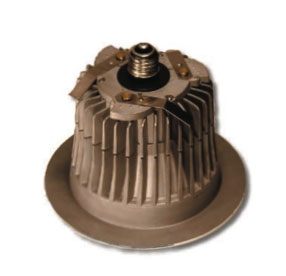
One of the best LED fixtures on the market today, the LR6, made by the North Carolina company Cree, is a downlight designed for recessed cans (a common type of light fixture in kitchens). The six-inch-diameter LR6 has 42 individual LEDs of different colors that, in aggregate, produce a white light that is almost indistinguishable from halogen-incandescent; there's a diffuser so you can't see the individual LEDs. One of the first installations in the country of this product was in Dr. Rebecca Jones's dermatology office on Elliot Street in Brattleboro--a very nice example of a green building if you get a chance to visit.
SUPPORT INDEPENDENT SUSTAINABILITY REPORTING
BuildingGreen relies on our premium members, not on advertisers. Help make our work possible.
See membership options »The Cree LR6 uses less than 11 watts to deliver 650 lumens for an efficacy of about 60 lumens per watt. This is far higher than the 15 lumens per watt from incandescent downlights and it's even higher than CFL downlights (partly because LEDs do a better job at focusing light downward). This fixture is available with a warm color temperature of 2700 K or a brighter-white 3500 K. Its color rendering index (CRI) is a remarkable 92--higher than the best CFLs--meaning that colors look very realistic under the light. The lamp is rated to last more than 30,000 hours (more than 15 years with five hours of average daily use). Our company, BuildingGreen, recognized this as one of the Top-10 Green Building Products of the year in 2007. The drawback is the cost, which is about $100 apiece.
The quality and efficacy of LED lighting has improved steadily in recent years, while costs have been steadily dropping. Cree has a screw-in reflector-type LED lamp under development with an efficacy of over 100 lumens per watt. As costs become more competitive, I'm hoping that this mercury-free light source will gradually capture market share from fluorescent and HID light sources, providing both energy savings and reduced mercury pollution.
Published January 5, 2009 Permalink Citation
(2009, January 5). LED Lighting – Efficient Illumination Without Mercury. Retrieved from https://www.buildinggreen.com/blog/led-lighting-–-efficient-illumination-without-mercury



Add new comment
To post a comment, you need to register for a BuildingGreen Basic membership (free) or login to your existing profile.