
Blog Post
Air-Source Heat Pumps
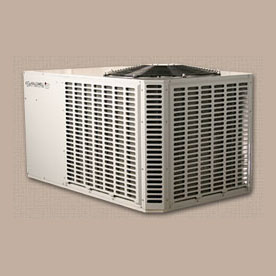
Last week's column looked at efficient but also very expensive ground-source heat pumps; this week we'll look at a less expensive option that's becoming more common even in our climate: air-source heat pumps. Traditionally, air-source heat pumps have been an option mainly for more southern climates, because they have to extract heat from the outside air, and when it's cold out their performance drops significantly.
However, a few things have changed. One is a relatively new type of air-source heat pump that's optimized for cold climates. The Hallowell Acadia cold-climate heat pump, manufactured in Maine, is an advanced, two-stage heat pump. This feature both allows the unit to work at much colder temperatures than conventional air-source heat pumps, and it boosts the efficiency--referred to as "coefficient of performance" with heat pumps.
While conventional air-source heat pumps essentially switch over to electric-resistance heating at temperatures much below 40 degrees, the Hallowell Acadia can operate at temperatures below 0 degrees and still perform significantly better than electric-resistance heat. Because these two-stage heat pumps are more complicated than conventional air-source heat pumps they're more expensive--but it's still a lot less expensive than ground-source heat pumps because trenching or drilling wells isn't required.
The other technology that's gaining popularity and has quite good performance in our climate is the "mini-split" heat pump that has been popularized by the Japanese companies Sanyo, Mitsubishi, and Daikin. Like central air conditioners, these are "split" systems that have an outside compressor and an indoor evaporator coil/air handler. A tube carries refrigerant between the indoor and outdoor units.
Because they do away with costly and space-hogging duct systems, these units are often called "ductless mini-splits." Refrigerant lines also move thermal energy more efficiently than ducts. The U.S. Department of Energy (DOE) estimates that ductless systems lose 1%–5% of their thermal energy through distribution, compared with 30% distribution losses for ducted systems.
Mini-splits often come with variable-speed compressors, improving energy efficiency. In typical air-conditioning systems, both compressors and air-handling units cycle between off and full capacity, with no settings in between. In most mini-splits, both the compressor and the fan coil are controlled by inverters, which can turn the compressor on at a low amperage and adjust the capacity as needed to meet actual loads. This improves system efficiency and durability as well as occupant comfort.
SUPPORT INDEPENDENT SUSTAINABILITY REPORTING
BuildingGreen relies on our premium members, not on advertisers. Help make our work possible.
See membership options »Most mini-splits can provide heat fairly effectively at temperatures as low as 0 degrees, Fahrenheit, with one Mitsubishi model able to work at outside temperatures as low as minus-13 degrees F. On the interior, most mini-splits are mounted high on a wall and offer one convenient system for blowing either heated or cooled air into the space.
Although more expensive than conventional central air systems, ductless mini-splits make up for that to some extent with lower costs to install, and their efficiency should make them less expensive to operate. If you already have a clean-burning, efficient heating system, and have an air-conditioning system you're happy with, there aren't many reasons for you to consider ductless mini-splits, or a cold-climate heat pump, for that matter.
But if you're looking to switch from a less efficient system, and you have some need for cooling as well as heating, ductless mini-splits or cold-climate heat pumps could provide a convenient, relatively cost-effective, efficient option. As I've written at other times in this column, electric heating and cooling can also make sense in a super-efficient off-the-grid home--another case where these systems are worth considering.
Not all local heating contractors offer these newer systems. For information and help locating a dealer, visit websites of Mitsubishi and Sanyo.
Published April 20, 2009 Permalink Citation
(2009, April 20). Air-Source Heat Pumps. Retrieved from https://www.buildinggreen.com/blog/air-source-heat-pumps



Add new comment
To post a comment, you need to register for a BuildingGreen Basic membership (free) or login to your existing profile.