
Blog Post
Deep-Energy Retrofits
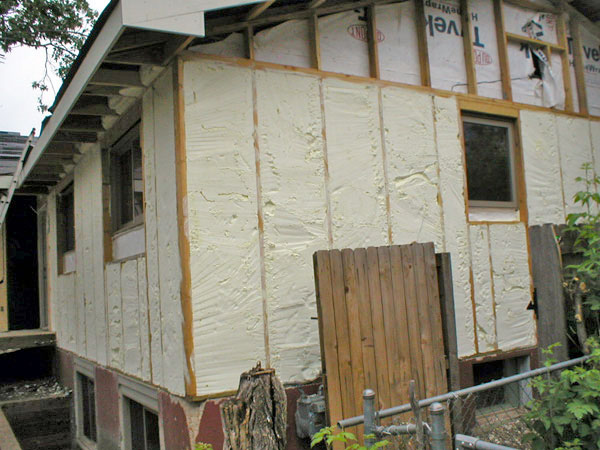
Starting in the 1970s, following the first energy crisis, major weatherization programs were launched to tighten up American homes. The Weatherization Assistance Program of the U.S. Department of Energy, which focuses on low-income homes, has weatherized some 6.2 million dwellings, reducing energy consumption by an average of 32%, since its inception in 1976. State and local programs and private weatherization companies have weatherized tens of millions of additional homes.
All this is great. But it isn't enough. If the U.S. is serious about reducing our contributions to global warming it is becoming increasingly clear that we will have to go a lot further in reducing the energy consumption of existing houses. Residential buildings account for 21% of total U.S. carbon dioxide emissions and 4.3% of the world's carbon dioxide emissions.
To achieve the sorts of carbon-reduction goals that climate scientists are telling us we need to achieve--a commonly quoted goal is an 80% reduction by 2050--we will have to reduce residential energy consumption by a lot more than the 30-35% that can fairly easily be achieved through simple weatherization.
We need to achieve more like 50-75% energy reductions in our existing housing stock. Achieving such significant savings will be both challenging and expensive. It will require what are now being referred to as "deep energy retrofits."
In new construction, a rule of thumb in northern climates for achieving that 50-75% savings is the "10-20-40-60 rule" for insulation: R-10 under foundation floor slabs; R-20 foundation walls; R-40 house walls, and R-60 ceilings or roofs.
While these targets aren't exactly easy to achieve in new construction, they are doable without too much additional cost or effort. With existing homes, on the other hand, meeting these targets is extremely difficult--and very expensive. It's rarely possible to achieve all of those targets with existing homes, especially the R-10 goal for basement or floor slabs. But it is possible to achieve dramatic improvement compared with standard weatherization--and that's what deep-energy retrofits are all about.
SUPPORT INDEPENDENT SUSTAINABILITY REPORTING
BuildingGreen relies on our premium members, not on advertisers. Help make our work possible.
See membership options »A few strategies for carrying out deep-energy retrofits of existing homes in a northern climate are described below:
Insulate foundation walls on the interior. Spray polyurethane foam (SPF) can be used against existing foundation walls--even rough walls such as stone. A good approach is often to add a couple inches of SPF against the wall, then build interior frame walls with 2x6s that are insulated with cavity-fill cellulose or fiberglass. You have to deal with any moisture problems first, since moisture entry and mold can be very significant problems.
Add rigid foam insulation to house walls. Getting anywhere close to the R-40 goal for wall insulation isn't possible by simply insulating existing wall cavities. (Insulating 2x6 walls with dense-pack cellulose or fiberglass achieves less than R-20.) The best approach for dramatically boosting wall R-values is usually to add a layer of foam insulation. Whether to add this on the interior or exterior depends on what shape the exterior siding and interior walls are in and how much space you have to work with. In a big house where the exterior siding is in good shape, insulating on the interior with 4" of rigid foam, then adding new drywall and trim may make sense. But in most existing homes, adding a thick layer of foam on the exterior usually makes more sense. Adding four inches is a reasonable plan.
Extend roof overhangs and window openings. Assuming rigid foam is added to the outside of walls, the roof overhang may need to be extended to protect the walls and windows. This is a big job that can easily cost $10,000. Window and door openings also will have to be extended, with proper flashing, air sealing, and trim.
Replace or upgrade windows. Windows are a key component of deep-energy retrofits. Existing single-glazed or insulated-glass windows will probably need to be replaced with state-of-the-art triple-glazed windows with two low-emissivity (low-e) coatings and low-conductivity gas fill, such as krypton. If the existing windows are in good shape, adding double-glazed, low-e storm windows might be an option, though such windows will likely have to be custom-made, since no insulated-glass storm windows are currently on the market.
Add more attic insulation. If you have an unheated attic, more insulation (cellulose or fiberglass batts) can usually be added on top of what's already there. If you have a cathedral ceiling and insulation in the roof, boosting the R-value can most easily be achieved by adding a layer of rigid foam insulation on top of the roof when re-roofing is done. In this case, detailing at the eaves and gable-end of the roof has to be carefully planned to keep the roof from looking clunky.
Cost of deep-energy retrofits, of course, is a huge challenge. For an average-sized house, the cost of this scale of retrofit could easily cost $50,000 to $75,000. I'm hoping that new loan funds will become available that will make this approach more feasible.
Published July 27, 2009 Permalink Citation
(2009, July 27). Deep-Energy Retrofits. Retrieved from https://www.buildinggreen.com/blog/deep-energy-retrofits



Add new comment
To post a comment, you need to register for a BuildingGreen Basic membership (free) or login to your existing profile.