
May I, as an architect, make some comments regarding your analysis of future electrical energy sources.
>
First, Nuclear Power IS A BAD IDEA! It will work pretty well for certain very small and specific uses, like ships and submarines. It's a terrible idea as a commercial source of power. The solution to world power needs is conservation of energy, lowering our energy requirements as a ratio to population density. This is possible and that's where the emphasis should be placed, not on trying to justify the use of a technology which has nothing but high downside risks. Lowering the need for individual energy units also address the problem of the low "density" of solar, wind, and geo-thermal sources which is often cited as a "problem" for those sources.
>
A few points regarding fossile fuels. While it may be true that the rate of discovery of new sources of oil has declined since the 60's the real problem is not that we can't replace the oil we're using, but that we're not able to exploit the oil in locations where we already know it exists. Part of the problem is economic, as the price of oil on the world market rises there are more sources of oil available, and partly regulatory in that we're not drilling for oil where we know it exists. (Let's leave the "global warming" debate out of the converstation for now.)
>
Nuclear power is a bad idea for a myriad of reasons some of which are being exposed every day by the debacle in Japan. When something like this happens it is entirely necessary to have a certain number of people who are willing to sacrifice themselves to make the necessary repairs under conditons which will without any doubt be deadly. Period!
>
When was the last time you saw a power plant of any kind in use 100 years after it's construction? Some dam's and even coal/oil fired plants may make that life span, but no nuclear facility ever will. When it has to be shut down, for whatever reason, you can't just tear it down and cover up the hole! The thing will exist for hundreds of years even when it's gone! Every brick, pipe, valve and chuck of concrete has to be handled like a deadly virus! The whole concept, that we can build a structure to house a material that's deadly to all life on earth requires an unbelieveable amount of faith and or ignorance!
>
Let's use this opportunity to put the issue of nuclear power to bed once and for all!
Blog Post
Meltdown in Japan and Our Energy Future
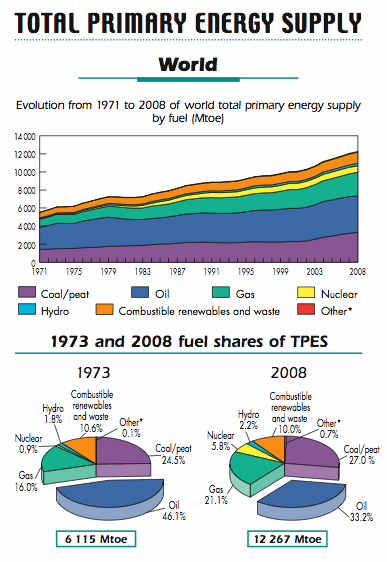
Looking for clean renewables in the pie chart of post-Fukushima global energy consumption? Try under “Other.”
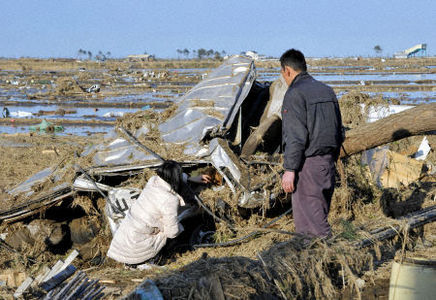
Two parents—identified by the caption—have their backs to the camera, ten feet away. The father is standing, and the mother crouching, both looking into what looks like a tangled pile of debris, but which we are told is a vehicle at a driving school in Miyagi Prefecture. The body of their daughter, killed by the tsunami, is trapped inside. I can only imagine the grief on their faces and in their hearts.
This photo stays with me more than another other image coming out of the compounded disasters of the earthquake, tsunami, and meltdown. In fact, I can’t get this whole disaster out of my mind, even as it moves off the front pages of the news. In addition to lingering concerns about radioactive fallout, the disaster provides an instructive lens with which to look at the energy solutions we currently rely on, and where they’re headed.
The numbers don’t lie
Worldwide, 5.8% of energy was produced by nuclear power in the most recently available figures (from 2008, published by the International Energy Agency, or IEA, in “Key World Energy Statistics”). The bulk of energy was produced by oil (33.2%), coal (27.0%) and gas (21.1%). Together, 81.3% of our total energy consumption came from these nonrenewable—that is, non-replaceable—fuel sources. Whether availability of these sources, or at least oil, has peaked, is a matter of some debate that I’ll save for another day. I will note in passing that worldwide oil discoveries peaked in 1964 and have declined sharply since then. We can’t burn it if we haven’t discovered it.
SUPPORT INDEPENDENT SUSTAINABILITY REPORTING
BuildingGreen relies on our premium members, not on advertisers. Help make our work possible.
See membership options »For all the hopeful talk about renewables, they still qualify as “Other” in the IEA pie charts. That’s right: solar photovoltaic, solar thermal, wind, and geothermal all lump together at 0.7% of global energy supply.
Hydropower, the biggest renewable energy source, stands at 2.2%, but has enormous development costs, environmental impacts, and not a lot of large-scale growth potential. Burning of biomass, biofuels, and similar sources, is also a complicated story. This group comes in at 10.0% of total supply, but not all of that is renewable. IEA says that doesn’t have a firm grip on how much of that 10% comes from biofuels versus landfill waste (much of which is plastics and other oil-based garbage). Burning of biomass and biofuels is a complex environmental story with many downsides as well as upsides.
We also need to note that worldwide energy consumption has been growing at 2% per year from 1973 to 2008. That means there is a doubling every 35 years. We need solar, wind, geothermal, not to mention oil, gas, coal and nuclear to all have strong annual growth rates just to meet projected demands. We’ll need even more phenomenal growth in renewables to keep up with demand while also phasing out of carbon.
Wherever you stand, I’ve got questions
Now, back to Japan. Both nationally and internationally, growth in nuclear power generation has been stagnant for decades. Prior to the crisis at Fukushima Daiichi, nuclear was going through a bit of a rebirth despite a strong headwind from people questioning its safety and the feasibility of safe long-term storage. I think it’s safe to say that that headwind will now be a gale worthy of the peak of Mt. Washington.
Wherever you stand on controversial energy issues of the day, I think you would have to admit we are in a pickle. If you don’t believe in peak oil, do you believe that fossil fuel consumption can increase indefinitely, which is what we currently require of it? Can it do so without causing disastrous global climate change and more mistakes like Deepwater Horizon?
Wherever you stand on nuclear power, do you see us adding hundreds of plants over the next couple decades to meet worldwide demand?
If you place your hope in renewables, how do you grapple with the low “density” of these sources? According to the book “Power Hungry” by Robert Bryce, solar photovoltaic installations require eight times as much land as a nuclear plant. Wind power requires 45 times as much land, and corn-based ethanol requires 1,150 times as much land. If we work hard now, we are probably decades away from having enough renewable capacity on a national basis to seriously compete for a big slice of the pie with the kind of steady “baseload” systems fueled now by gas and coal. Hope is not a plan, as they say in the military.
Japan’s energy is part of our economy
It may be tempting to think about energy in the abstract—simply something we use to do the things we really want to do, like getting to work, getting to school, staying warm, making things, growing things, powering life-support systems, and downloading movies.
Japan provides a picture of what it’s like to suddenly run short of power in a modern society with all its conveniences. There, we see rolling blackouts, empty shelves, halted trains with commuters unable to get to work, and evacuees sleeping on floors in community centers to stay warm.
Japan’s energy picture is part of our economic picture, too. It took just days for GM to shut down a Louisiana pickup truck plant due to lack of parts from Japan. Consumers looking for new iPads have found supplies limited. Farmers looking to sell beef in Japan have found that containers can’t be unloaded because refrigeration isn’t guaranteed in warehouses and stores. Without energy, Japan’s economy is at a standstill, and ours will be affected, perhaps deeply if you look at how we finance our debt.
Few people anticipated a 9.0-magnitute earthquake on this fault line, or a tsunami of this magnitude. The family in Miyagi probably never foresaw what was coming. On the other hand, we can see from easily available information that major imbalances in our economic and energy futures that could be very disruptive to many lives. I hope that all of us will be in a position to face these issues squarely and resourcefully.
Looking back 200 years, our recipe for economic growth has been to expand availability of cheap energy supplies. How we stay powered up over the next 10, 20, 30, and 100 years is going to be a compelling story that I will be paying close attention to and covering in this column. I plan to address both important big-picture issues, key design breakthroughs and tools for professionals, and hands-on solutions for business owners and homeowners.
If you have feedback on the column, or questions or comments about energy solutions in your life, please leave your comments below or contact me here. I will answer your questions in future columns. Please send your good wishes to my colleague Alex Wilson, who is generously lending me this space while he is on sabbatical. You can follow his upcoming bike trip at www.ATWilson.com.
Photo credit: Kyodo News
Published March 22, 2011 Permalink Citation
(2011, March 22). Meltdown in Japan and Our Energy Future. Retrieved from https://www.buildinggreen.com/blog/meltdown-japan-and-our-energy-future
Comments
May I, as an architect, make

I built a little device when
I built a little device when I was in my teens that would pick up radio waves and convert them to electricity. It made enough to register on a volt meter, just barely. Your Telsa's Secrete is probably the same device. Won't power your home, won't even power a LED.
Andrew
Gary, Sounds too good to be t
Gary, Sounds too good to be true = Scam. Yes the Tesla's Secret thing is a scam. And they've seemed to make a bunch of fake website chatter to clog up the Google search queue. They claim a wire (antenna) is going to pick up the DC magnetic field of the earth and generate enough energy to power your whole house. The only way an antenna can generate current is from a fluctuating EM field. Like radio waves. The earth's field does not move or fluctuate so no magic power source. And the current from radio signals is so small which is why radios need plugs and batteries to amplify it.
Tristan, nice article. It is a bit depressing when you see all of the growth in renewables in the past 10 years and we're still less then a percent of total production. I think regions like the EU that are working hard to increase alternative energy generation will become the goto place for production because of the reliability offered.
Tristan, I appreciated your a
Tristan, I appreciated your article. I think the "other" could be enlarged if we had at home generation such as wind, solar, or combo. I think less impact on the land etc.
I recently saw an ad for "Tesla's Secret" that promised to provided plans that would allow one to build, for about $100, a collection device that would harness earth's electro-magnetic field. I am ever the skeptic but Nikola was ahead of his time. Do you have knowledge of whether this could actually produce enough to power a home?
Thanks,
Thanks for the comments and d
Thanks for the comments and discussion so far.
Buzz, what evidence are you seeing that a partial meltdown has not occurred? Japanese authorities have by all accounts been cautious about releasing information about events, and they said as early as March 12 (10 days ago) that a partial meltdown was in progress, to the best of their knowledge. Other authorities (such as our Energy Secretary Chu and NRC chair Jaczko) agree. It may be weeks or months before we know in detail what happened (or what is still happening), but plenty of evidence points to partial core meltdowns at Reactors 1, 2, and 3.
For today, I wanted to take a hard look at some of our challenges. I plan to explore solutions, and it will take more than one essay. I hope you'll stay with us!
Tony, I didn't mean anything by excluding tidal and wave, except perhaps that they aren't a significant part of the energy mix right now. I hope to report more on them.
Michael, I think biomass has a role to play and I plan to explore that role in future articles. I am deeply skeptical that corn-based ethanol specifically generates favorable energy returns.
Your long essay alerted us ov
Your long essay alerted us over and over again that "we are in a pickle". Agreed ... I think everybody already knows this ... the only question is what to do about it. Please offer concrete suggestions in the next essay.
A adherence to rational discourse would be a good start ... I do not believe it has been confirmed that there was a "meltdown in Japan"; rather that's what they were trying to avoid.
Tristan, Welcome. I look forw
Tristan,
Welcome. I look forward to your articles while Alex is on sabbatical.
One area that I would be interested in learning more about is bio-fuels and electricity supplied by landfill gas and biomass sources. In particular, the life-cycle carbon emissions (global warming potential) associated with these "renewable" resources. As you know, Congress is debating the efficacy of stimulating the bio-fuel industry, like corn, in the next budget. But how much of this debate is focused on scientific understanding of biomass as a solution to climate change and how much is being driven by politics and lobbyists in the agri-industry? Are there non-food sources of biomass that have a lower GWP than corn to compete with oil as fuel? As you point out, it will take Herculean efforts to raise solar, wind, and geothermal energy to a level that will reduce GHG emissions. Can biomass be a major player or are we fooling ourselves and just lining the pockets of agri-industry?
I was surprised by the omissi
I was surprised by the omission of tidal and wave power from the list of renewable options. These may still be "below the radar" in the US but - after a long period of research with little funding - are now, finally, beginning to be taken seriously in Europe, where France's Rance River Barrage has been operating steadily for many years.
To be sure, these forms of energy are restricted to the coasts; but the US has long east and west coasts, with many inlets and sounds which could prove to be fruitful. It would be interesting to know whether these sources of power have been investigated in California, a coastal state with well-documented power problems.



Add new comment
To post a comment, you need to register for a BuildingGreen Basic membership (free) or login to your existing profile.