
Blog Post
Radiant-Floor Heating
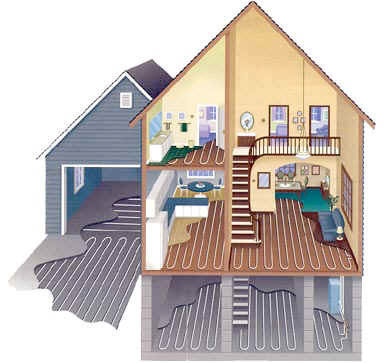
Occasionally I wonder if I have some sort of masochistic streak--somehow enjoying the grief I get when bursting people's favorite bubbles. I'll brace myself for such a response to this column, when I point out why radiant-floor heating systems don't make sense for new, energy-efficient houses.
Radiant-floor heating is a way of delivering heat through the floor--usually with hot-water tubing embedded in a concrete slab. It's a very popular heating system advanced by zealous proponents. If you want to pick a fight in the building industry, simply criticize such sacred cows as radiant-floor heating or ground-source heat pumps (stay tuned on that one).
Don't get me wrong. Radiant-floor heating makes a lot of sense for the right applications. In fact, I think it's a great heating system...for lousy houses. But with new construction, if the house is designed and built to be highly energy-efficient (something I always encourage as the number-one priority), it doesn't make sense.
Before explaining why radiant-floor heating is a poor choice in new construction, let me describe what I like about it. The heat is distributed over a large surface area, so it is delivered at a relatively low temperature. It's uniform, and it warms people directly, rather than having to heat the air. This means that radiant heat can provide comfort at a lower air temperature than is required with forced-warm-air or baseboard hot water heat. You might be able to keep your thermostat lower--say 65 degrees--and be perfectly comfortable with radiant-floor heating, while 68 or even 70 degrees would be required with other systems.
Most people with radiant-floor heating absolutely love the warmth underfoot; you can walk around barefoot even in the middle of winter. If we're used to drafty old houses, there's nothing nicer than a floor that's warm underfoot and gently radiates heat upward. Radiant heat also tends to have less of a drying effect than does forced-air heat. And because there aren't baseboard radiators, furniture can fit right up against the wall.
So, what's wrong with radiant-floor heating?
SUPPORT INDEPENDENT SUSTAINABILITY REPORTING
BuildingGreen relies on our premium members, not on advertisers. Help make our work possible.
See membership options »I have two concerns, both of which apply only to very energy-efficient--superinsulated--houses. First, in a highly insulated house (and I'm talking about a really tight house with at least R-40 walls, an R-50 ceiling, and triple-glazed low-e windows), such a tiny amount of supplemental heat is needed that a radiant floor needs to be kept no more than a few degrees above the air temperature--or else overheating will occur. If a concrete-slab or tile floor surface is maintained at 72 or 75 degrees, it will likely feel cool underfoot--since it's at a lower temperature than your feet. So you may not get that delightful benefit of a warm floor surface. And, if you're delivering heat to the floor during the nighttime, and then have significant passive solar gain during the daytime, overheating is likely to occur. In short, radiant-floor heating just isn't a good fit with superinsulated houses.
My second issue with radiant-floor heating has to do with economics. Radiant-floor heating systems, with tubing embedded in a concrete slab, multiple pumps for different zones, and sophisticated controls, will easily cost $10,000. I'd rather see someone spend that $10,000 on better windows, more insulation, and so forth--then recoup some of that extra cost by spending less on the heating system. Homes built to the rigorous German Passivehaus standard (which I'll describe in a future column) can be heated with, literally, a few incandescent light bulbs in each room. In a more typical superinsulated house, we can provide the desired comfort with one or two through-the-wall-vented gas space heaters or a few lengths of inexpensive electric baseboard heating element.
Again, these arguments apply to highly insulated houses--usually new construction--when you can pull out all the stops and far exceed typical insulation standards for New England. In existing houses or in new construction when fairly standard energy details are being used, radiant-floor heating makes lots of sense. In a house with a relatively large heating load, and especially in a drafty house, a radiant-floor heating system is a great option.
If you're thinking about radiant-floor heat for your current house, the challenge is that these systems are not easy to install in existing houses. I like to benefit from the thermal mass of a slab floor with embedded radiant tubing, and that's a difficult retrofit project. Some people use light-weight gypsum-concrete slabs that are poured over existing floors; others attach the radiant tubing underneath a wood floor or subfloor.
One last point: if you do install a radiant-floor heating system, be aware that it should be controlled differently than other central heating systems. The set-back thermostats I described in last week's column aren't effective. This is because these systems take a long time to warm up and cool down and are thus typically operated to maintain near-constant temperature day and night.
Published March 29, 2009 Permalink Citation
(2009, March 29). Radiant-Floor Heating. Retrieved from https://www.buildinggreen.com/blog/radiant-floor-heating



Add new comment
To post a comment, you need to register for a BuildingGreen Basic membership (free) or login to your existing profile.