Autoclaved Aerated Concrete (AAC): Will the U.S. Ever Lighten Up?
Lighter, more fire-resistant, and a better insulator, autoclaved aerated concrete caught on in the rest of the world ages ago. It's taking a lot longer in the U.S.
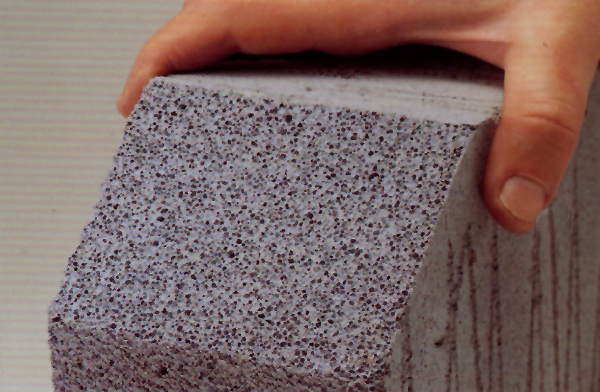
The porous AAC structure comes from being "leavened" with aluminum. Photo: H+H UK
To read what manufacturers and distributors say about it, you'd think autoclaved aerated concrete (AAC) was some kind of new, space-age environmental miracle.
Although it certainly has some nifty properties, AAC isn't new and isn't miraculous--but it's certainly popular in Europe, and has been for decades; according to one source, it accounted for 60% of all new construction in Germany in 2006. It has enjoyed pretty flat market share (of near zero) here in the U.S., though, since it was first introduced in the 1990s.
Is there space for AAC in the U.S. market? Should the green building community be working to make space?
How AAC is made
AAC is similar to other concrete types, except that it contains no aggregate; sand or fly ash is included, with aluminum powder added to react with one of these ingredients and "leaven" the concrete, creating tiny bubbles just like baking soda does when it reacts with the buttermilk in your muffin batter. (Your muffins are full of carbon dioxide bubbles, but AAC is full of hydrogen bubbles.)
[Note: Robert Riversong points out in comments that sand is aggregate, which I also thought when I started researching it, but after some more digging, my understanding is that the sand is used as a reactant and is therefore not considered aggregate in AAC. For more, see here.]
The concrete is poured into molds, left to rise, and then "baked" in an autoclave, which uses steam and pressure to complete the chemical reactions and speed up the curing process significantly--completing in hours rather than weeks. The resulting blocks are so full of bubbles that a block of the same size has about one-fifth the material required by regular concrete.
SUPPORT INDEPENDENT SUSTAINABILITY REPORTING
BuildingGreen relies on our premium members, not on advertisers. Help make our work possible.
Like conventional concrete masonry units, AAC is sold in a variety of block shapes and sizes, but unlike conventional units, most don't have cores. They are porous and light, like muffins, but not hollow.
Benefits of AAC
The main advantage of AAC when it was first developed in Sweden in the early 20th century was simple: it wasn't wood. It's still not wood, but in North America (unlike in Sweden at the time and in most of Europe now), wood is still plentiful and cheap.
Compared with conventional concrete, AAC still has advantages, though:
Despite the energy-intensive autoclaving process, manufacturers say it takes about 50% less energy to make, because of the lower portland cement content by volume (we're haven't found anyone to challenge those claims, but are still looking for data).
It's lighter, which cuts down on transportation costs and fuel use.
It's a better insulator, with a steady-state R-value just a hair above R-1 as opposed to something more like R-0.2 (neither of these factors in thermal mass, which we'll get to later).
There are few manufacturers in the U.S. (that was in 2006, and now there are almost none, since Xella has moved its Hebel operation to Mexico); this means higher costs, which is a huge barrier for adoption.
AAC requires a learning curve for builders, because the mortar application is more precise.
We would like to add a few drawbacks that we've found:
The barriers for builders don't stop with the mortar. According to Derek Taylor, owner of AAC distributor SafeCrete, the only manufacturer in North America right now is a German company whose block dimensions don't work for U.S. builders. These often need to be sawed, adding labor and fuss to a building system that's supposed to be simple. (Taylor's looking forward to two new plants coming online in the States in the next couple years.)
Since right now your AAC is most likely coming from Mexico, the advantages offered by lighter weight will diminish significantly as the mileage increases.
Thermal properties are better than those of conventional concrete, but they aren't good enough to make AAC a viable wall material (relative to BuildingGreen-recommended R-values) in most U.S. and Canadian climates without additional insulation. (The European climate, where AAC is popular, is milder.)
Unless rebar is added--which adds to the weight and amount of material in the blocks--AAC can only be used for low- and mid-rise construction. But it seems to be popular for single-family homes as well as schools.
Unlike conventional concrete, AAC can't be used as a finish; it is more porous and needs cladding or stucco on the outside so it won't absorb moisture.
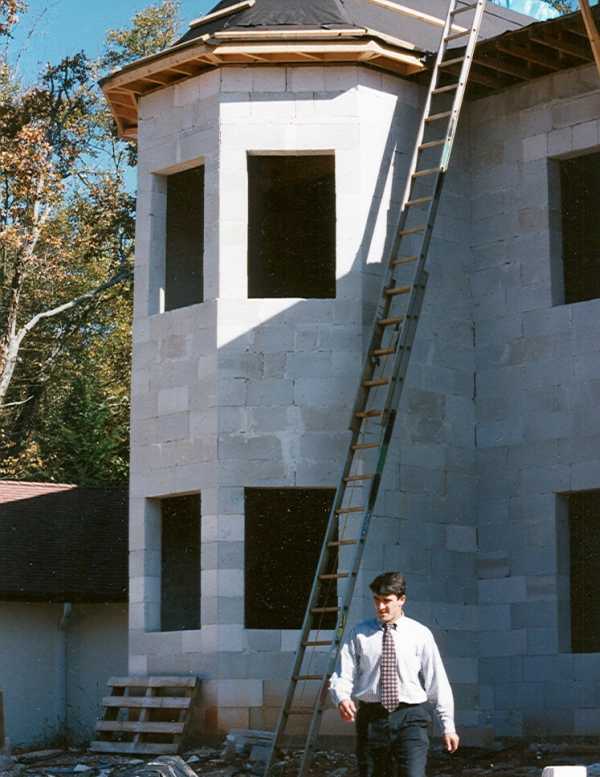
AAC is popular for residential construction but not suitable for high-rise buildings without structural reinforcement. Photo: SafeCrete
Would you use AAC?
That said, AAC does appear to have significant advantages for applications where conventional concrete would normally be the best material--like in the American Southwest and in other climates where thermal mass can increase the "effective" or "mass-enhanced" R-value of the wall. Even then, its performance may still be outmatched by that of insulated concrete forms, depending on the needs of the client.
Unfortunately, much of the information we have on AAC performance in the U.S. comes from manufacturers. We'd like to hear some empirical evidence from the field.
Are you using AAC on any of your projects?
If you've used it, how did it perform? If not, what would it take for you to try it out?
(2012, February 1). Autoclaved Aerated Concrete (AAC): Will the U.S. Ever Lighten Up?. Retrieved from https://www.buildinggreen.com/news-article/autoclaved-aerated-concrete-aac-will-us-ever-lighten
We built a small cottage in central Wisconsin with AAC purchased from SafeCrete near Atlanta. We also toured the Aercon plant in Florida, but the shipping distance was greater for us. Both businesses were extremely helpful. This is important especially because we were a small account. My husband and I built the AAC walls ourselves - which says how easy it is to do as we are "retirement age." Our profession is in IT, not masonry. The walls were incredibly square. For the exterior we used foam board under cladding (stone and cedar). One interior wall separates the garage from the living area.
Other benefits are...
- Adding wall tile to the interior surface - a breeze
- Using plaster for interior walls - marvelous
- Not having to look for studs to nail into, but attaching items where you want them, letting us fit items in the small utility room - fantastic. This was true with the cabinets in the kitchen & bath as well.
- The sound and fire insulative quality - super, especially for fire as we are in a forest area
- A tiled, low-walled walk in shower - no glass or curtains needed - plus serves as a shelf.
- If you estimate requirements well, there is very little construction waste.
- Low VOC, low pest invasion, low thermal bridging
We have in-floor electric heating but use primarily a small woodstove. I have no accurate numbers for energy use, but from looking at the bill and the woodpile, it appears to be very low. It is also very comfortable in summer.
In short, it’s an elegant wall sandwich and we are enjoying the comfort tremendously. We would like to build another and try some new ideas. We initiated, funded, and contracted the project ourselves. We did our own research and design. The building inspectors were most cooperative and showed a real interest.
Hi there,
15 years ago I built a strawbale house in VT and used AAC blocks (then manufactured by Ytong in FL) for all interior partition walls in the house.
They were easy to put up (I hired a mason to do part of that work) set directly on the slab with rebar drilled to hold the bottom in place) we site poured headers out of concrete where applicable, although Ytong offered precast options for those locations) I used 4", 6" and 12" blocks depending on the situation. There is plenty of load bearing capacity in AAC to substitute for a 2x4 or even 2x6 wall. In Germany AAC is offered in 3 or 4 different densities with higher R-values achieved in lower densities. R-values are similar to Mineral wool or Cellulose dens pack in the R3.5 range. Often houses will have a core of load bearing AAC with lighter elements up to 12" thick glued on the outside for an overall R-value in the mid 40ties. Air tight, not sure what the responder above means by saying that CMU andAAC is not airtight. Maybe not vapor tight, but air tight for sure. There have been numerous Passiv Houses constructed using AAC. http://www.ytong-silka.de/de/docs/Ytong_Multipor_WDVS_042010.pdf
I think the main adoption problem is that single family residential construction in the US is geared completely towards wood (maybe with the SW as showing some exceptions), there is not sufficient familiarity with masonry construction with architects and builders in that field. Urban construction where masonry is used a lot is dominated by the concrete and steel industries, for obvious static reasons. That leaves a comparatively small market of low-rise multi-party buildings.
To the responder from NM above: if you have mold on masonry, you have a leaking stucco system. AAC should not be finished with cement stucco, it is hydroscopic and not vapor permeable enough.
All in all I would build an entire house out of the stuff, it is easy to do yourself, even with only basic masonry skills, you can saw it by hand and glue it like foam blocks. If Xella starts offering this material in a coherent system again in the US it might catch on, but I think they have been too busy consolidating their AAC empire worldwide to pay attention and their web presence, marketing and sales strategies in the country have always been abysmal, my experience with them was before Ytong was bought up and was o.k. Later attempts to get information, pricing etc from Hebel have been terrible.
The sound deadening properties are o.k., I agree that they are not much better than a 2x6 wall insulated, but they retain heat much better.
I currently live in the American Southwest, in an adobe house, with a one-room addition built in AAC, as well as a small AAC outbuilding. If this region is supposed to be the best for AAC, then I marvel that AAC is accepted anywhere.
We have moisture problems, cracking, and spalling. This is the only room in the house which shows interior mold on the walls, a rare problem in this climate. Many of the AAC blocks appear to have been physically damaged during transport or installation, especially in the outbuilding. Perhaps the builder sorted out all the broken or nicked blocks, and intentionally used them for that building, but the damage rate was apparently high. Even with our dry climate, I think these AAC blocks need more moisture and rain protection than the cement stucco that they have. I think the spalling has been caused by absorbed water freezing in the bricks.
The supposed insulation value, which the builders and manufacturers tout, is clearly insufficient for this climate, both winter and summer. If there is any thermal mass effect, it is not sufficient to make this room comfortable without supplemental heat or cooling, three seasons a year. Our Spring's large daily temperature swings would maximize the supposed thermal advantage, but this room still needs heat.
While they must offer some soundproofing, our AAC blocks don't strike me as particularly effective. It's easy to compare to the adjacent adobe walls, and the AAC is much less effective at curtailing sound transmission. Based on my experience, I think these AAC blocks transmit sound better than brick, CMUs, or strawbales. They don't seem that much different than insulated, cement-stuccoed 2x6 frame walls, although somewhat better than 2x4 walls.
I don't know how our AAC blocks compare with those of other manufacturers, but I am not tempted to use them in the future.
"...These often need to be sawed, adding labor and fuss to a building system that's supposed to be simple." That's no different than working with timber, and you can use the same saws - they get blunt quicker, sure, but they'll cut AAC pretty well even when blunt.
"Since right now your AAC is most likely coming from Mexico, the advantages offered by lighter weight will diminish significantly as the mileage increases." This is a purely US disadvantage - until you start producing it at home again.
"Thermal properties are better than those of conventional concrete, but they aren't good enough to make AAC a viable wall material (relative to BuildingGreen-recommended R-values) in most U.S. and Canadian climates without additional insulation." So what? Most external walls need some additional insulation - the question is: how much?
"The European climate, where AAC is popular, is milder." Tell that to the folks in Central Europe, where winter temperatures regularly get down to -20°C and in the current cold snap have been down to -39°C.
"Unless rebar is added--which adds to the weight and amount of material in the blocks--AAC can only be used for low- and mid-rise construction. But it seems to be popular for single-family homes as well as schools." It's not intended for high-rise construction, is it? For low- and mid-rise construction it does pretty well; and for high-rise it works for non-load-bearing walls - and is also frequently used for interstitial services floors. Also, it can be produced with integral reinforcement - but usually mesh, not rebar.
"Unlike conventional concrete, AAC can't be used as a finish; it is more porous and needs cladding or stucco on the outside so it won't absorb moisture." Just like CMUs.
Tony, do you have any theories on why AAC hasn't caught on in the U.S.? I see your logic, but that still leaves me wondering why it's not more popular, given its advantages.
Robert brought up a good point about the sand, and I've added something to explain that. Someone with a background in the chemistry of concrete might have more to add, which would be great. I think it is mainly a question of semantics.
Yusuf, I think that suitability for moist climates would depend on what's in the rest of the wall assembly. If it has drying potential, then moisture shouldn't be a problem, but if you started introducing materials that act as vapor barriers, the results might be harder to predict.
we have used it in a couple of projects. Once for a 2 family home, where we used 8" block with a sider-oxydro stucco finish. We had some leak issues, and i've been concerned that with the bond beams and reinforcement and cored blocks that the R value is often compromised. The client is happy though with the tightness of the house and feels it doesn't cost much to heat.
We are also using 12" blocks as back up for brick and for a trespa rain screen on a project going up now in NYC. Masons said it was easy to work with. We haven't had any issues yet, but have had to be careful they use the right screws for brick anchors etc. These are face mounted, and the size of the block has not been an issue - its been easy to channel out for electrical fixtures etc. We chose it for insulation and lower embodied energy reasons, although now we would make sure we added another layer of continuous insulation.
"•Unless rebar is added--which adds to the weight and amount of material in the blocks--AAC can only be used for low- and mid-rise construction. But it seems to be popular for single-family homes as well as schools."
You may want to check building codes in earthquake areas before recommending unreinforced masonry (URM). California has made many owners spend lots of money in the recent past to strengthen URM structures, many low-rise. Building schools with URM today seems a particularly good way to get big headlines after an earthquake.
AAC worked wonderfully well for us in India. We have been able to do away with insulation altogether in our projects. Thereby justifying the additional cost over flyash and red sand bricks. I did know about the substantial increase in thermal conductivity with such little increase in moisture content. So does this mean that AAC blocks may not be suitable for coastal regions?
First, I don't used buttermilk in my muffin batter, nor do I use baking soda – most bakers use baking powder with aluminum compounds, which may be linked to Alzheimer's disease – I use non-aluminum baking powder. And my muffins are not "porous and light" but rich and dense.
You say that AAC is "similar to other concrete types, except that it contains no aggregate; sand or fly ash is included". You mean it contains no coarse aggregate, since sand is fine aggregate, and the mix won't harden into calcium silicate hydrates without the silica. While the reaction produces hydrogen bubbles, it is exchanged with air before use.
AAC is somewhat porous, depending on the precise mix, density, size and configuration of pores, and it's certainly not an air barrier by itself – any more than are CMUs without a stucco coating.
While the R-value is approximately a 10-fold improvement over conventional concrete, because it's so porous and hygroscopic AAC will increase 42% in thermal conductivity with each 1% increase in moisture content by weight ("Structure and Properties of Aerated Concrete: a review", N. Narayanan, K. Ramamurthy, Building Technology and Construction Management Division, Department of Civil Engineering, Indian Institute of Technology Madras, India, 1999).
And the thermal mass value is quite poor – about double that of packed snow (the thermal mass index, which is the product of thermal conductivity and volumetric heat capacity, is about 1/60 of concrete). "In consistently cold climates, the savings may be somewhat less because this material has lower thermal mass than other types of concrete." - Portland Cement Association
Additionally, it's probably more appropriate to compare embodied energy with CMUs, not poured concrete: "…with respect to embodied energy, AAC consumes approximately 50% and 20% less energy than that needed to produce concrete and CMUs, respectively." - Autoclaved Aerated Concrete as a Green Building Material, Stefan Schnitzler, October 2006, UC Davis Extension.
So it's no wonder that AAC has not caught on in the US. The advantages are highly overrated.
I am a commercial builder in Maryland. We tried to use AAC on two projects several years ago. We could not get pricing quotes from suppliers either time despite a great deal of effort on my part. I really wanted to try this stuff out. I had a couple of masons convinced as well. But lack of pricing meant one project went to CMU and the other to GWB. Sorry to throw the suppliers under the bus, but...
I wanted to use AAC for the demising walls on some high end condos. The fire ratings and high sound proofing would have made for a great wall. But without pricing we went to GWB with some special details.
I think AAC would be a good substitute for CMU walls, but if you are using concrete for a wall you are probably picking up some serious loads and AAC likely won't cut it.






Add new comment
To post a comment, you need to register for a BuildingGreen Basic membership (free) or login to your existing profile.