A lot of people still point to products like early water-saving toilets, compact-fluorescent lamps, and recycled-plastic-lumber decking as evidence that new-fangled green products don't work very well. Clearly, there were some poorly performing products out there as manufacturers scrambled to respond to consumer demand and new regulations. But, for the most part, we've climbed up that learning curve, and current-generation products work very well.
Let's take a look at the history of a few of these product categories.
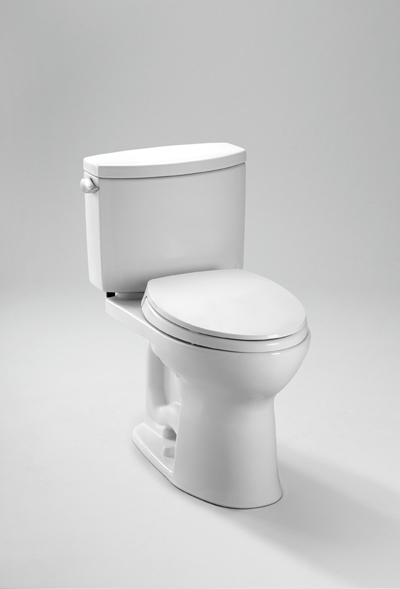
Low-flush toiletsThe Energy Policy Act was signed into law in 1992 with a requirement that all toilets sold in the U.S. had to use no more than 1.6 gallons per flush (gpf) by January, 1994. That wasn't much time for the plumbing industry to redesign their toilets, and many of those early 1.6-gpf toilets were indeed pretty unsatisfactory, requiring double flushing and frequent cleaning.
The problem was that those first low-flush toilets weren't designed from-the-ground-up to use 1.6 gallons for a flush; they were older toilets with bowls and trapways that had been designed to use 3.5 gallons or more; the only change was a modified flush valve that reduced the flush volume. Industry got the message loud and clear, and later models were designed to flush very well with 1.6 gpf--and some with even less. A new test procedure for toilet performance (Maximum Performance or MaP testing), introduced in 2003, helped manufacturers design better toilets by more accurately measuring flush performance.
The bottom line is that complaints about new 1.6 gpf toilets have largely disappeared and, in fact, a new generation of "high-efficiency toilets" (HETs) that use even less water (HETs are defined as using at least 20% less water than the federal standard, or a maximum of 1.28 gpf) often actually outperform those 3.5 gpf toilets that were on the market in 1990. We're using far less water today and getting better performance.
Compact-fluorescent lampsEarly compact-fluorescent lamps (CFLs) used magnetic ballasts causing the lamps to blink as they switched on, then flicker 60 times a second and buzz or hum during operation. New CFLs all use "electronic" ballasts that switch on instantly and eliminate flickering and buzzing. The light quality has also improved. The phosphors (the coatings on the inside of the glass that absorbs the UV light given off by the energized mercury vapor gas and emits white light) used in most CFLs today produce warmer light that makes objects look more realistic. The light quality from the best CFLs today nearly matches that of incandescent light bulbs.
Recycled-plastic lumberThe first recycled-plastic decking was made from 100% recycled plastic--usually high-density polyethylene (HDPE). The decking planks were very heavy, usually black, got really hot in the sun, and softened to create undulating deck surfaces. Today, most recycled-plastic decking is made of a composite material, with both waste wood fiber and recycled HDPE. The wood fibers increase the decking strength and reduce thermal expansion, so sagging is less of a problem. It's a much better product.
SUPPORT INDEPENDENT SUSTAINABILITY REPORTING
BuildingGreen relies on our premium members, not on advertisers. Help make our work possible.
Low-VOC paintsEarly efforts to reduce the volatile organic compound (VOC) content of paints to improve indoor air quality led to compromises in performance. The solvent-based products performed much better even as they gave painters headaches and likely contributed to health problems among homeowners. Over the past 10- 15 years, though, the vast majority of R&D work going into paint technology has been focused on acrylic-based, low-VOC products, and performance has dramatically improved. Indeed, there are now zero-VOC paints that satisfy the toughest performance standards of the paint and coatings industry. New and improved products continue to appear almost monthly.
* * *
I've reviewed just a snapshot of product categories here. The point is that the manufacturing industry has responded to consumer and regulatory demand for greener, more-efficient, healthier products. While there are still green products whose performance isn't where we'd like it to be, most green products work very well today. And we can look forward to continued improvement in the years ahead.
I invite you to share your comments on this blog. Do you think "green" product performance is improving? Are there examples of continuing performance problems among green products?
(2010, March 16). Green Building Myth #3: Green Products Don't Work as Well as Standard Products. Retrieved from https://www.buildinggreen.com/blog/green-building-myth-3-green-products-dont-work-well-standard-products
If a CFL is used for more than 50 hours (which is very likely) than it outperforms an incandescent on a life-cycle basis.
It would be great to get the mercury out of efficient lighting, but it's more urgent to get it out of the whole product life cycle, including power plan emissions!
I noticed that when I corrected you with back-up documentation you still dislike CFL's and made new reasons for your dislike. I feel you will always dislike CFL's no matter what information I can provide and how many of your points I address.
The levels of mercury are very low in modern CFL lamps. But people are scared of mercury no matter the amount. The detailed instructions for cleaning up a broken lamp are for addressing these fears people have. They can be summed up as, open a window and use a damp cloth to clean up the mess. Hardly an ecological disaster. But good use of imagery to make your point.
Statistics are an interesting area. I can show that eating 1 serving of fish a week (at EPA safe limits) for a year and you will consume 3.5 mg of mercury. That's direct ingestion of mercury into your body. And you're worried about breaking a lamp and spilling that much or less in your home. Like I said, the levels of mercury are so small that they should not be feared. Take reasonable precautions, but don't fear it.
Regarding the total energy used in temperate climates. I'd love to see any information you have to support this position. I might never turn off my lights during the winter. When the A/C is running do we change all of the lamps to CFL? Is my energy star TV and refrigerator now increasing my home's heating bill too?
The info I found shows that CFL's save about 17% total energy in Canadian homes. 24% if there's A/C. Natural gas heating will see gretater savings. What have you got?
I can vouch for using CFL lights. I recently bought a CFL Torchiere Floor Lamp for my wife and she freakin' loved it! The price seem more normal these days, a solid lamp can cost you round $200. Looks good and saves money.
I enjoyed reading the article - particularly the vast amount of text concerning what to do if one of these "energy-saving" CFLs breaks and creates an ecological disaster within your home.
As for the mercury emissions saved because the CFL uses less power, in temperate climates this is a fallacy. Why? Because the heat given off by the incandescent contributes to heating the building (particularly in winter!). If you use a CFL, you only have to burn the equivalent amount of fuel at the power station to run the make-up electric heater.
CFLs are still an ecological disaster: non-recyclable; contain poisonous mercury; far more embodied energy than an incandescent bulb - and still take far too long to reach full brightness (try using the bathroom in the middle of the night!). The brightness comparisons with incandescents are also typically misleading.
CFL's put LESS mercury into the environment then typical incandescent lamps. By a 1:2 ratio per the EPA. See here for your reading enjoyment. http://www.energystar.gov/ia/partners/promotions/change_light/downloads/...
It's different a people seem to hate change. Like all things there are some benefits and some negatives to different technologies. Many can't get past the desire for instant on and instant full brightness. Buying the cheapest CFL's doesn't help improve their opinion.
The whole mercury content issue seems to be a more recent issue that's getting raised more and I think is a sales tactic for many LED manufacturers. A small percentage of the mercury in the lamp becomes pollution. Most ends up trapped inside of the glass. What does get out is focused in a landfill. Coal plant emission which goes everywhere, is a much larger share of the total mercury pollution, and seems to be ignored by most people.
I'm sorry you feel that way, Bill, but I'm not "messing with you" or "spreading false information" - I'm just putting the case from my side of the fence as I see it. If what I say makes CFLs sound really scary, it's because in my view they are.
You may well not believe what I say about the effects of minuscule amounts of coherent radiation - I'm sure there are many thousands of people that won't; but the mobile phone industry is still doing its utmost to play it down, despite increasing medical evidence to the contrary (check out a negative TNO report that disappeared from the Web after only 2 days).
As for wearing a foil cap, no, I don't... but I did seriously consider papering the ceiling of my rented apartment with it, when the landlord agreed to letting a mobile operator set up a base station on the roof.
The local telecoms operator posted a notice saying the radiation level had been tested and found within accepted safety limits and I haven't felt any ill effects so far (I'm covered by 3 reinforced concrete slabs anyway), so I don't worry about it... but I do worry when my head feels warm after a long mobile phone conversation with one of my colleagues when I haven't got my headset handy.
And that apartment is full of fluorescent tube lights that I've been happily living with for the last 15 years (with replacements I can count on less than the fingers of 2 hands)... but I wouldn't give a CFL house room.
I agree: when it's all been said, it's time to move on.
But here's a parting thought "out of left field": the lighting manufacturers getting the UK government to pass a law to force everyone to buy CFLs to save energy is the same as the NRA getting the US Government to pass a law to force every US citizen to buy a gun for protection. Isn't it?
I addressed everything I understood from your mass of text.
I refute your comments and you agree with just about everything I say. For every one point I call you on you raise 4 new points and with such intensity like we're talking life and death. Based on what you say CFL's seem so scary you'd expect bodies to be pulled from houses like we were in the Bubonic plague.
Your main point right now seems to be that you think, with admittedly zero reason, that minuscule amounts of UV flashing on our skin may make us sick. And a normally operating CFL and incandescent does not have a noticeable strobe. If this was really such an issue for you not liking CFL's I would have expected to see it raised in the first 3 of your posts. This is right up there with wearing foil on our heads to keep our thoughts safe. How can I refute that. It's just silly.
I'm trying to help educate people who want to learn. I don't like seeing false information spreading and scaring people so I address it where I can. You seem to just like messing with me so I'm considering my side of this debate over.
I’ve just been surprised at the strength of your opinion that CFL’s are bad even though you admittedly have questions, not data, to support your opinion. I would understand doubt and skepticism of CFL benefits. But insistence CFL’s are bad no matter what seems extreme to me. Asking questions and doubting what is “fact” I think is good and should be done more. I have many opinions that are considered wrong by the general public and by experts in my own field.
- That T5 and T5HO lamps are less efficient then standard T8 lamps.
- That LEDs are currently less efficient than T5’s or T8’s.
- Constant light Sports lighting systems do not save money.
- Incandescent lamps create more mercury pollution than fluorescent lamps.
We have to be willing to admit we’re all just learning. Sometimes we are right, sometimes we are wrong, it happens. My personal philosophy is that when I am in the minority opinion the onus is on me to prove my point. Asking lots of questions does not prove my point. I’ll state my opinion if the subject comes up but I don’t insist others are wrong because they can’t convince me that I’m wrong and I’m not able to prove I’m right. That’s just me.
It’s odd to me that questions are asked, answers provided. New questions asked, new answers provided. And again more questions are asked. I love a good debate but it’s frustrating from my point of view that this debate feels one sided. You probably disagree but this is how it feels to me. A lot of the questions are good, but the reasons to ignore the answers seems confusing.
Why does it matter how many CFL’s are in the study home? It could be 1 or 100. An energy savings was shown. And shown in Canada. I see no support for your view that this is only a savings in Florida or other A/C only environments. If a home is always, 100% of the time, in a heating mode I can see the argument you are making. And only if the heating is electric. But even in Canada, during the summer, the heating is turned off. Where I live in the Mid-West the furnace is on only 4-5 months during the year. The other 7-8 months the waste heat from an incandescent lamp is just waste energy. I don’t need A/C to see a savings.
Five CFL’s are in the study because a typical house uses 5 lamps significantly more than the other lamps in the house. The rooms that we use the most. This higher use means it has the fastest payback. And a 2-year payback, in a heating climate, is good. We can expect better results in the US. My customers would be thrilled if all of the suggestions I gave them only had a 2-year payback.
Stuff goes in the garbage and into the landfill. Not ideal but it happens more than it should. Do we fault a product because of this? Does the insistence that every element get recycled at end of life influence your purchasing decisions in every product you buy? Just buying a cell phone would be a nightmare. This is a whole level of scrutiny you are applying to lamps that seems unjustified. I don’t know anyone who recycles incandescent lamps. And CFL’s only get recycled because of the hype about mercury. (I notice big orange lets people drop off lamps for recycling) So the focus is on capturing mercury and not every other item in the lamp. Insisting that every last bit of a lamp is recycled is not a realistic part of the total cost in the life cycle of this product because it never happens. I haven’t seen you raise this end of life cost concern with any other product mentioned on this site. So why raise it for CFL's?
If I had to give my personal order of overall preference in light sources it would be linear fluorescent, MH, LED, CFL, incandescent, HPS. I use them all. But each has its place. CFL is not even in my top half. I’m sure other lighting designers would order this list differently because different things are important to them.
Total Mercury Pollution: Less with CFL than Incandescent
Total Energy Use: Less with CFL than Incandescent
Total Cost: Less with CFL than Incandescent
Instant On: Better with Incandescent
Color Quality: Better with Incandescent
Total Waste: Probably more for CFL
UV light: Minimal for both
Fine, you don’t like CFL's because of the lamp warm up time and the lower color quality. Personal choice. I would rather save money. And I have seen nothing showing that CFL’s don’t save money in my home.
I have downloaded both the highlight and full versions of the Canadian document.
First of all, it confirms that when heating, what you gain on the swings you lose on the roundabouts. However, over a whole year, in a climate where there's some summer cooling with a/c, there will be an overall saving of energy (less if you don't use a/c).
However, the study related to only 5 CFLs in the test house and - based on CFL costs in 2005, when the testing was carried out (and CFLs were admittedly more expensive than they are now) - the payback period was 2 to 6 years.
Not very impressive, is it?
I also downloaded the 'dust-to-dust' article, which I will need to go through in detail to sort the wheat from the chaff. On a first scan, I can go with about 50% of it. However, what it says about recycling I find problematic:
It assumes that the recycling energy cost for a CFL will be the same as that used for its production - but that's a fallacy, because you just can't recycle all the electronic gubbins or the mercury & phosphor-contaminated glass.
It then puts the recycling cost for an incandescent at zero, because "you throw it to landfill", when an incandescent is easily 100% recyclable - just using a little heat:
first the contact solder melts and can be recovered and re-used
then the _uncontaminated_ glass melts and can be re-used
then the brass cap and contact(s) melt and can be re-used
then the filament support wires
and last of all the tungsten filament wire - also re-used
Sorry! I forgot the argon gas filling - that goes back home to the atmosphere, where it came from.
And the bit of colored glass or ceramic that seals the cap to the base - let's not forget collecting that final residue for recycling as hardcore.
So, which one is _really_ greener?
By the way, I should mention all the reports about skin and eye damage from CFL lights (the UV spill is stronger and more concentrated than that from a fluorescent tube, because typically closer to you), and the documented effects on people with epileptic tendencies (again because all the mains-frequency flashing - the phosphor remanence only damps it a bit - is concentrated within your field of vision rather than above and mostly beyond it for the typical tube light).
Fancy changing to LEDs? Just make sure that any LED light you buy has the device well diffused and/or shining via (not in front of) a reflector, because the light is near-coherent and akin to that from laser pointers, which carry all sorts of health and safety warnings.
Don't believe me? Just wait until you're stuck in a traffic jam behind one of those nice new models with a spray of piercingly bright red LEDs as stop lights....
Latest news (per BBC World News, April 12:
Philips admits that "green" lamp bulbs can interfere with some TV remote controls.
If that doesn't make "Joe Public" sit up and take notice, I don't know what will.
Waiting 2 minutes (not unusual) for a 15W CFL to warm up to full brightness uses at least 15 times as much energy as clicking a 60W incandescent on for 2 seconds for a quick glance at something.
I thought we were talking residential. > We were, but there's so much more to the CFL story...
There are no safety concerns with the 60 Hz strobe effect. > Really?
There are no health concerns with the 60 Hz strobe effect. > I happen to think so. You evidently don't.
I don't see any strobe effect in CFL's. > I did say it was possibly noticeable during the long startup period.
Only linear fluorescent with magnetic ballasts have a noticeable strobe effect. Change to electronic ballasts and the frequency is at 20,000 Hz or higher. Very far outside of our perception range. > True, as long as everything is working as designed.
A self ballasted CFL has no ballast factor. > I'll check some manufacturer's data sheets but agree that if you're going to design such an animal, you might as well do it properly.
The ballast factor is 10% for magnetic ballasts for linear fluorescent or HID lamps. > Not according to the HVAC books.
Power Factor is irrelevant to residential customers. We are billed for Wattage used. 0.6 leading, 0.6 lagging, or 1.0 will all show as the same price. > Maybe so; but that doesn't mean to say that if the power factor of millions of domestic CFLs isn't 1 it won't have an effect at the power stations.
The inside of a CFL is nearly a vacuum to force the mercury into a gas state at room temperature. 4 mg of mercury is about the size of the point of a pen. At end of life most of this mercury is embedded in the glass. There's not much to spill. > True; but please read my remarks on mercury and multiply that 4mg by the millions of CFLs that it seems are likely to fail long before the manufacturers say they will.
Incandescent lamps create as much UV as an average CFL. > I still don't (not won't) understand this, given that the CFL generates native UV and the temperature of an incandescent filament is relatively low. I'll have to see if I can find a source of comparable output spectrum data for various types of lamp.
Strobing vs constant has no health impact. > I happen to think so. You evidently don't.
Total accumulated UV does have health impacts. > Yes: melanoma, which is particularly nasty and becoming more prevalent as people like myself who when young reveled in Mediterranean sun grow older.
1 minute outside is more UV exposure than 8 hours inside. > In total quantity, yes; but I already stated my reasons for believing that the indoor UV is more dangerous. If you don't believe me, that's your business.
There are higher UV levels in Saudi Arabia than Scotland. Twice as much. > You can't pro rata the levels and relative amounts of the different types of UV at ground level according to the relative total solar irradiation levels in those two locations. I'm speaking from personal experience here. The real figures must be somewhere on the Web.
A coal fire power plant is about 37% efficient. Only if it's not CHP.
If your CFL's fail quickly consider buying better quality lamps. If your car keeps breaking do you go back to riding horses or look for a better car.
> Kindly refrain from casting aspersions upon my wife's veracity or her ability to tell supposedly good quality products from lesser material. CFLs - at least the twirly tube parts - must be failing with monotonous regularity for there to be several web pages giving instructions for recycling the still good driver electronics in the bases to drive the evidently much more reliable straight 20W tube lamps.
And how should one respond when you write say you will always dislike CFLs no matter what information I can provide and how many of your points I address.
A word came to mind with this definition:
"A false belief strongly held in spite of invalidating evidence"
I thought we were talking residential.
There are no safety concerns with the 60 Hz strobe effect.
There are no health concerns with the 60 Hz strobe effect.
I don't see any strobe effect in CFL's.
Only linear fluorescent with magnetic ballasts have a noticeable strobe effect. Change to electronic ballasts and the frequency is at 20,000 Hz or higher. Very far outside of our perception range.
A self ballasted CFL has no ballast factor. The ballast factor is 10% for magnetic ballasts for linear fluorescent or HID lamps.
Power Factor is irrelevant to residential customers. We are billed for Wattage used. 0.6 leading, 0.6 lagging, or 1.0 will all show as the same price.
The inside of a CFL is nearly a vacuum to force the mercury into a gas state at room temperature. 4 mg of mercury is about the size of the point of a pen. At end of life most of this mercury is embedded in the glass. There's not much to spill.
Incandescent lamps create as much UV as an average CFL. Strobing vs constant has no health impact. Total accumulated UV does have health impacts. 1 minute outside is more UV exposure than 8 hours inside.
There are higher UV levels in Saudi Arabia than Scotland. Twice as much.
A coal fire power plant is about 37% efficient.
If your CFL's fail quickly consider buying better quality lamps. If your car keeps breaking do you go back to riding horses or look for a better car.
As a consequence of your screed, it seems I have to go into a lot more detail in order to - hopefully - swing you over to my point of view, or at least have you understand it. I just hope that Justin will tolerate me using all this blog space...
Firstly, let's look at credentials. It seems from your last posting that you're a lighting designer, so the legally enforced change to CFLs is going to have a big effect on your business. I reckon that must influence your position to some extent. As for me, I'm a mechanical engineer, working in construction and mostly involved with HVAC, so lighting has quite an influence on my designs. However, when it comes to CFLs, what I set out is purely my view as a "regular Joe" with a bit of accumulated technical knowledge.
So, what is my view? You were right when you wrote: "I feel you will always dislike CFLs no matter what information I can provide and how many of your points I address."
I regard CFLs as at best little short of "greenwash." At worst, they are the biggest scam of the last few decades, perpetrated upon an unsuspecting public by means of a concerted effort by profit-hungry lighting manufacturers, who have managed, by massively over-hyping their energy savings in use while keeping quiet about their many negative points, to hoodwink governments worldwide into introducing legislation that is nothing less than draconian, in order to eliminate from the market the humble, totally innocuous and above all extremely cheap (because of extremely low manufacturing costs and extremely low profit margins) incandescent lamp.
There's nowhere to hide any cream in a regular bulb; but the CFL was introduced as an "all-new", "green" and "high-tech" product - a "must-have" for well-heeled "early adopters", who were ready and willing to accept the correspondingly high price point. And that point was set at a level which allowed for the application of generous dollops of cream at each of the many stages of the much more complicated production process, with nobody outside the business to be any the wiser. The price of CFLs has come down since, as the early, expensive ceramic bases were changed to squirt-molded plastic - but there's surely still plenty enough cream left. Consequently, legislation to outlaw incandescent bulbs effectively gives the CFL makers "a license to print money" - at the consumer's expense. And while Western consumers may grumble and pay the price to avoid falling foul of the law, if the same legislation is passed in poorer countries, their populations will be sorely pressed.
If you don't believe me, just look at the iPhone and the furor generated among the early adopters when Apple later slashed the price, because it was "taking off". The big drop in price didn't exactly harm Apple's performance, did it?
Is that rabid enough for you? If you think so, you may as well not bother to read what follows, because you will never believe it. Anyway, here goes...
Firstly, please read what I wrote concerning CFL energy savings. I did freely admit to Justin that there was an annual saving over incandescents, which was bigger if lighting was in use together with a/c in the cooling season; but the Canadian figures also bore out that, during the heating season, if you used CFLs instead of incandescents, whatever energy you saved had to come from the heating system instead.
Now, let's look at heating energy.
If you use electric heat - as we do here in Saudi Arabia, because practically nobody in a regular home has oil or gas heating and there's no coal - the power station doesn't care whether it's feeding a lamp or an electric heater - except that a regular incandescent lamp has a very nice power factor of 1 but that of a CFL (and any other type of fluorescent tube lamp) is lower. Industry typically fixes this problem by using the leading power factor of fluorescent tubes in the workplace to offset the lagging power factors of production machinery motors, so that the power station sees the factory as a load with a power factor of approximately one; but that won't happen in regular homes. So what is going to happen to the efficiency of the power generation and distribution networks when all those incandescents get forcibly changed to CFLs with no lag to balance them out?
Did I hear you say that that's part of the job of all that electronic gubbins in the base of the CFL? If in my HVAC calculations I have to make a 25% add-on "ballast factor" for regular tube lights with lagging iron chokes, are you going to tell me that CFLs will really be any different?
By the way, I had better mention in passing what you must know but folks reading this may not: that industrial fluorescent lighting fixtures typically have three tubes. Why is that?
When an incandescent lamp is switched on, the filament very rapidly heats up to its working temperature. When Thomas Edison (or Mr. Swan in UK, if you prefer) invented this type of lamp, he was generating direct current. So, the current through the lamp was practically constant, as was the light output (a few years ago there was still an Edison carbon filament lamp burning in a fire house in San Francisco). With the advent of alternating current supplies, courtesy of Mr. Tesla, while the current now varies with the voltage - from 0 to maximum and back twice per cycle at 50Hz (UK) or 60 Hz (USA) - happily, thanks to the thermal storage of the filament metal, its temperature varies far less and the light output changes very little. To the human eye it is effectively dead steady (but not if you make the frequency any lower).
The fluorescent is a different kettle of fish: it "fires" the mercury vapor to produce a flash of UV 100 or 120 times a second - each time the voltage gets high enough; but that flash is cut off as soon as the voltage drops again. The UV is useless to us, because we can't see with it (insects can), and dangerous to our eyes and skin; but it is converted to visible light by "exciting" the phosphor coating on the inside of the tube. Although that phosphor has a remanence, so that it still puts out some light between flashes, the visible light from fluorescent tubes still flashes more than an incandescent, and at "mains frequency".
This is dangerous in industry because, like a "strobe lamp" it can make any machinery rotating at "synchronous speed" - 1500 or 1800 rpm, or some multiple or sub-multiple - look as if it is still, or only rotating very slowly. However, long ago industry began to use 3-phase electricity supplies for big motors to produce more even power; and for the same reason putting 3 tubes, one connected to each phase, in an industrial light fixture produces more even light - good enough to make the strobe effect unnoticeable.
What has this to do with CFLs? Just that they don't work on 3 phases, so you get the same mains frequency flashing as in a tube light - an effect which you don't consciously notice, because of your eye's remanence, but is there just the same.
Many people complain that fluorescent lighting isn't as easy on the eyes as incandescent. If you've read this far, you now know exactly why. Now, whereas a tube light is generally high up on the ceiling - above your normal line of vision - and typically four feet long - mostly out of your field of vision, a CFL, which is designed to be a "drop-in" replacement for a regular incandescent bulb, is likely to be much closer to your eyes, and concentrates all that flashing entirely within your field of vision.
Yes, I have read the articles which say that, because a CFL works on a much higher frequency than "mains" in order for the electronic ballast in the base to be feasible, the flashing effect is much less noticeable than in a regular tube light; but there are also plenty of admittedly anecdotal reports from people who still find this a problem with CFLs, possibly mostly during their extended warm-up time.
Although a CFL is typically rated at 10~15W against 40W for a typical tube, it's not the amount of light that is the problem but the flashing and the UV spill.
The retina of your eye contains thousands of light sensors called rods (for brightness) and cones (for color). When you turn on an incandescent lamp, its steady light means that these sensors can register a brightness value and adjust to it - once, until you switch the light off again. Not so with the flashy fluorescent - it forces the rods and cones to be permanently trying to follow the "bumpy" brightness level. Is it therefore any wonder that incandescent light is generally reckoned to be "softer" and "easier on the eyes"? I'll leave it to the health science people to investigate whether there's any correlation between the incidence of fluorescent lighting over the years and the proportion of the population requiring spectacles.
As for UV spill, when looking at the Canadian data I find it hard to understand how an incandescent bulb which natively gives of visible light can come in the middle of the UV power generation range of a load of CFLs which natively generate UV and have to convert it to visible light. Nor can I fathom how it can produce more UV than a metal halide lamp which works at much higher filament and color temperatures, unless the MH bulb envelope is extremely efficient at cutting the UV down. I doubt it because, when MH lamps first came out, they all carried warnings about not looking directly at them because of their UV generation. You can call me a conspiracy theorist if you like, but it would have been difficult to push through legislation forcing the adoption of CFLs, wouldn't it, if that Government's own research facility couldn't provide the evidence to back it up?
And while we're talking about electronic ballasts, I had better mention that I first heard about these devices when at college back in the mid-60s. The principle which allowed a set of capacitors to look like an inductor (the iron choke in a tube lamp) was well-known; but implementing it in practice wasn't possible, because the capacitors needed at mains frequency would have been physically huge. A few decades later and the appearance of high-capacity, small size capacitors, coupled with the vast reduction in size of electronics through development of the now-ubiquitous silicon chip, not only made the mobile phone pocketable and affordable - but also made the CFL's high-frequency electronic choke feasible.
Let's get back to the main track...
You want to use fossil fuel instead of electric power to make up the lost incandescent heat? Feel free to do so; but first, is your home furnace which is just used for heating really more efficient than the power station which, these days, if it's CHP, is making use of 85~90% of the energy in its fuel and delivers the "P" with 10~15% line loss (less if it's local and much less if the utility is thinking ahead and installing superconducting feeders).
You could, of course, choose to use a much more efficient condensing boiler to run a central heating system (not to mention that these new-fangled devices are notoriously finicky and need difficult and expensive regular servicing)... but don't forget to account for the "overhead" power of the boiler burner and blower and the water circulating pump.
Isn't it amazing how complicated things start to become, when you start looking into every little detail?
Ah, yes - the mercury question. Based on using electric heat, I said the savings with CFLs were a fallacy. True for the heating season only, I have to admit - that was borne out by the Canadian figures - and also only on the assumption of coal-burning power stations, as I am pretty sure there is far less mercury in fuel oil (perhaps not much less in the heavy "residual" grades) and practically none in natural gas or LPG. I guess I have to give a bit on that one. However, let's also look at the environmental issues.
We get uptight now about the spillage of mercury if a CFL should get broken in the home, and the Health and Safety rules for cleanup are horrendously complicated - but that's now. Where were they when fluorescent tubes, which contain just as much mercury and probably considerably more, first came on the market? Back then, people were aware that these lamps contained mercury; but mercury was an everyday thing. Many thermometers contained it; and if one broke, you just collected as many of the little beads of metal rolling about on the floor as you could into one, then picked it up with a piece of folded paper and disposed of it in the trash (or maybe played with it!). Dentists kept bottles of it for mixing into amalgam for filling teeth, and mine used his as a doorstop.
You were right about the rag and ventilation, Bill. We've only gotten more careful about mercury and other environmental pollutants since people in general have become - albeit very slowly - aware of what ecology means. So, what about all those old tube lights? Yes, at the time there were warnings about safe disposal of them - but practically nobody took any notice, there were no public facilities for their disposal, so they just got dumped into landfill with the regular trash... and from there, the mercury made its way wherever. The Mad Hatter in Alice in Wonderland is a caricature of a real occupational health problem down to mercury compounds; but far worse was the Minimata disease, which was caused by heavy mercury pollution.
Ask yourself honestly what you think the chances are that dead CFLs will really get their mercury safely disposed of or recycled. And when you have your answer, ask yourself whether we should really be not only giving these devices house room but actually forcing people to use them.
Now for "embodied energy". Let's make a direct comparison, part by part:
Cap:
The same for both
Housing:
Incandescent - None CFL - Plastic
Manufacturing the plastic housings of the millions of CFLs which are going to be sold as a consequence of this legislation will use up huge amounts of the world's fast-depleting oil reserves. It's also worthwhile noting in passing that most plastics are produced from oil - to the extent that people who worry about how much of the world's oil production is used to power all forms of transport should look at what proportion of the total oil production that represents, because much of the rest is used to make all our "throwaway" plastic products (In UK ICI used to sell gasoline as a by-product of their plastic production).
Filament and support wires:
Incandescent - more
Although the CFL has two filaments (one at each end of the twirly tube, as for a normal straight one) they are smaller.
Electronics and circuit board:
Incandescent - None
CFL - 24 electronic components (per "Dust to dust"), all requiring manufacture, assembly, soldering, testing etc.
Envelope:
Incandescent - A blob of glass, a puff of air to shape it and a dash of inert Argon for filling
CFL - Extrusion of the glass tube, forming the intricate shape, internal coating with phosphor and filling with (poisonous) Mercury vapor.
Although "Dust-to-dust" shows a large figure for the energy cost of the CFL's electronics, I would like to know just what it covers - only the assembly of the components or the manufacture of each individual component as well? And remember, practically none of that stuff is recyclable - except maybe the copper wires, so it represents Earth resources being extracted, used and going to waste, together with all the associated energy.
I repeat: if you wanted to do it, an incandescent is 100% recyclable.
All in all, the CFL's embodied energy content is far higher than for an incandescent; and I would venture to suggest that the proportion is bigger than shown in "Dust-to-dust". The comparison there was between one CFL and eight (8) incandescents, based on a comparison of expected life figures; but that's where there's lots of room for fudged figures.
If you switched on an incandescent lamp and a CFL with the same measured light output and left them on, and did that for a large number of samples under laboratory conditions, I could accept that the overall life ratio could well be as high as 8. However, the ratio will be considerably different if the same lamps are switched on and off as they would be in a domestic situation, because switching a fluorescent causes more stress than it does for an incandescent, where again the thermal inertia of the filament "softens the blow".
My wife just confirmed that over only two years she has fitted no less than 6 CFLs in a bedroom light fixture that is used for only a couple of hours a day, with some failing after only a few days of use. Normal bulbs last far longer in the same fixture. Needless to state, she has given up on CFLs, as have many other people.
There is one case where CFLs make real sense, as was explained to me by a colleague who had worked on a retail complex project. To replace a failed bulb on a light pole at the far end of a large outdoor car park would require - apart from the time and cost for the paperwork involved - an electrician and helper (to hold a ladder securely), the customary pickup truck (to carry the ladder), and a fair amount of time. Consequently, for such a lamp, which was either always on or switched on and off by a light sensor, it would make perfect economic sense to use the considerably more expensive but much longer-lived (in this application) CFL.
In the home the economics are completely different, with the theoretical purchase cost of multiple bulbs roughly balancing that of one CFL. As for the energy saving in use, two things must be considered: firstly convenience, as because an incandescent is "instant on", it can often be on for only a few seconds - to glance at a clock in the middle of the night, or for a quick visit to the bathroom - whereas the CFL must be left on much longer to warm up to its full brightness - typically minutes; and second because there is a current surge when the CFL switches on that makes its actual power usage greater than the indicated wattage. Many anecdotal reports also say that the light output of CFLs is rarely, if ever, as much as that of the manufacturer's claimed incandescent equivalent.
I guess I'm about through from my side. Now I have to address the points you raised...
T5 and T5HO less efficient than T8: I'm not a lighting guy but I seem to remember reading this somewhere. It certainly wouldn't surprise me, as the T5s were introduced for the format (to make the ID people less unhappy than they always were with regular tubes).
LEDs less efficient than T5s or T8s: Again, I wouldn't be surprised. I have seen some LED efficiency figures floating around the Web.
Constant light sport systems do not save money: Maybe they do if you compare them with systems or, more likely, users which switch expensive lamps on and off too frequently, reducing their life.
Incandescent lamps create more mercury pollution than fluorescent lamps: See above
I'm always learning - and often getting into trouble for speaking my mind on subjects which I have been told are: "Not your patch, so keep your nose out". I reckon if you stop learning, it's about time to wonder why you're still around. And I'm not afraid to admit it when I find out I'm wrong about something.
Number of CFLs in the study home? I accept your point but it just seemed such a small number - and of course, now, it will have to be all the lights. As for energy savings, I dealt with that above.
Stuff in the garbage and the landfill? Recycling?
If you only knew how much energy is wasted (and diesel particulates generated) by multiple rounds of refuse trucks kerb- (curb)-crawling while multiple operatives very carefully deposit all the carefully-segregated waste into the different bins on the truck; how much water is wasted because cans and jars can't be put into the recycling unless they've been rinsed clean; how much fuel is burned because you can't dump scrap in the bin anymore - you have to drive miles to the disposal (sorry! recycling) depot. Or read the reports by journalists who have followed the recycling truck and watching all the carefully segregated waste bins being emptied into the same orifice.
There are places where "high-tech" is used to segregate and recycle, burn (for CHP) or dispose of all forms of waste in a totally unsegregated input stream, eliminating the energy waste of segregated collection. The problem is that it costs a LOT of up-front money, which most local authorities aren't prepared to stump up. Same old story, I'm afraid: if you want green, you have to pay up front to save down the line.
As for "Just buying a cell phone would be a nightmare", you evidently aren't familiar with WEEE (look it up in Wikipedia and frighten yourself!). The EU's Waste Electrical and Electronic Equipment directive is requiring manufacturers of such equipment to take it back (including all those rechargeable and non-rechargeable batteries) for safe recycling or disposal at end-of-life. It has already affected equipment design. For example, H-P now make desktop computers which only need one screw for assembly.
By the way, I'm not insisting on recycling incandescents - I just wanted to point out that they can be easily recycled, while CFLs, which use much more of Earth's resources, can't be.
More UV light walking to your car than when sitting under a fluorescent light all day? Maybe. I guess it depends on the type and amount of UV, and the Canadian study didn't give a breakdown. I can for sure tell you that I can tan faster in Scotland, where there's more UV under the North ozone hole, than in Saudi Arabia, where I'm out in the sun a lot more.
You should also take into account one of my favorite hobby-horses: coherence. The light from any tube fluorescent lamp cycles at mains frequency (OK, it's higher for a CFL), giving regular pulses to your skin, which is usually in a fairly constant (CFL: also close) positional relationship to the lamp. In contrast, the UV from the sun is dead steady and totally incoherent (as is any from an incandescent bulb); so according to me - I'm not asking you to believe me - it's far less dangerous, because all the peaks and dips of the googols of individual photons from all over the vast surface of the Sun cancel out. A corollary - again according to me - is that a load of people all using mobile phones inside an aluminum railroad car is less dangerous for you than you on your own using your mobile held to your ear, because the aggregate field from all the individually coherent phone signals bouncing around every which way is practically totally incoherent.
I'm sorry, but I can't understand why you, as a lighting engineer, would put linear fluorescents top of your lamp likes list; but I agree that each type of light has its place. I'm already on record elsewhere griping about LED stop lights on automobiles - and also about the dangers of dazzle from modern small-diameter, high-intensity headlamps. The Big Three had the answer to this back in the 1950s: cross-polarized headlamp glasses; but the idea never made it to production - I wonder why? Perhaps it is time to resurrect it?
As for why I personally don't like CFLs, do you now understand, even if you don't agree?





Add new comment
To post a comment, you need to register for a BuildingGreen Basic membership (free) or login to your existing profile.