Green Building Myth #1: Does Green Building Have to Cost More?
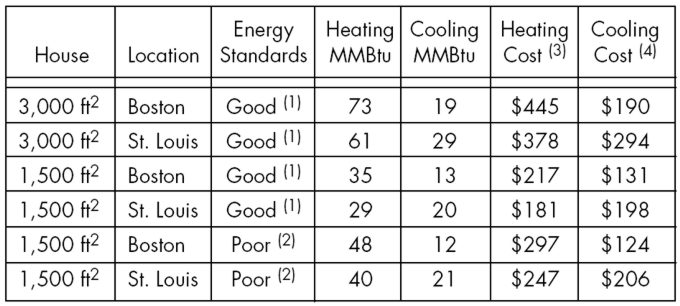
Even if a small house has lower levels of insulation than a larger house, it's likely to cost less to heat. 1. R-19 walls, R-30 ceilings, double-low-e (U=0.36) vinyl windows, R-4.4 doors, infiltration of .50 ACH, and R-6 ducts in attic; 2. R-13 walls, R-19 attic, insulated glass vinyl windows, R-2.1 doors, infiltration of .50 ACH, and uninsulated ducts; 3. Natural gas at $0.50 per therm; 4. Electricity at $0.10 per kWh.
Having written about green building for more than twenty years now, I've encountered lots of misperceptions. One of those is that green building always has to cost a lot more than conventional building. There are plenty of examples where it does cost more (sometimes significantly more), but it doesn't have to, and green choices can even reduce costs in some cases. Let me explain.
When someone is considering building a green home, my first, number-one recommendation is to keep the size down. Since 1950, the average house size in the U.S. has more than doubled, while family size has dropped by 25% -- so we're providing 2.8 times more area per person than we were back then. If you think you need a 3,000 square-foot house, consider whether 2,500 would suffice, or even less. There are some really great homes being built at 1,400 to 1,500 square feet -- homes where every square foot is optimally used and there aren't rooms, like formal dining rooms, that sit empty most of the time.
Often, because we're conditioned to think that bigger is better or because we're told by a real estate agent that a house has to be large to keep its value, we build the largest home possible. By stretching budgets to maximize square footage, we're then often forced to skimp on quality and performance. If, instead, we downsize the house, we can improve its quality (durability, detailing, energy efficiency, green features), and we might even be able to reduce the overall costs.
With green building, there may be some other ways to lower costs that don't require reducing the house size. At the development scale, if we design an onsite infiltration system for stormwater (rather than building a stormwater retention pond or installing storm sewers) that could both reduce costs and make the project greener. With larger facilities, it's sometimes possible to save millions of dollars with such changes -- paying for all of the additional green features.
Where we build can also influence cost. By clustering houses in a development, we can reduce the total amount of pavement, the length of utility lines, and other associated infrastructure costs. By putting a house fairly close to the access road, we both save costs and reduce the impacts of that additional pavement and material usage.
Relative to materials, there are some important ways to use materials more efficiently and save money. With "advanced framing," studs and rafters (or roof trusses) can be installed 24 inches on-center, rather than the standard 16 inches, reducing the amount of wood used in construction. By carefully planning overall building dimensions and ceiling heights, one can optimize material use and reduce cut-off waste.
And it's sometimes possible to have a structural material serve as a finished surface, obviating the need for an additional layer. This can be done when structural floor slabs are made into finished floors (often by pigmenting and/or polishing the concrete), or when a masonry block is used that has a decorative face, eliminating the need for another wall finish.
SUPPORT INDEPENDENT SUSTAINABILITY REPORTING
BuildingGreen relies on our premium members, not on advertisers. Help make our work possible.
When it comes to energy, building a green, energy-efficient house usually does increase costs. But we can significantly reduce that extra cost -- occasionally even eliminate it -- by practicing "integrated energy design." If we spend more money on the building envelope (more insulation, tighter construction detailing, and better windows) so that we dramatically reduce the heating and cooling loads, we can often save money on the heating and cooling equipment. With a really tight, energy-efficient house, for example, we might be able to eliminate the $10,000 to $15,000 distributed heating system in favor of one or two simple, through-the-wall-vented, high-efficiency gas space heaters, or even a few strips of electric resistance heat.
If, along with that really well-insulated envelope, we carefully select east- and west-facing window glazings that block most of the solar gain and provide natural shading from appropriately planted trees, we might even be able to eliminate central air conditioning.
These savings on mechanical equipment can cover a lot of the added cost of the improved building envelope. In rare cases, these savings in heating and cooling equipment (if we eliminate a really expensive system, such as a ground-source heat pump, for example), we can pay for all of the envelope improvements and even reduce the total project cost.
(2010, March 4). Green Building Myth #1: Does Green Building Have to Cost More?. Retrieved from https://www.buildinggreen.com/blog/green-building-myth-1-does-green-building-have-cost-more
Attaining the energy savings and associated sustainability goals is neither difficult nor costly. but rather a straightforward implementation of practical, cost-effective, off-the-shelf technologies.
On the commercial side, it will be critical for large building portfolio owners to have insight into current physical conditions of their buildings (FCI – see www.fciworks.com) to be able to properly allocate reinvestment dollars between energy and operational needs.
Operational efficiency is CRITICAL, as buildings typically deteriorate in performance by as much as 30 percent in the first three to four years. Simply renovating to “green” will not be of value in itself if not coincident with better building operations, maintenance, and associated capital planning processes and metrics.
In many cases owners can save 20% in energy just by improving operational and maintenance practices.
Lastly, ROI for many of the above programs can be less than a year.
By 2030, a milestone date for many sustainability initiatives, 75-85% of all current buildings will still be standing. Investing $170B in energy retrofits would yield 25%-30%+ in energy savings, a 15% ROI ! (McKingsley Report and others).
LEED Platinum, Gold, and Silver for new construction is a great tool for awareness building / marketing, but will do little to reduce GHG, carbon foot print, and energy usage.
The new ASHRAE Standard 189.1, Standard for the design of High-Performance, Green Buildings Except Low-Rise Residential Buildings, is a good start. This provides for a 15 percent higher efficiency than the previous Standard 90.1.
What’s coming? Standard 90.1-2010, set for release this summer, is a potential minimum compliance standard, a 30 percent reduction in energy over 90.1-2004.
Nicely put. Quite simply, the energy usage and lifetime carbon footprint of a house is directly proportional to the size. Building costs are also directly related to costs so efficient design really pays for itself.
A number of municipalities, including Portland, Seattle, and Santa Cruz are updating zoning codes to allow backyard cottage housing on residentially zoned lots. (Up to 800 sf in size in Seattle and Portland) increasing density and creating choices for local families. For more information visit us at http://www.seattlebackyardcottage.blogspot.com and http://www.microhousenw.com
Thanks for the reminder, especially about downsizing. A huge green house is an oxymoron. We really need a lot less space than we think.
I've downsized to 925 square feet and that's more than enough for one person, but I need a large exercise area because there are no gyms here and even walking outside is not an option.
But if I were to do it again, I would choose an apartment or a townhouse in town.
In the commercial sector a sustainable / high performance, energy efficient building carries a minimal increased price tag 3%-6%, if at all.
The high cost myth comes from confusing high performance buildings with LEED certification and associated lack of knowledge.
Very well put, almost common sense in nature. As we all journey along this path of Green Building looking for the magic elixir, we sometimes lose track of how easy it is to find the right path. This is not rocket science 101. Your correlation to tightening the building envelope and loosing the Ground Source Heat Pump is right on target. The Ground Source Heat Pump has become a diva of the energy world here in the Mid Atlantic. It is an extreme waste of money if you tighten your thermal envelope properly. There are many such items, unfortunately too many times consumers and professionals try to take giant leaps looking for a solution, instead of following a prescriptive path. Plus energy efficiency is "The Invisible Man," and tough to brag about in public unless one is keeping track of utility bills. Keep up the common sense, I love it.





Add new comment
To post a comment, you need to register for a BuildingGreen Basic membership (free) or login to your existing profile.