Utility Wind Energy: Worth the Environmental Impacts?
Taking a look at the environmental effects of wind turbines
Correction: The author has posted a comment (see below) clarifying the likely width of the ridgeline road associated with this project.
One of my favorite pieces of Vermont trivia has been that the tallest manmade structure in the state is the Bennington Battle Monument, at 306 feet tall--and construction of it was completed in 1889
I'm due for an update, however (and so is the Wikipedia entry on the monument--correction, it has been updated since this was first posted). Since 1997 Vermont has had a major wind development in Searsburg, with turbines "only" 132 feet tall, but this summer First Wind has been installing 16 turbines, each 420 feet tall, on a Sheffield ridgeline in the Northeast Kingdom (read Sheffield resident Martin Holladay's supportive post about these on GreenBuildingAdvisor.com). By next summer, 21 460-foot wind turbines are likely to be installed on four miles of ridgeline in Lowell as part of Green Mountain Power's Kingdom Community Wind project.
We need nonpolluting energy
I would consider myself open-minded about wind power. I believe we need nonpolluting sources of energy to wean ourselves from fossil fuels and to stave off climate change. On the other hand, I've heard that wind developments can have a surprisingly big impact on the environment.
To understand this issue better, I spoke this morning with Steve Wright. Steve is the former president of Sterling College, and was the Commissioner of Vermont Fish and Wildlife under Governor Kunin. Recently he has been volunteering as a liaison for the Town of Craftsbury in the permitting process for the Lowell wind project. Although the project is located in Lowell, the neighboring towns of Craftsbury and Albany have been very concerned about impacts to their towns from the development, as well as statewide effects.
SUPPORT INDEPENDENT SUSTAINABILITY REPORTING
BuildingGreen relies on our premium members, not on advertisers. Help make our work possible.
What impacts? When viewed from afar, many people think that large wind turbines look picturesque, even inspiring. It would be easy to imagine that those turbines were planted in the ground like trees from some sort of giant helicopter, with no effect on the surrounding area. Not so. The road you have to build to get the turbine there, and building infrastructure like transmission lines, has a huge effect. "There is a huge difference between planting a turbine in a cornfield next to a residence, versus putting a turbine on a ridgeline where there are no roads and no transmission lines, which is the case with most of Vermont's ridgelines," says Wright.
According to Wright, who quoted permitting documents to give me these figures, the Lowell project will require an access road of between 190 and 215 feet in width along four miles of ridgeline. Then, at each turbine, an additional 190 feet must be cleared in a circle for the crane to be able to turn around it and do its work.
An Interstate highway on a mountain ridgeline
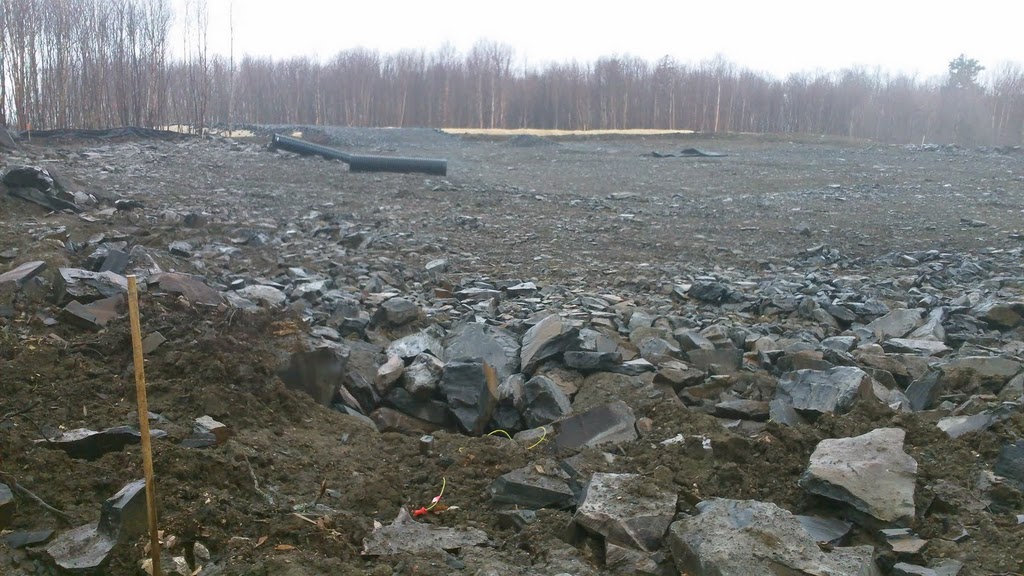
Given the density at which the turbines are being placed, this amounts to 400 feet of road running almost continuously across what is now an untouched ridgeline. Like any highway, this one will require extensive blasting and flattening to provide the required access.
For comparison, one lane of I-91 is 12 feet wide, meaning that 33 lanes would fit into this "access road." That doesn't include additional access roads and clearing performed for transmission lines.
According to Wright, there are basically three permitting bodies that a project like the one in Lowell has to go through: the Public Service Board, the Agency of Natural Resources (ANR), and the federal government, in the form of the Army Corps of Engineers. The Lowell project has cleared the first two hurdles.
Can our stormwater systems handle the runoff?
Having just been through Hurricane Irene, and the massive and destructive flooding that it brought to Vermont, I am acutely aware of the natural flow of water through our mountainous landscapes, and how water can build and lead to flooding, erosion, and sedimentation patterns that would be difficult to imagine in drier times. Much of the reaction after the flooding has focused on lost homes and destroyed highways, but fish and wildlife are adversely affected when streams, pools, and other waterways fill up with silt and when riparian habitat is washed away.
I asked Wright how building four miles of Interstate highway on top of a ridgeline--a rocky environment exposed to plenty of rain, and upstream of hundreds of square miles of streams, pools, culverts, bridges, and roads--could be deemed safe by ANR with respect to flooding risk.
Dueling experts disagree
Wright depicted the permitting process as involving "Two sets of dueling experts who come together and see who has the most people standing, once they have tried to cut each other into pieces." The result? "We felt that we proved that the engineering design was unworkable and then we reinforced that with the opinion of a disinterested third party, but even then the ANR rejected our findings and approved the project."
To be clear, Wright noted that neither he nor the towns that he is working with, Craftsbury and Albany, are opposed to the Lowell project. "We never said that we don't want the development. We have said that you had better take care of our interests and concerns."
For its part, GMP's FAQ section on its website emphasizes on the wind project's website that the project has passed the required environmental impact review:
What environmental impacts will result from the installation of Kingdom Community Wind?
The project's developers, state and federal environmental experts and regulators have closely studied the potential impacts of the project. All necessary environmental permits must be received and complied with, as well as additional conditions placed on KCW as a result of its certificate of public good (CPG) issued by the Vermont Public Service Board (PSB). With those requirements, including mitigation plans for known impacts, the regulators have determined that KCW poses no undue adverse impacts to the environment.
I don't think they answered the question--do you? The question that was asked as about "impacts." The question that was answered was about "undue adverse impacts" as defined narrowly by lawyers.
Black bears need beechnuts
What about the interests of other Vermonters--black bears, among them? "Loss of wildlife habitat" is so abstract--but Wright explained to me exactly what that means.
Right about now, in early fall as black bears are getting ready for hibernation, beech stands at high elevations are an important source for protein. Although they are still in a a milky, unhardened state, beechnuts are forming now in abundant clusters in healthy, high-quality stands. Bears climb the trees, often quite a ways up, gather up clusters of nuts in "brooms" and chew them down.
The developer in Lowell plans to destroy 22 acres of "high quality" American beech growth for the access road up from Route 100. ANR approved a deal in which they preserved about 500 acres of land in a different location, but according to Wright, this land contains much lower-quality beech forest.
Learning everything I've shared with you here has been enough to give me serious pause in considering wind development. Is it hypocritical for environmentalists to oppose wind? We do need clean energy, right? Exploring that issue will require another column, however. In the meantime, send your comments and questions on monuments, ridgelines, bears, beeches, and anything else from today.
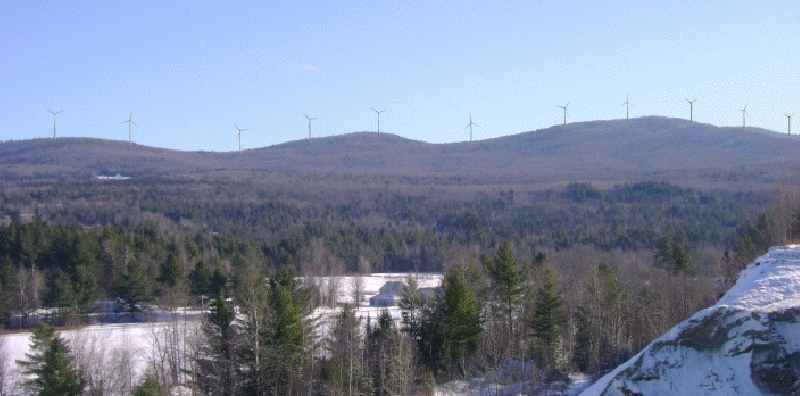
Top image: A photo simulation of Kingdom Community Wind in Lowell, Vermont. Green Mountain Power
(2011, September 13). Utility Wind Energy: Worth the Environmental Impacts?. Retrieved from https://www.buildinggreen.com/news-article/utility-wind-energy-worth-environmental-impacts
Crama: "photosynthesis is still technology that we humans haven't as of yet successfully reproduced"
The term "technology" has always meant the art, skill and craft of human beings in solving problems or meeting their needs or wants, and has more recently come to mean the organized effort of civilization to apply knowledge to the manipulation of the environment to serve social purposes or create value.
Unless you accept "intelligent design" and postulate a cosmic designer applying knowledge to create the natural world, then nothing in the other-than-human realm can be considered "technology".
It's a common modern error to look back upon prehistoric humanity or to the world which preceded humanity and project our current understandings and practices backwards. Animals use tools, as did early humans, as simple extensions of their native abilities. But it wasn't until the agricultural revolution that humanity began consciously and systematically altering the natural world for its own purposes - and that was the beginning of technology.
As complex - and simple - as is a natural process like photosynthesis, it is not technology. Our attempt to replicate it is. That is also hubris, and the cause of all human tragedy.
Robert Riversong said in quotes: "It's not about what is acceptable to various people (some have vested interests in certain technologies or industries and most are unaware of the implications of their choices) or about 'what we really want' when most of our wants are far in excess of our authentic needs."
Agreed.
"Gaia, the planetary super-organism which most of us know as the biosphere, the ecosystem or the web of life, has flourished, evolved and sustained itself for 3.5 billion years with no energy technologies more sophisticated than passive solar and photosynthesis."
Of course, photosynthesis is still technology that we humans haven't as of yet successfully reproduced. Although we are trying. I'd say that photosynthesis is quite sophisticated, even though we take it for granted as it happens all around us every day. We should be in awe of the process.
"All human technologies have unintended negative consequences - even PV, hydro and wind power. It is not just that we must get off carbon-based energy, but that we must relinquish our self-destructive and ecologically-damaging addiction to technological "solutions" and blind faith in 'better living through chemistry' (or science) which the entire history of human civilization has proven false."
Agreed again.
It is our addiction to technology that has allowed us to grow to 7 billion humans. The earth's carrying capacity for humans is way lower as we know. How much is the question. Of course, that depends on the amount of resources our future lives demand.
We need to decide what is accepable. Of course, what is okay for one person is not okay for another. We need to ask ourselves what we really want. Do we want to continue to use carbon based fuels, which will keep adding to the global warming issue or do we want an energy system that doesn't add to that issue and doesn't require war and/or polluting of our streams, rivers, and water aquifers, like hydro-fracking for natural gas here in New York State.
The alternative would be to get serious about a massive use of thorium nuclear power, that in theory, is much safer that current nuclear energy, with way less waste. These thorium power plants would be faster to build. Cheaper to build. And I believe can be air cooled, therefore no river required. As well as built in a factory, not site built, and moved by railroad and truck.
I'm all for wind, solar, geothermal, CSP, etc. But folks keep complaining about almost all sources of energy production near their communities. Everything has a trade off. But the message is, that we need to get off carbon based energy sources NOW, not in 20 or 40 years.
Crama: "We need to decide what is accepable. Of course, what is okay for one person is not okay for another. We need to ask ourselves what we really want...Everything has a trade off."
It's not about what is acceptable to various people (some have vested interests in certain technologies or industries and most are unaware of the implications of their choices) or about "what we really want" when most of our wants are far in excess of our authentic needs.
Gaia, the planetary super-organism which most of us know as the biosphere, the ecosystem or the web of life, has flourished, evolved and sustained itself for 3.5 billion years with no energy technologies more sophisticated than passive solar and photosynthesis.
All human technologies have unintended negative consequences - even PV, hydro and wind power. It is not just that we must get off carbon-based energy, but that we must relinquish our self-destructive and ecologically-damaging addiction to technological "solutions" and blind faith in "better living through chemistry" (or science) which the entire history of human civilization has proven false.
In the wide open Midwest, wind turbines can be placed in open fields. In Vermont, the wind resource is at the ridge line.
Yes, it's Jevon's Pardox, and it is applicable only where consumer demand for more efficiently (i.e. less costly) produced goods is "elastic" - can grow with the increased production that is the result of efficiency gains. In a stagnant economy, consumer demand is relatively inelastic.
But the more salient point is that Gaia (or the earth's ecosystems) cares not a whit how efficiently we consume energy - only how much total energy is consumed (and, consequently, how much entropy - waste, pollution and heat - results).
I, too, wonder where these highly exaggerated claims of mountain-top removal come from.
According to the Army Corps of Engineers section 404 permit application pf February 14, 2011, the access road up the mountain will be 18' wide and mostly follow existing logging roads. "After construction, all cut and fill earth slopes earth will be seeded and allowed to re-vegetate naturally." The ridge-top crane path will be approximately 4.4 miles long with a minimum passable width of 34 feet and maximum grades of 14%. "Horizontal adjustment of the crane path would be up to 50-feet to allow for site balancing while also limiting tree clearing. Clearing and crane path locations would, however, follow a fixed design at wetland, stream, environmental buffers, and state rare plant locations to minimize construction impacts. At the conclusion of construction activities, fill slopes composed of blasted rock will be covered with a bio-mass and soil mixture and re-seeded to promote re-vegetation."
"The wind turbine pads themselves would be 250-feet in diameter, constructed using a permeable surface of 3-5 inch stone...the slopes composed of blasted rock fill will be covered with a bio-mass and soil mixture and re-seeded to promote re-vegetation."
"There would be two main Project construction staging areas: an approximately 5-acre area at the intersection of the Project access road and Vermont Route 100, and an approximately 0.75-acre area located approximately 1.3 miles up the access road from Route 100. The second area would be located within an existing clearing that would be expanded from approximately 2.0 acres to 4.5 acres to allow for the new KCW Substation and maintenance building. All staging areas, with the exception of the area at the maintenance building, will be seeded and allowed to naturally re-vegetate at the conclusion of construction. The farm field staging area at the base of the access road will be restored to pre-construction conditions where able."
Tristan, are you sure of those road figures? I've checked with folks in Maine deeply familiar with mountaintop wind projects here. They inform me that wind-farm roads here are a maximum of 32 feet (9.8 M) wide, most of which is allowed to revegetate to something like a lightly-used logging road. Cut and fill adds some on steep slopes (a good thing, otherwise erosion). Do you have data showing that those Vermont roads are actually going to be 190 to 215 feet wide? Or perhaps that will be the legal definition of the road right-of-way? There's a big difference. Thanks for any clarification. Your larger point, that we could have less impact siting wind farms on less-steep, less-fragile, windy sites, is certainly a good one. But everything has a context, and we have to be sure of our facts.
Also, it's a highly controversial phenomenon. It is real, but it does not apply equally in all times and places. (Short form: it's much more applicable in the developing world than in the context of a fully saturated consumer culture like ours.)
Yes, energy conservation and efficiency in massive doses are required to minimize the adverse impacts of wind and other forms of renewable energy and to reduce our demand for energy to low enough levels to make meeting that load via renewables possible. But why does the wind farm need a ridgeline road with a 200 foot wide clearance? I have seen wind farms where the access roads are much narrower and the impacts on the land are more reasonable. Also, we should remember that forest clearance (destruction) is not involved when turbines are placed in farm' fields.
A 2008 report from Stanford University (http://news.stanford.edu/news/2009/january7/power-010709.html) and published in Energy and Environmental Science, claims to be "the first quantitative, scientific evaluation of the proposed, major, energy-related solutions by assessing not only their potential for delivering energy for electricity and vehicles, but also their impacts on global warming, human health, energy security, water supply, space requirements, wildlife, water pollution, reliability and sustainability." It states, "The raw energy sources that [professor of civil and environmental engineering Mark Z.] Jacobson found to be the most promising are, in order, wind, concentrated solar (the use of mirrors to heat a fluid), geothermal, tidal, solar photovoltaics (rooftop solar panels), wave and hydroelectric. He recommends against nuclear, coal with carbon capture and sequestration, corn ethanol and cellulosic ethanol, which is made of prairie grass. In fact, he found cellulosic ethanol was worse than corn ethanol because it results in more air pollution, requires more land to produce and causes more damage to wildlife."
A 2010 study, by Mark Z. Jacobson and Mark A. Delucchi, Department of Civil and Environmental Engineering, Stanford University, for submission to Energy Policy, was called Evaluating the Feasibility of Meeting all Global Energy Needs with Wind, Water, and Solar Power. It not only determined that wind power has the lowest financial cost and smallest ecological footprint, but that renewables can meet all global demand by 2030.
It states, "A large-scale wind, water, and solar energy system can reliably supply all of the world’s energy needs, with significant benefit to climate, air quality, water quality, ecological systems, and energy security, at reasonable cost. To accomplish this, we need about 4 million 5 MW wind turbines, 90,000 300-MW solar PV plus CSP power plants, 1.9 billion 3 kW solar PV rooftop systems, and lesser amounts of geothermal, tidal, wave, and hydroelectric plants and devices…The obstacles to realizing this transformation of the energy sector are primarily social and political, not technological."
We are witnessing the social obstacles to wind power development in the Northeast Kingdom of Vermont. Some of that resistance is based on valid ecological concerns, some is ideological opposition to a capitalist (industrial) approach to or scale of energy, and some is typical NIMBYism. Unfortunately, much of the opposing argument relies on emotionalism and exaggerated claims (or language which tends to the superlative, such as the use of the adjective "huge" in this blog).
We can choose to stop or limit future energy development if we choose to reverse the growth of energy (and product) consumption (which requires reversing the growth of human population and lifestyle), and then dramatically decrease our energy and consumer demand to mitigate global climate change. Efficiency alone will not be a solution because every increase in efficiency has resulted in increased consumption (Devon's Paradox). We can't rely, in other words, on using more power more efficiently – we need to use less power, a lot less power. If we're not prepared to significantly reduce both human population and our consumer lifestyle, then we must choose which types of large-scale energy development we're willing to tolerate.
Flatting the top of the mountain beats the heck out of removing it entirely to access coal, but it's hardly sustainable in any meaningful sense of the world, or ecologically sound.
Renewable energy has gotten most of the green press, because it's sexy and (often) high-tech and frequently has (at least the appearance of) opportunities for investors to make outsize returns. But like all human activities, it has an impact. And since it's an industrial-scale activity, the impact is proportionally big.
Compared to renewable energy, renovation and even design for efficiency just aren't nearly captivating. But if the goal is to make human civilization part of the living world, rather than being a destructive force over it, radical efficiency MUST be our primary tool. Renewable energy projects need to get done (very likely, even including this one) but if we think we can solve our environmental crisis by substituting "green" power for regular power on a one-to-one basis, we're fooling ourselves.
It's a very attractive illusion, though. Because the alternatives are either deprivation, or working very hard and being very clever in order to create negative economic growth (i.e. a reduction in consumption of resources).
There are places that are flat, windy and isolated where we can put wind turbines and avoid some of the problems you mentioned. They could be put on floating barracks at sea. A recent trip to Iceland made me think they could become a supplier of wind power. They have very little population and, man, is that country blessed with lack of trees, isolation, AND wind.
Filings by the Green Mountain Club during the permitting process for this project indicate that the ridgeline will be cleared to a width of 200 to 400 feet, and up to 600 feet, as I indicated in the article. In claiming that the road would be built to that width, however, my source was incorrect, and I apologize for repeating information that appears inaccurate. While other permitting documents indicate a road width of 34 feet, those filings indicate that some blasting, grading, and "flattening" will occur extensively within that 200 to 400 foot width, and may be up to that width in places, but it appears unlikely that this full width will be completely graveled and take the shape of an access road. I apologize for this inadvertent exaggeration, but I must emphasize that clearing 400 feet for 4 miles along a high-elevation ridgeline, if that takes place, is a big step and not one that the ecosystem will recover from quickly.
The facts provided on the bear habitat has not been questioned and I have no reason to doubt them.
Another environmental impact, relevant to probably most areas, is the loss of birds. Here's a NY Times article and video discussing the bald eagle impact wind turbines have had in N. California. http://articles.latimes.com/2011/jun/06/local/la-me-adv-wind-eagles-2011...
Also, note the road in the video through the turbines is only about 12' wide.
The raptor mortality problem at the Altamount Wind Farm in CA is for golden, not bald, eagles. This was one of the first wind farms in the US, with low, fast-turning turbines. They are being replaced with fewer, taller and slower-turning turbines (much like the ones proposed for VT) which have significantly lower bird and bat mortality rates.
This is excellent information that highlights how complicated solutions can be. Today it seems that folks feel a need to make decisions and choose solutions based upon the least amount of information possible. This makes it easy for one to decide, get it over with, and move on to the next dilemma, and then decide again. As if this moves us forward and away from our problems. The paradox is that when we move more slowly with deliberation we move faster toward sustainable solutions, in my opinion. In other words, thanks for a story with depth that left me with the job of making an opinion, as opposed to it being made for me.
Pat Vincent-Collawn, PNM president and CEO said, "Without an energy storage component, renewable energy is a limited resource that needs to be backed up by traditional generation facilities. Although this technology is in its early integration stage and additional research and development is needed, the PNM Prosperity Energy Storage Project is a significant first step toward making renewable energy reliable energy."
Can large scale high voltage DC lines provide power from areas of production a thousand or more miles away, and thereby replace the need for more localized renewables energy storage?
It's important to add that the big picture perspective on US government subsidies for fossil fuels has to also include the cost of the current resource wars in Iraq (originally named Operation Iraqi Liberation – O.I.L.) and Afghanistan (the Trans-Afghanistan Pipeline to transport Caspian Sea natural gas from Turkmenistan through Afghanistan into Pakistan and then to India and the West, avoiding both Iran and Russia).
Assuming Willem Post is correct that "the US grid modifications…to accommodate wind energy are in the order of $250 billion", this would be a very modest investment compared to the military "subsidy" to the oil and gas industries.
According to a report released in 2011 by Brown University, written by more than 20 economists, political scientists, lawyers, anthropologists and humanitarian personnel for Brown's Watson Institute for International Studies, the United States will have spent between $3.7 trillion and $4.4 trillion on the wars in Iraq, Afghanistan and Pakistan (in addition to costing nearly a million lives and creating 7.8 million refugees) by the time the conflicts end.
From your response I take it you are not an engineer.
My objective is to inform, not to mislead.
My articles are peer reviewed by energy systems analysts who are mostly retired engineering professionals with decades of experience.
Ireland has a relatively modern grid built in the last 25 years with 66% of its energy from OCGTs and CCGTs.
When Ireland uses these units for balancing its wind energy, they need to operate in part-load-ramping mode to accommodate wind energy surges and ebbs which consumes so much additional fuel and emits so much additional CO2 as to completely offset the fuel and CO2 wind energy was meant to reduce.
The Udo analysis was based on MEASURED 1/4-hour data sets posted by EirGrid on its website.
As with most of the arguments against utility-scale wind power in Vermont, Willem Post's are more than a bit misleading.
During operation, wind power is one of the most ecologically-benign zero-carbon sources of electrical power available today. That a relatively new and better generating technology should, initially, be more expensive than older dirty technologies and require some public support is to be expected. The federal government gives much greater subsidies to fossil fuel and, especially, nuclear (which would never exist without federal R&D, the Price Anderson liability shift to public coffers and the promise of a national waste repository). I pay more for organic food too, but am getting a much better value (and better health) for my money. I also pay a $/kWh premium to get a fully renewable energy mix at my meter.
That the current mix of generation capacity (only 2.3% wind nationally) and the current grid control and distribution systems now require quick-ramping balancing generation to complement locally-irregular wind power is a vestige of an obsolete system that will take some time to convert to a more sustainable matrix. With a much higher percentage of distributed wind generation, the turbines will balance each other and require no dirty complementary energy.
Large-scale studies, like the 2010 one by Mark Z. Jacobson and Mark A. Delucchi, Department of Civil and Environmental Engineering, Stanford University - called Evaluating the Feasibility of Meeting all Global Energy Needs with Wind, Water, and Solar Power – have not only determined that wind power has the lowest financial cost and smallest ecological footprint, but that renewables can meet all global demand by 2030 (if we have the political will).
It takes time and effort, financial investment and public support to transition our obsolete energy grid to a more earth-friendly mix. When sufficient wind (and other renewables) come on-line, the total CO2/kWh will substantially decrease - but we have to reach a critical mass. Fighting each wind power development is not going to allow the critical mass necessary, and using current grid CO2 output as a measure is like judging a new house to be inefficient because the occupants turn up the fuel oil furnace every time a too-small woodstove cools down. We can't dismiss a good technology just because previous industry choices have made it challenging.
Below are the URLs of three of my articles. Please read them .
Wind energy has been proven to NOT reduce CO2 by two recent studies using MEASURED operations data, instead of modeling, estimates, statistics, etc.
Speaking as an Engineer, wind energy reduces coal consumed and reduces pollution.
Anyone can get a "peer reviewed" paper. How long has Tobacco kept citing papers proving their product was not addictive. And the phrase "Reviewed" gets massively abused as noted in testimony during the Scopes 2 trial.
The energy industry has always be quick to say how wind was too expensive to be a realistic option. The last couple of years Wind has become the LESS expensive option when compared to traditional generation like coal, gas, & nuclear. I find if funny now how they're fighting tooth and nail to discredit Wind, or at least throw up enough confusion to scare people.
A large scale wind farm has to go thru public hearing and every possible negative gets stressed. But a gas well using fraqing goes in next door with no prior notification, exempt from all environmental laws, and the chemicals they inject in the ground is proprietary. If you protest the wind farm you're a patriot standing up for your rights, but anyone protesting the gas well or mountain top removal is anti-business.
Another 5-years and solar will be cheaper than coal. Wonder what fears will be raised against them then. The glare is dangerous to pilots!!!
You're correct that I'm not an engineer, so I'm not missing the big picture by focusing on minutiae. Your motives may be admirable, but your facts are incorrect.
Nuclear has long enjoyed R&D subsidies, construction subsidies, operating subsidies, the Price-Anderson Liability Limitation Act , production tax credits, shut-down subsidies, totaling currently to $13 billion in cradle-to-grave subsidies and tax breaks per plant (source: Public Citizen). Amory Lovins (Rocky Mountain Institute) notes that the US nuclear industry has received $100 billion in government subsidies over the past half-century.
The Union of Concerned Scientists (USC) report, “Nuclear Power: Still Not Viable Without Subsidies,” found that more than 30 subsidies have supported every stage of the nuclear fuel cycle, from uranium mining to long-term waste storage. Added together, these subsidies often have exceeded the average market price of the power produced. The Energy Policy Act of 2005 introduced a new suite of subsidies for nuclear power. The report estimates that these subsidies could be worth between 4.2 and 11.4¢/kWh, or as much as 200 percent of the projected price of electricity when these plants are built. According to the report, legacy subsidies exceeded 7 cents per kilowatt-hour (¢/kWh), well above the average wholesale price of power from 1960 to 2008.
“All low-carbon energy technologies would be able to compete on their merits if the government established an energy-neutral playing field and put a price on carbon,” stated Ellen Vancko, manager of UCS’s Nuclear Energy and Climate Change Project.





Add new comment
To post a comment, you need to register for a BuildingGreen Basic membership (free) or login to your existing profile.