
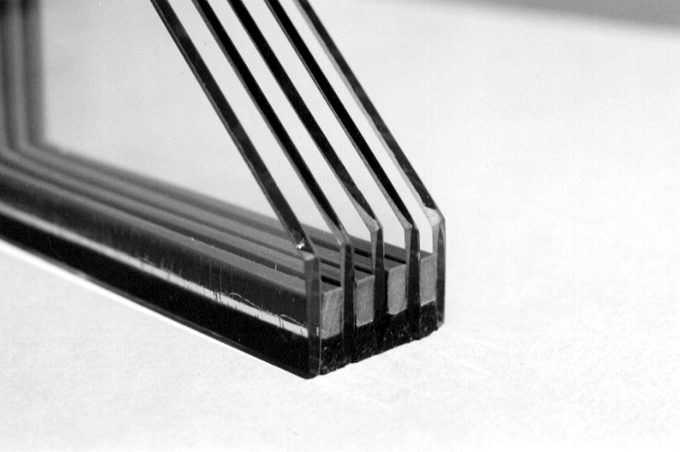
Looking at that quintuple-glazed window at the top of the page, I'm imagining some kind of electric or hydraulic window opening mechanism to lift the weight of a double-hung sash and some kind of safety mechanism with alarms and flashing lights to prevent children from beheading themselves or losing a hand if the windows accidentally close.
Blog Post
Will "Superwindows" Save the Day? (and Can We Afford Them?)
Everybody loves a high-tech innovation, and our windows are very high-tech, but have we reached a point where we don't need to push further?
As I've said before, windows are a silent but very high-tech part of our buildings. The advances in glazing in the last 30 years have been phenomenal. Will windows keep getting better and better with no end in sight?
In recent years, an increasing number of window manufacturers have been combining and refining the features that have given us today's high-performance windows: multiple layers of glazing, multiple low-emissivity (low-e) coatings, and very-low-conductivity gases such as krypton. They've been creating super-high-performance windows, or "superwindows," a term coined by Dariush Arasteh, a staff scientist at Lawrence Berkeley National Laboratory.In the early 1990s, Arasteh predicted that advances in technology could make all windows, even north-facing windows in northern climates, net-energy-gainers. Whether or not that day has arrived is a matter of debate, but there's no doubt that the advances since the 1990s, when window buyers were dreaming of U-0.05 (R-20) windows (and window makers were making tantalizing demonstrations in that direction), have been astounding.
The superwindow race cools off...
Today, that race has cooled off to some extent in favor of climate-specific solutions. As Stephen Thwaites of Thermotech Fiberglass in Canada told me, "A window doesn't have to be R-20 to be as energy-efficient as the wall around it," due to the ability of a window to gain solar heat and provide ventilation. "A home with no windows will use more energy than a properly designed home with R-5 windows," Thwaites said.
That's a change from the mid-1990s when the prototype, quadruple-glazed window shown at right was built by Thermotech as a demonstration of what was possible, with a goal of R-20. Today, ambitions have become more climate-specific.
...But it's still exciting to look for what's next
Today, R-5 windows are aspirational for many, but not really that special in the windows market. But instead of pushing past that, we are seeing more emphasis on proper design by orientation, shading, and window-to-wall ratios, and on buying the best windows for each application according to the budget.
SUPPORT INDEPENDENT SUSTAINABILITY REPORTING
BuildingGreen relies on our premium members, not on advertisers. Help make our work possible.
See membership options »It's still exciting to dream of what we'll see in the next 30 years. For example, vacuum glazing, in which most of the air is evacuated from the space between panes, reduces thermal conduction and convection to nearly zero (leaving radiation as the primary means of heat transfer), and can currently offer U-0.08 (R-12) with double-glazing and one advanced low-e coating. Vacuum glazing is still largely in research and development, however. The seal is tough to get right, since the vacuum puts a lot of pressure on it.
The biggest limit on energy performance is and may continue to be not what technology can do, but what the buyer can afford. Windows imported from Germany meeting the Passivhaus standard, for example, offer U-factors under 0.14--at a cost of over $90 per square foot of window area. Triple-glazed Canadian windows typically cost $40–$50 per square foot, in contrast with a price range for more conventional double-glazed windows of $30–$35.
The problem with getting great windows is how they're sold
On the subject of price, I'm going to quote a few paragraphs here from a comment I received by email after last week's post about reading NRFC labels. This comment with some follow-up discussion is posted on GreenBuildingAdvisor.com.
"Your recent columns on windows have struck a raw nerve, and it's worth sharing why. Construction has just begun on a small sunroom addition to my home. The problem with getting great windows is not product availability, but the awkward way they are sold.
"Building supply dealers seldom post prices of anything. Items which are ordered, like windows that have lots of options and sizes, are much worse--requiring the entry of data into a computer to get a quote. The quote of course is for the whole window, making it really tedious to test out individual options. The retail staff, though both knowledgeable and helpful, cannot possibly keep prices for all those options in their heads, and nothing good can come from a customer mistaking a ballpark guess for a quote.
"Net result: it is ridiculously difficult to get a cost comparison of option A vs. option B, on anything. In my case of a south-facing sunroom where I knew I'd be starting a lot of veggie seedlings in spring, I depended on my own reading and research in preferring clear glass (full-spectrum, high solar gain), and triple pane (reduced heat loss). It took several days to get a price.
"Going through that process for the dozens of decisions in a given project is simply not going to happen. Even a highly motivated customer has little choice but to just give up and trust the contractor to do something reasonable. And still miss here and there. You recently noted that using argon gas was a no-brainer; that column came too late, and I didn't expend the effort to price argon vs. air."
It may not help to say this, but if you've faced this window-pricing issue, you're not the only one. Martin Holladay at GreenBuildingAdvisor.com had some great comments on this which I'll paraphrase here. There is little transparency on pricing in the window industry, and someone who wants to really shop around and price out different options easily faces dozens of hours of research on a new home. Hopefully they can get good cooperation from dealers, but that's not always a given. It would be great to see just one window manufacturer post accurate and complete prices online. I suspect it would make their business stronger, not weaker.
Published June 4, 2011 Permalink Citation
(2011, June 4). Will "Superwindows" Save the Day? (and Can We Afford Them?). Retrieved from https://www.buildinggreen.com/news-article/will-superwindows-save-day-and-can-we-afford-them
Comments
Tristan, Further to your comm

Tristan,
Further to your comments on the sealing problems of vacuum glazing, people considering purchase of double-or triple-glazed units with "exotic" gas fillings to improve the U-value should be aware that such improvement is also dependent upon the effective life of the seal.
The filler strip between double glazing panes typically contains a desiccant material to absorb moisture which would otherwise cause the internal condensation often visible in older units. Where moisture gets in, the exotic filler gas will get out, leaving the unit filled with regular air and having the regular U-value.
The effective life of the adhesive seal can be expected to be in inverse ratio to the amount of stress placed on it by thermal movement. That is: the seals of units in temperate climates with a small annual temperature range can be expected to last considerably longer than those in desert or arctic conditions, where the annual range can be 60K (-5°C to 55°C or -30°C to 30°C).
As the emailer suggested, the
As the emailer suggested, there are far too many window options for any manufacturer or retailer to display a price list - every window is really a custom unit. However, it's not difficult to compare prices among various manufacturers by picking one set of variables and getting apples-to-apples quotes from each.
But dealing directly with a factory rep or salesperson, such as is the practice with Pella Windows, makes it relatively easy to get quotes on a single window size and type with any number of various options, since it's just a matter of having them run their program and they should be more than willing to do that to make the sale. Also, when working with someone who only sells windows, rather than a lumber yard for instance, you're much more likely to get good advice about matching options to your application and budget.
To Paula Melton: Should it no
To Paula Melton:
Should it not also be mentioned that using external shutters, however, will reduce solar and cold induced stress on windows. A practice quite common throughout Europe.
Thanks for bringing up the is
Thanks for bringing up the issue of heat and seals, Tony. In addition to climatic temperature ranges (which we can't really control), there is also an issue with some high-performance window attachments when combined with high-performance windows.
Peter Yost and I took an in-depth look at window attachments in the current EBN feature (which subscribers can read here: http://www.buildinggreen.com/auth/article.cfm/2011/6/1/Making-Windows-Wo...), but the long and short of it is that if you have a really good window, you should NOT try to push for more R-value by adding an insulated shade or a low-e storm window. Those two types of window attachments could potentially cause severe heat stress and destroy your window seals. If you're investing in superwindows, you shouldn't need storms at all--and you should use conventional shades, not cellular shades or window quilts, particularly on south- and west-facing windows.
Research on these interactions is ongoing, so use caution in the meantime.
At some point it seems we wil
At some point it seems we will reach a point of diminishing return given the cost of the window or door. Sure, it's great to be able to maximize the efficiency of a window, but we tend to forget the original reason for having a window was to allow light and ventilation into an otherwise dark and stuffy room. We've become so intent on making the most air tight, efficient product, the whole concept of a window has been lost. Let's face it, as a homeowner, sitting next to a window in your dining room, can you really tell the difference between a window with a U-.25 and one of U-.35? Really?? I doubt it. It's a number. There's a lot of hype by companies trying to get their U-value lower than the next guy's. But at the end of the day, customers want to be more comfortable, know that what they purchased is better than what they had before, and generally be content that they got value for what they paid.
As to the concerns about pricing, the comment was made that if 'manufacturer's' would simply post their pricing online. Other than a very small number, the vast majority of windows and doors are still sold through dealers and distributors, not direct from manufacturers. Independent retail dealers can price the product as they choose, but given the competitive nature of the window business, pricing is generally not far off between different dealers. Many vinyl replacement windows are sold 'factory direct', but the selling process for those is generally in-home, higher pressure sales, and of course, no prices are going to be displayed since that is virtually all commission based sales. Lastly, due to the vast amount of styles and options available today in windows, it is nearly impossible to price out a specific window. Most manufacturers offer 'option rich' product lines to appeal to as many potential customers as possible, making windows a made-to-order industry. The days of stocking limited sizes and features are pretty much over.



Add new comment
To post a comment, you need to register for a BuildingGreen Basic membership (free) or login to your existing profile.