
I like being able to see the discussion
Blog Post
Why Did My House Survive?
Green Econome founder Marika Erdely reflects on the Palisades blaze and how fire hardening measures may have saved her home
Amid the orange smoke from the Palisades fire, Marika Erdely's home remained standing, possibly due to fire-hardening measures she had implemented just before the blaze ripped through her neighborhood. Though the home was spared, it will require tens of thousands of dollars' worth of cleaning and repairs to be habitable. 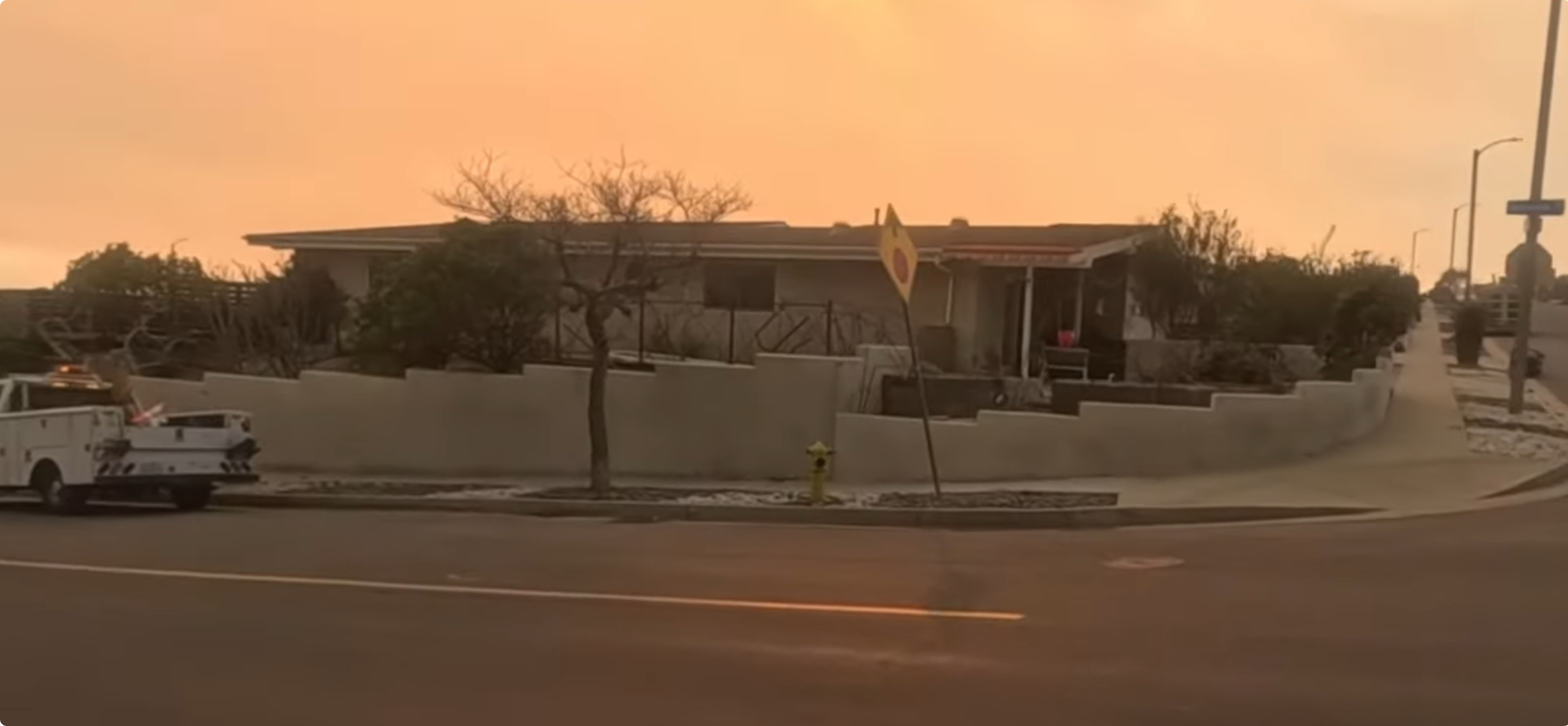
I push the button on my new coffee machine, generously given to me by the new man in my life and old friend that I started dating back in September. (I changed from the environmental hazardous Nespresso machine, which spits out its aluminum pods with no inkling of what happens once the pod has been consumed.) Bear and I go on a walk, and I enjoy the hills and views of the ocean from various points of the neighborhood. Truly idyllic.
I grab another coffee and sit down to work at the front bedroom of my home. I work for my own company, Green Econome, which I founded in 2009. Green Econome is an energy consulting and construction company located in L.A. I had been working as a CFO for a privately held home builder in Calabasas and knew that my job would soon be over, since I knew we wouldn’t be building any more homes once the project was completed.
With plenty of time on my hands, once the final home closed escrow in 2007, right before the recession, I studied for and passed my California contractor’s license and LEED AP BD+C (LEED accredited professional with a specialty in building design and construction). I figured both certifications would be helpful when I started my new company. To this date, I regret not completing my California broker’s license training. Do what you can today, as you will most likely not be able to later in life.
I have always been an environmentalist. As a small child, I grew up in a Hungarian Scout community focused on spending time in nature. My parents, my 4-year-old brother and my Nana, my mother’s mother, had escaped the Russians in 1956 during the Hungarian uprising. I was born a few years later into a very immigrant experience—I didn’t speak much English until I started kindergarten. Although my parents were not outdoorsy and rarely spent time with me outside, I have always gravitated to it, even from an early age.
SUPPORT INDEPENDENT SUSTAINABILITY REPORTING
BuildingGreen relies on our premium members, not on advertisers. Help make our work possible.
See membership options »When deciding to attend college, I thought about getting a degree in Ecology, which would have set me up for a life in the mountains, but I felt more ambitious and felt strongly that I wanted a career, so that I could support myself and be independent. All of my Hungarian girlfriends who I grew up with had stay-at-home moms and we all wanted more than that experience. I instead decided to study Business Economics, since my father was a businessman and had me managing the accounts payable of the small liquor store business he ran for a short period of time during my teens.
With the Business Economics degree and an MBA, I excelled in understanding numbers and keeping everything balanced, as accounting requires. But my last employer also presented me with a very difficult Me Too experience, and after many years pushing off his advances, I decided I never wanted to work for someone else again. So began the story of LEED by ME, Inc., DBA Green Econome.
Our office used to be located in Santa Monica, on a cute street filled with walkable shops and restaurants. But as our business grew and our team moved around L.A., it became difficult to have everyone come to the office, so in December 2023, we decided to close our office and go virtual. So on that fateful morning, I headed to the front bedroom of my house and turned on my laptop to begin working.
I had meetings and responded to emails and stood up at 10:50 a.m. to see what was happening with my first cousin’s 30-year-old son, who had been staying with me for more than two months of a three-month visit to experience America and figure out his next steps. He had a bad cold and had woken up late and was sitting at my breakfast table eating his usual sliced meats, cheese and tomatoes as Europeans do. I asked him how he was feeling and then I looked out across the ocean and all I saw was an orange sky.
I looked at him and immediately felt something was very wrong, so I opened the slider and went outside to see what was happening. I looked to my left and saw a giant smoke bloom coming from the direction of Pacific Palisades. We both froze. My phone started ringing. It was my older daughter calling to ask if I could go pick up my granddaughter from her preschool just a few blocks north of Pacific Coast Highway on Sunset Boulevard. The preschool was evacuating. It was now 11:00 a.m. I called my client and advised him that I couldn’t make our meeting at noon to review his energy audit report.
I jump in my car and head out and reach her school. The view of the smoke became even closer. The staff is just starting to understand what is happening. I can feel that they don’t really understand. I grab my granddaughter and her backpack and head back to my car and look again at the smoke. It is very close. I drive back home, and she loves my cousin, so she runs to jump and fly around in his arms as she has done numerous times before. She has no idea of the danger heading toward us.
My phone starts peeping, again and again. I pull it out of my pocket. It is the City of Malibu with a mandatory evacuation notice. It is now 11:20 am. We had received a similar evacuation notice weeks earlier for the Franklin fire, but we were just outside of the evacuation zone. This is our life living in this area.
The wind is really strong. The wind sculpture in my backyard is twirling faster than I have ever seen it. I’m in a panic. I have a cousin who isn’t familiar with what the process is, and I have a 2-year-old and a large black lab to fit into one car. I go to my bedroom—what should I take?
I grab some essentials and my most expensive business suits, as I figure they will be the most expensive to replace. I grab some small containers of the remains of my family and pets and some dearly loved pictures of my family. We take one more look outside and I remember, thankfully, to move the patio furniture away from the house.
My cousin and I push everything onto the grass lawn. I recall that the City of Malibu Fire Inspector that I asked to come visit my home to inspect it for fire defensiveness in November 2023 had mentioned this and had put it in his report.
We stuff ourselves into the car and take off.
As we head south on PCH, the traffic is moving slowly in the northbound lane, so emergency vehicles are driving down the center of our lane. The sirens are on, the traffic is heavy, the fear of the unknown is in the air. We head to my daughter’s house in Santa Monica. We arrive in shock and have that feeling of not knowing what is going to happen next. I cancel all of my meetings; we sit in front of the TV to see what is happening.
My younger daughter, who lives in San Francisco, is calling, wondering what is happening, while we all sit and wait to see what happens next. At 5:51 p.m., I’m reminded by one of my daughters to check my Ring camera footage. We see the Ficus trees behind my barbecue on fire and the embers blowing toward the house, right where the patio furniture would have been. Like many other people during the January Palisades and Eaton fires, Erdely and her family could only watch helplessly as her Ring camera revealed the fire reaching her home before the screen went black. Click to view video.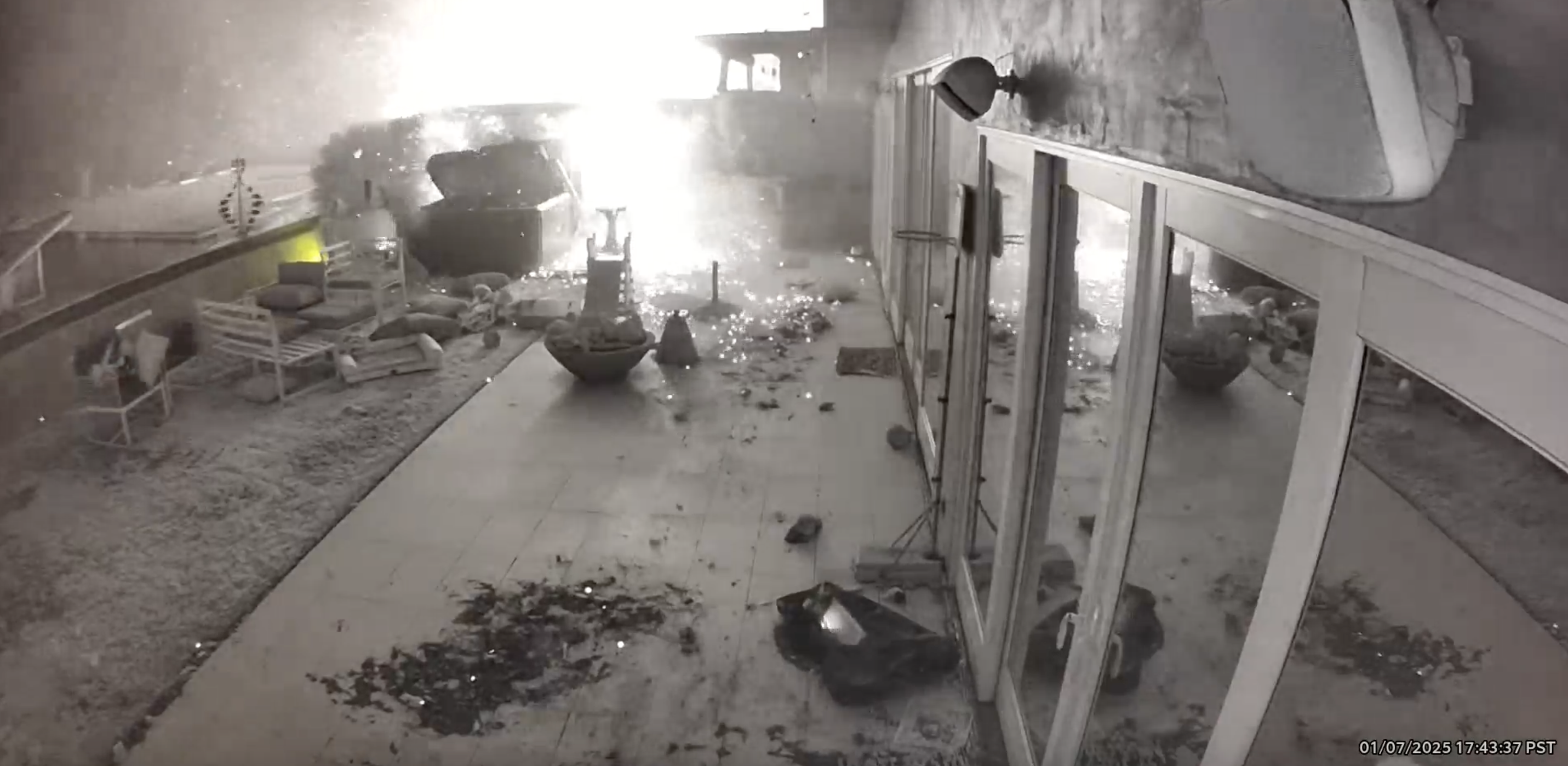
We breathe a sigh of relief that the pillows are not there to catch fire. But the fire grows larger and a big bloom of fire blows up in the corner and then the ring camera goes out. We all fear for the worst. The fire has made it to my yard. It appears hopeless. We spend the night at my daughter’s tossing around on a leaky air mattress as we view the TV footage until we can no longer take it.
In the morning, we wake up not believing what has been happening. Text messages start flowing in from neighbors, family, best friends, old friends and business associates. We have no news; we are all in shock. Then, as the TV anchor walks around the base of our neighborhood, down the street from my home, my grandson shouts out that the back of my house is visible in the footage. We scream, we cry, we can’t believe it! But what about the front; we can only see the back and south side.
Minutes later one of my neighbors, a family man with the cutest of young girls who have been picking my fruits and enjoying my garden, send a picture of the front of my house. We can’t believe it. Their house didn’t make it. We are in shock. My best friends in the neighborhood lost their home. My home appears to be one of the only ones of our group standing. I can’t believe it. But what am I going to do? I cancel all of my meetings for the rest of the week. I can’t work, I can barely think. I’m traumatized.
I end up being fortunate enough to be able to rent a small bungalow one door away from my daughter in Santa Monica. She and her husband and my younger daughter and her husband drive down from San Francisco to help me get set up: rent me furniture, bring me clothes, buy dog beds and food and take me to Costco.
Clearly, I had not brought the right clothes—I can’t wear those suits I so carefully packed into my car. We have no idea when I will be let back into my neighborhood. A real estate agent was able to drive through our neighborhood and film—pure devastation. It is horrific. It is unbelievable. Why did this happen?
And why did my house survive? Eerily, on the morning of the fires, I had this persistent thought that I needed to call my mother. I always felt like I didn’t call her enough, so whenever I had time, I always made a point to call her. This persistent reminder come into my head that morning, and I hadn’t had it for several years since she had passed from Covid at 92. How can I call her, I thought. Later, when my house miraculously survived, I wondered if she was there, helping to take care of my home? After all, she was so proud that I had such a beautiful home and she so enjoyed sitting out in her large floppy hat enjoying the sunshine and ocean views.
I am a big believer in things that happen for a reason. My divorce in 2023 took a lot out of me, but in the end, it was clear it was what was supposed to happen. As I had mentioned earlier, I had started dating an old friend of mine that I had met when I first joined the USGBC in 2009. The L.A. Chapter was new and there were all kinds of committees forming to help develop this new green industry.
My new man started a finance committee, which seemed right up my alley. He and another friend had stayed close when we first met in 2009 and had remained regular friends meeting for lunch and keeping in touch. Later in 2024, when our friendship became romantic, he reminded me how overgrown my fruit trees had become on the south side of my property. Erdely hosted visitors interested in learning more about her fire-prevention methods at her Malibu home during a tour conducted by USGBC California in August. 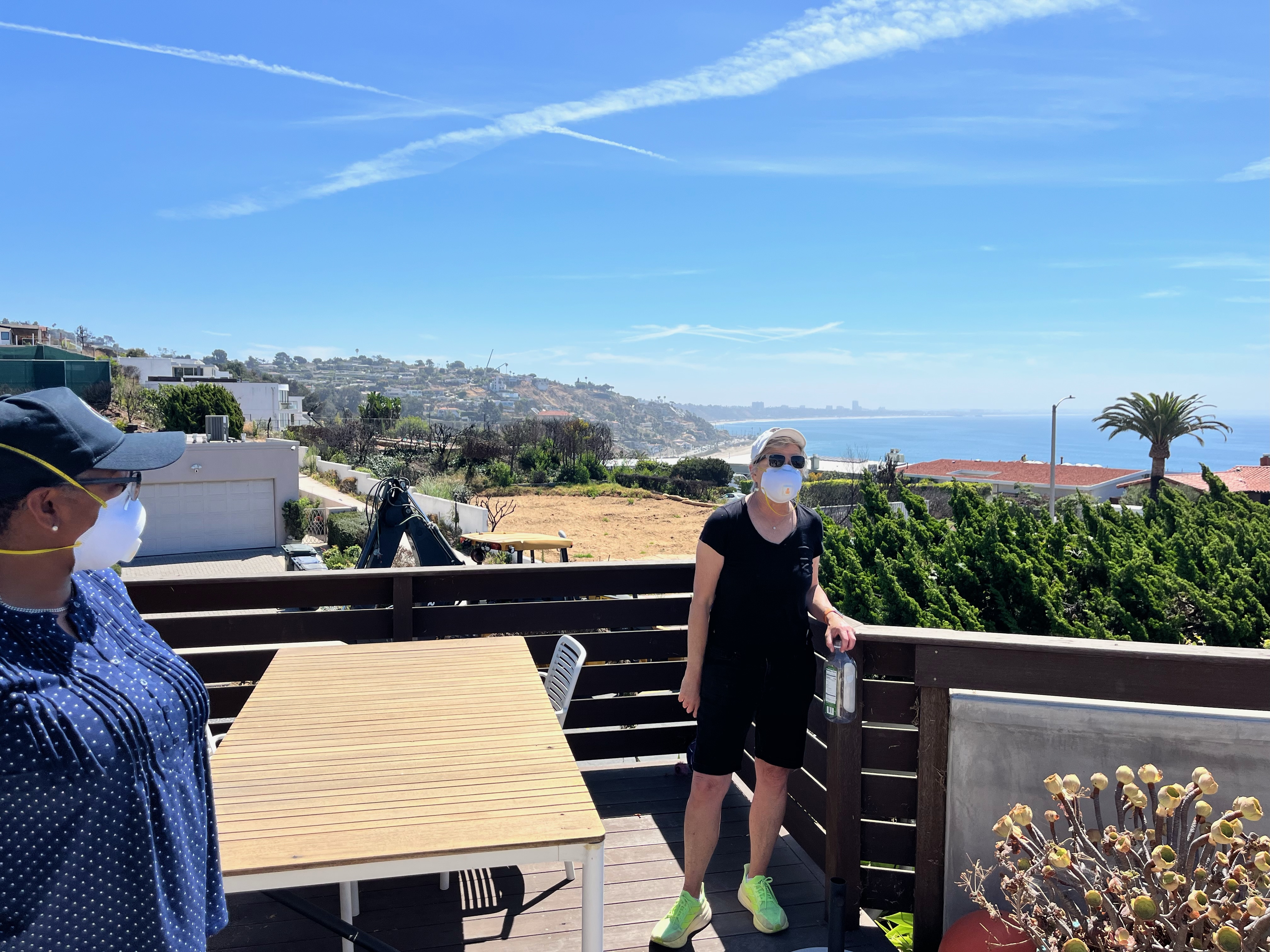
I figured this was a perfect project to have my Budapest cousin involved with, as well as my 7-year-old grandson. Starting in December 2024, we filled 18 green trash cans over multiple weekends and cleaned up the area, except for one last section. The Sunday before the fires, we decided to clean this last section out. However, without access to additional trash cans, I left a large pile of debris to remove over the weekend. Monday morning, my daughter asked if I could pick up my grandson, since his new school aftercare wasn’t available until Tuesday. With his help, we finished up all of the debris. The trash truck came Tuesday at 11 a.m. and removed the last bit.
The moral here for me is, if I hadn’t gotten a divorce and hadn’t started dating this old friend and if he hadn’t been nice enough to offer to clear the dead trees and leaves and had I not encouraged the change in aftercare, the side of my yard would be filled with debris and most likely my house would have burned down.
Yes, my house remaining standing is a miracle. However, the debris removal, the movement of the furniture from behind the house, the more expensive fireproof roof and, as it turns out, the plaster walls around my property and the new smooth plaster—installed in 2010 by one of the subs from my homebuilding days—all made a difference. There were no wood eaves or vents that old 1960s houses have, where the embers go directly into the house and catch fire. I had none of that. The lack of plants within five feet of my home also made a difference.
When I contacted the City of Malibu inspector a few weeks ago to let him know my house made it and to thank him for the advice he gave me, he said it was ME doing it. He didn’t play any part in it, he said. It is through my own efforts that these things were done, which ultimately made a difference.
My connection with the L.A. Chapter, recently expanded with multiple regions and renamed USGBC California, remains. Their fire-defensive classes have piqued my interest on why my house survived while others did not. Maybe it was due to decisions I made along the way. For example, my wood deck is made out of ipe, which is very difficult to burn (we thought for sure that the deck was gone). Burned-out lots just steps from Erdely's Malibu home are prepped for rebuilding.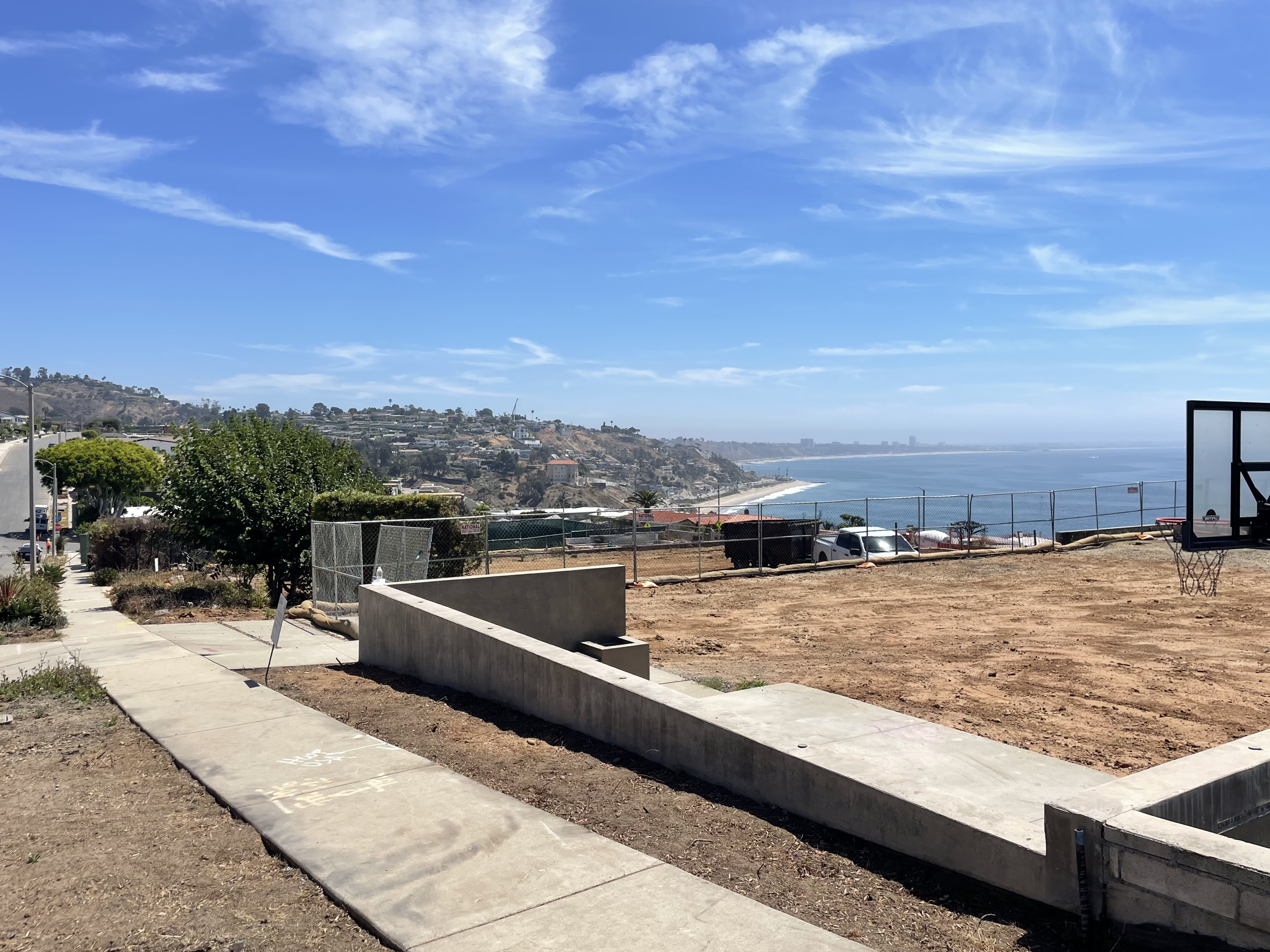
Here are some very important facts I have learned about fire defense now that I have completed the USGBC CALFIRE Fire Defense training for Contractors.
I learned some key factors that you should consider when evaluating your home, and in italics, I mention what my home had in regard to these considerations.
The two most important fire defense strategies are using noncombustible materials and creating adequate defensible space around your property. I do have some wood gates that could have been considered combustible, but the smart contractor I had hired had used a hard wood similar to ipe, and the wood didn’t burn, as it was noncombustible.
The most important hardening measure is the roof. It is very important to have a roof made from Class A materials. This means it is noncombustible, which means it is incapable of igniting and burning when subjected to a fire. I have a Class A roof.
Defensible space around your property is critical, including good use of hardscaping. My yard included gravel in planters all around the home, brick paver driveway, tile patio, concrete stepping stones with gravel.
Weatherstripping around the garage door is important to keep embers from entering the home. I also had a good seal around all four sides of my garage door.
Windows that are single panel are very fragile and the heat of the fire can break them and allow the fire to enter the home. Luckily, I had replaced my windows with dual-pane windows throughout.
In the Palisades fire, many old homes with vents burned from the inside. This was due to the vents being larger than 1/8" (minimum) to 1/16" spacing. Homes should all be checked for this and someone out there should create a replacement vent cover to reduce the likelihood of embers entering the space. Luckily, the vents in my garage, although ¼", were covered by an interior grill and the embers were unable to enter.
Rain gutters should be cleaned on a regular basis and made from noncombustible materials. Covering the gutters with a noncombustible leaf guard helps prevent that buildup of flammable materials that can accumulate.
Through this training, I learned that due to climate change we have identified fire regimes, which are local patterns that establish the frequency of fires and the intensity of fire over a long period of time in a certain ecosystem. This basically means that fires that occur in certain areas will continue to occur due to the weather and climate patterns and vegetation types that exist.
In order to change these patterns, we need to do everything we can to lead sustainable lives but also to build with noncombustible materials and make changes to our landscapes to help break these patterns. Wildfires that have occurred in an area historically will continue to occur. I was very sad to learn this.
Last month, USGBC California conducted a tour of my home to show those interested in my fire hardening tactics. I hope it helps others save their homes. A bird's-eye view of the L.A. County Recovers Palisades Fire Damage Map of Erdely's neighborhood post fire. The red house icons indicate the structures that were completely destroyed; green indicates partial destruction and black indicates no damage.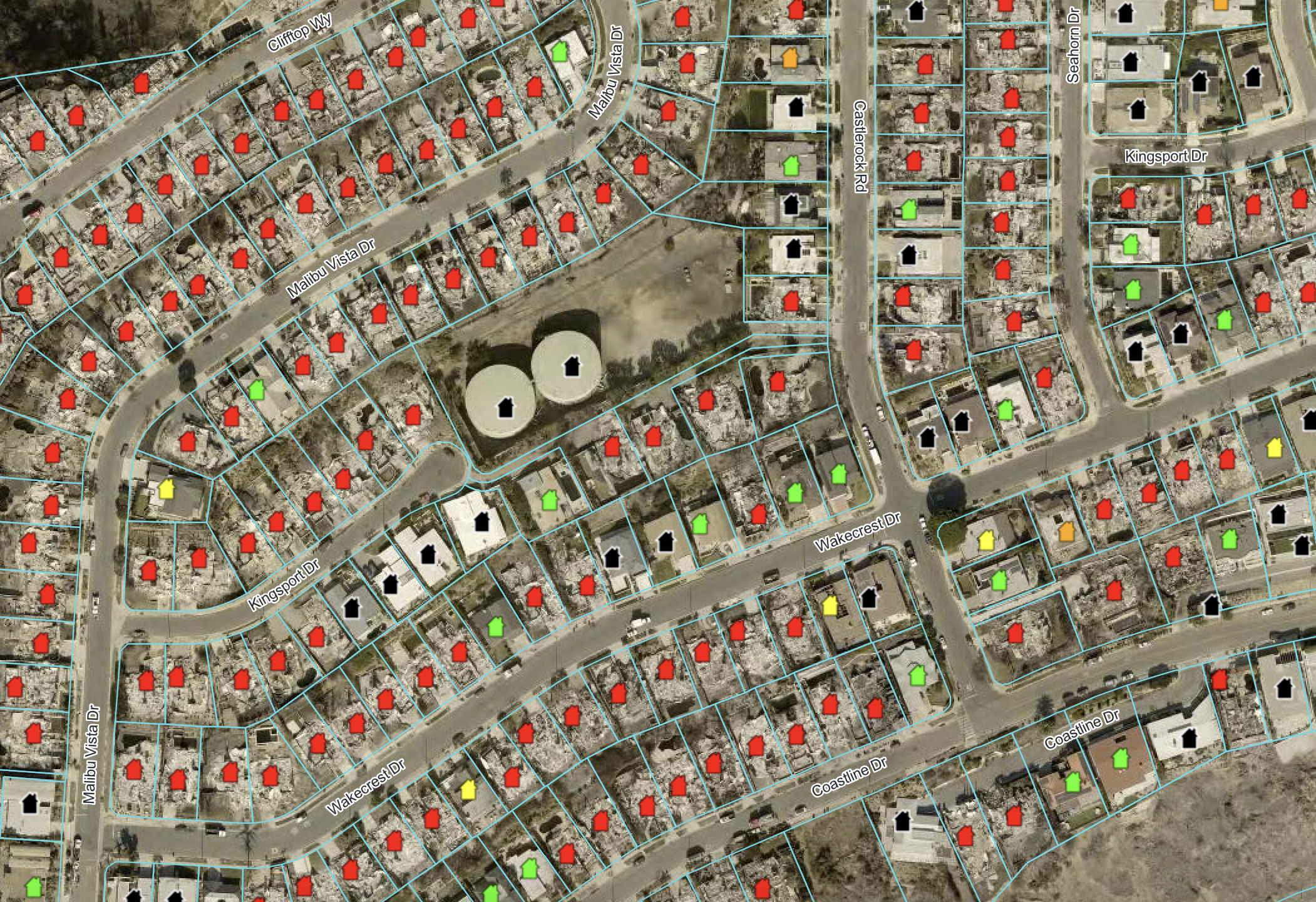
Recently, I finally had the bandwidth to review the three different cleaning proposals I had received to clean the inside walls and manage the cleanup of the contents of my home. The prices range from $30,000 to $78,000, with one right in the middle. I now must figure out which makes the most sense so my home is clean for me to live there and for my family to visit. The trauma from the fire is still real and I struggle to understand why it happened and why our community didn’t prepare better.
I hope to be able to help other communities avoid this experience, while I continue to advocate for commercial building owners making their buildings more energy efficient to reduce the emissions they send into our atmosphere, in order to help reduce the impact of climate change on the weather patterns that we must now live through. It has been a difficult year, I hope with time and moving back into my home, I can start to enjoy my garden and the fruits of my labor.
Published September 8, 2025 Permalink Citation
Erdely, M. (2025, September 8). Why Did My House Survive?. Retrieved from https://www.buildinggreen.com/blog/why-did-my-house-survive
Comments
Re: comments on main issue

Hi Christopher, please hit the feedback button on the right of your screen, or send your comments to editor@buildinggreen.com. We will have 4 themed digital issues per year like the one we released yesterday, plus more articles and CEUs on our main site as before.
comments on main issue

Is there no way to comment on the new format, style etc. ?



Add new comment
To post a comment, you need to register for a BuildingGreen Basic membership (free) or login to your existing profile.