Can you make your life more resilient in case of disaster? Yes, and it may be greener, too.
Sometimes being a practical person isn’t that fun. Last night my wife and I were watching the classic 1977 movie, “Close Encounters of the Third Kind.”
Leading up to the climactic scene, the protagonists are racing to the location where they expect aliens to appear, while outrunning the U.S. Army and the United Nations. To do this, they must escape the authorities and their cattle cars, drive a station wagon off-road through Wyoming, and spend several hours scrambling up the dry, rocky landscape around Devil’s Tower.
Setting aside whether they or their station wagon are capable of these feats, I kept thinking, why the heck didn’t they bring some water along? Forget the aliens—I’d be trying to slake my thirst after a couple hours of this! Instead of the closing credits, I’d like to see the scene after our hero boards the flying saucer, as he figures out how to intone to the alien, “Do you have some H2O?” Hopefully that’s on the in-flight service menu.
Making life safer and easier if Fukushima happens nearby
I don’t do well without food, water, and other basic stuff like that. Sometimes it makes me complain about movie plots. Sometimes it leads to interesting conversations.
I just got off the phone with a reporter from Florida who saw my column from a couple weeks ago about how to measure nuclear radiation and contamination. He asked me, “How can homeowners shield themselves from the types of plant accidents that are occurring in Japan? Are there green solutions that may make life easier should such a disaster happen nearby?”
SUPPORT INDEPENDENT SUSTAINABILITY REPORTING
BuildingGreen relies on our premium members, not on advertisers. Help make our work possible.
He immediately assumed that there is not much you can do, relative to nuclear safety. Not so—there is a lot you can do depending on the situation. I’m a journalist, not an expert on nuclear issues, there is a lot you can to do to protect yourself from the worst fallout by staying sheltered. Regional and federal authorities, as well as other groups, have a lot more information on those issues.
Would you be prepared?
Let’s say there has been an incident where your most practical and safe option is to stay at home, but external power, water, and services are not functioning. Would you be prepared, or would you be like the guy trying to figure out how to ask aliens for water?
A lot of us have learned the hard way that we’re not very well prepared. A couple major ice storms in the last decade in New England, the August 2003 blackout, Hurricane Katrina, flooding in the Midwest—you may not have to look far back in your memory banks for a situation that challenged your home’s livability, or at least someone you know or saw on TV.
There is a lot you can do—it’s called passive survivability
The good news is that if you’ve thought about things in advance, there is a lot you can do to make your home or community more livable in extreme conditions. There is a concept for this, pioneered by my colleague Alex Wilson: passive survivability. Passive survivability is, in short, a building’s ability to maintain critical life-support conditions if services such as power, heating fuel, or water are lost. Resilient design is another term for this, and both concepts can be extended from the building to the community scale.
The neat thing about passive survivability is that it’s not just for emergencies. Using these practices can reduce your environmental impact, and your energy bill, year-round.
Using, not wasting, solar heating
Losing power or heating fuel in the winter can not only render buildings quickly uninhabitable, but exposing water piping and hydronic heating pipes to freezing temperatures can cause catastrophic damage both to those systems and to the home itself, due to water damage.
To counter this, maximize your use of passive solar heating. If building new, orient on an east-west axis, with the long side facing south. Use windows on the south face with a high solar-heat-gain coefficient. (With good insulation, passive solar doesn’t take as many windows as you may be picturing, by the way.)
If you don’t have the luxury of spinning your home around on its lot to get better solar orientation, stop and observe. How is solar heating as a resource is being used—or blocked? Blinds that are always closed, or landscaping that started out small but that is now blocking the sun through the winter, may be hindering your access to free heat. Doing an energy audit may reveal easy ways to make your home tighter, and keep inside the solar heat you do get.
Avoid deadly heat during summertime blackouts
Be careful to balance heating and cooling. Summertime blackouts can be deadly, with high indoor temperatures causing heat stroke. Before air-conditioning was common, we reduced our need for cooling through simple design measures. For example, small roofs or overhangs over different designs over windows are a nifty design feature, common on older homes, that make your window’s paint job last longer. They can also be designed to allow in low-angle winter sun, when you need it for heating, but block summer sun that is high in the sky. Using awnings and blinds, as well as opening windows at night to flush the heat out are other great ways to naturally stay cool.
Use onsite renewables. When a tree hits the power line, or worse, it’s great to have a renewable power source onsite. We live off the grid, and at one point last fall, our neighbor stopped by to charge her iPhone at our house after a tree knocked out power on our road. I was happy to share the electrons, which were plentiful that day.
Intermediate steps to going off the grid
Going off the grid is a big move, but there are intermediate steps. For a few hundred bucks you can buy out-of-the-box systems that use a couple of small solar panels and basic electronics. These can help with smaller essentials like charging a phone in the event of an outage.
For a more sophisticated system, get help from a local professional. It’s common these days to use grid-tied solar power, and that’s a great way to get started, but you won’t have access to that power if the grid goes down unless you design it with that in mind. That may require an inverter, a battery bank, and other switches and controls. Look at key appliances that you would like to keep on during an outage—like your furnace, for example—and try to keep a system affordable by addressing just these loads. It will cost you a bit, but there are very attractive tax incentives in place right now to lighten the load.
Don’t forget the root cellar
One great resource you don’t hear discussed a lot these days is a root cellar. Having canned goods and root vegetables put away for the winter (or as part of your year-round pantry) used to be common practice, but the 24-hour supermarket seems to have blotted this kind of space from our memories. Besides having access to tasty, nutritious food from your own garden year-round, a root cellar provides a great buffer in case services get interrupted following an earthquake or oil embargo. The empty shelves in Tokyo last month demonstrate the value of that. Your house may have had a root cellar in the past, or you may find a space like the bulkhead that’s perfectly suited to it.
Consider storing extra water. You can get kits at any hardware store to set up a gutter and a rain barrel to collect a few extra gallons, or you can get fancy and set up a rainwater harvesting system tied into your home water supply. Either way, such a system will provide a buffer for washing your hands, flushing the toilet, or even cooking and drinking with (provided the system is designed with proper sanitation), in case you lose power to your well pump, or the city loses power to its treatment systems.
And you’ll always have a glass of water on hand in case you want to chase down some extra-terrestrials. Just make sure to offer them some, too. Mars is pretty dry these days.
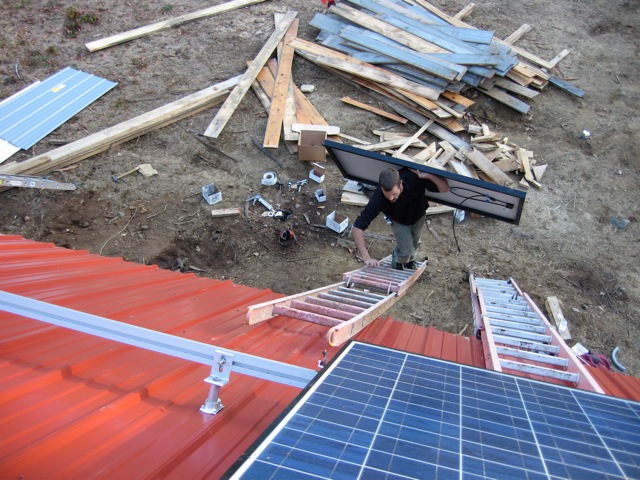
Images: Close Encounters of the Third Kind Installing my PV panels with help from Simon.
(2011, April 12). Surviving a "Close Encounter" with Disaster. Retrieved from https://www.buildinggreen.com/news-article/surviving-close-encounter-disaster
The advice to keep extra water on hand is absolutely sound. It's the first, most critical resource for survival and should be first priority. We have a half dozen 5-gallon bottles stashed in the basement. It's important to keep them in the dark (prevent algae growth) and change them out every couple of years since they will get funky at some rate.
For food, we used to keep jars of dried beans until we realized just how much time (hours and hours) and fuel is required to cook them. Now we keep lentils instead, which don't require soaking and cook up much faster (particularly the red lentils).
Of course, you need a heat source if you're going to cook anything. We have a gas grill, which is great for general use in the summer but also provides us with an off-grid source of cooking heat in an emergency. We keep several of the 5-gallon propane tanks on hand as an emergency fuel source. We also bought an adapter that lets us connect these large tanks to a camp stove (which normally takes small propane canisters) so we have a way to boil water in an emergency.






Add new comment
To post a comment, you need to register for a BuildingGreen Basic membership (free) or login to your existing profile.