Fear and Clothing: How Our Sense of Risk Endangers Us
Risk perception is irrational and does not respond well to data. Can we make the leap from science to persuasion without leaving the facts behind?
Is our fear of nuclear power misplaced? Maybe polka-dotted pj's are a more realistic threat.
As news began to trickle out of Japan about the impending meltdown at a nuclear plant, I knew what was coming. Any second now, the local anti-nuclear folks would be protesting Vermont Yankee, an aging nuclear plant in Vernon, Vermont that is developing a pretty serious incontinence problem.
While my sympathies lie almost entirely with the protestors--I don't like the plant and don't trust its owners--I don't participate in these events. Though many of the protestors are educated about all the problems associated with nuclear power generation, the rhetoric seems to focus on fear of meltdown rather than more pressing issues.
You can see why, though: it gets people's attention. Despite the fact that meltdown is a vanishingly remote possibility (assuming we are vigilant, the worst-case scenario is apparently preventable even if you have a major earthquake and a tsunami), it is the thing many people fear most about nuclear power. We seem to ignore real and present dangers while distracted by our phobias of horrifying but highly improbable events.
What are you wearing?
As an example, what is that you're wearing?
SUPPORT INDEPENDENT SUSTAINABILITY REPORTING
BuildingGreen relies on our premium members, not on advertisers. Help make our work possible.
What evil lurks in the fibers of flame-retardant pajamas? And what counts as a realistic sense of risk in our daily lives?
A coworker casually mentioned the other day that we may unwittingly be buying clothing treated with the same chemicals the green building community has been trying to get out of carpets and upholstery for years--flame retardants, stain repellents, and antimicrobials. I could not confirm the details, but clothing manufacturers are not required to supply an ingredient list--and I have noticed that some clothing labels actually market these chemicals as though they were a good thing.
I'm not sure why anyone would want pesticides in their pants, but I shudder to think what happens to these chemicals after they come out in the wash. And while I try not to think too much about everything that is slowly killing my family, I'm much more concerned that my child's insides will be bathed in toxic substances than I am that she will spontaneously combust and take her jammies with her.
But that's just me, apparently. A lot of people seem willing to accept the ignorable, long-term risks caused by constant chemical immersion in order to feel safe from an easily imaginable but highly improbable horror like burning to death. I can't blame them for that (although manufacturers who trade on people's phobias don't get a free pass). Like everyone else, I have my own quirky sense of danger that probably makes no sense to anyone else. If spring ever comes to Vermont, I'll be blithely risking my life twice a day by riding my bike to and from work--but don't get me started on my terror that I will get into a minor fender-bender someday and have my neck broken by my own air bag.
The bizarre psychology of risk
Apparently, the bizarre psychology of risk is a well known phenomenon; our perception of risk is visceral and is affected intensely by minute-to-minute conditions (which is probably why people in hot rooms are more likely to express concern about global warming than people in cold rooms). This is problematic, to say the least, when it comes to long-term planning on a large scale, in part because it has a huge effect on our political discourse. People's irrational, erratic perception of risk makes it very difficult for us to process data about "inconvenient truths" like climate change. I don't think anyone has figured out quite what to do about it.
It's something we really need to face, though, especially given our reluctance to address remote and long-term risks. One thing that bothers a lot of us who loooove charts is that statistics don't tend to persuade people who don't already agree with us. You can fill the ear of a global warming denier with data for hours, and in most cases your numbers will come out the other ear unprocessed, because of optimism bias--our tendency to believe that things will come right in the end. This does not happen because the person is stupid; it happens because the person is human. The same phenomenon keeps me happy-go-lucky on my bike despite the dangers (and has also kept me, so far, from having my car's air bags disabled). In a very real way, we believe exactly what we want to believe, regardless of what the charts say.
As we look to our energy future in the wake of a nuclear crisis in Japan, two major oil spills in the Gulf of Mexico, water pollution caused by hydraulic fracturing methods used to extract natural gas, and many other energy-related travesties, we need to find responsible but rhetorically compelling ways to help people get a more immediate sense of the risks involved.
Numbers don't lie, but they also don't usually convince. How might we appeal to people's visceral understanding of danger while ensuring we remain true to the facts? Preferably before the next disaster happens?
UPDATE:
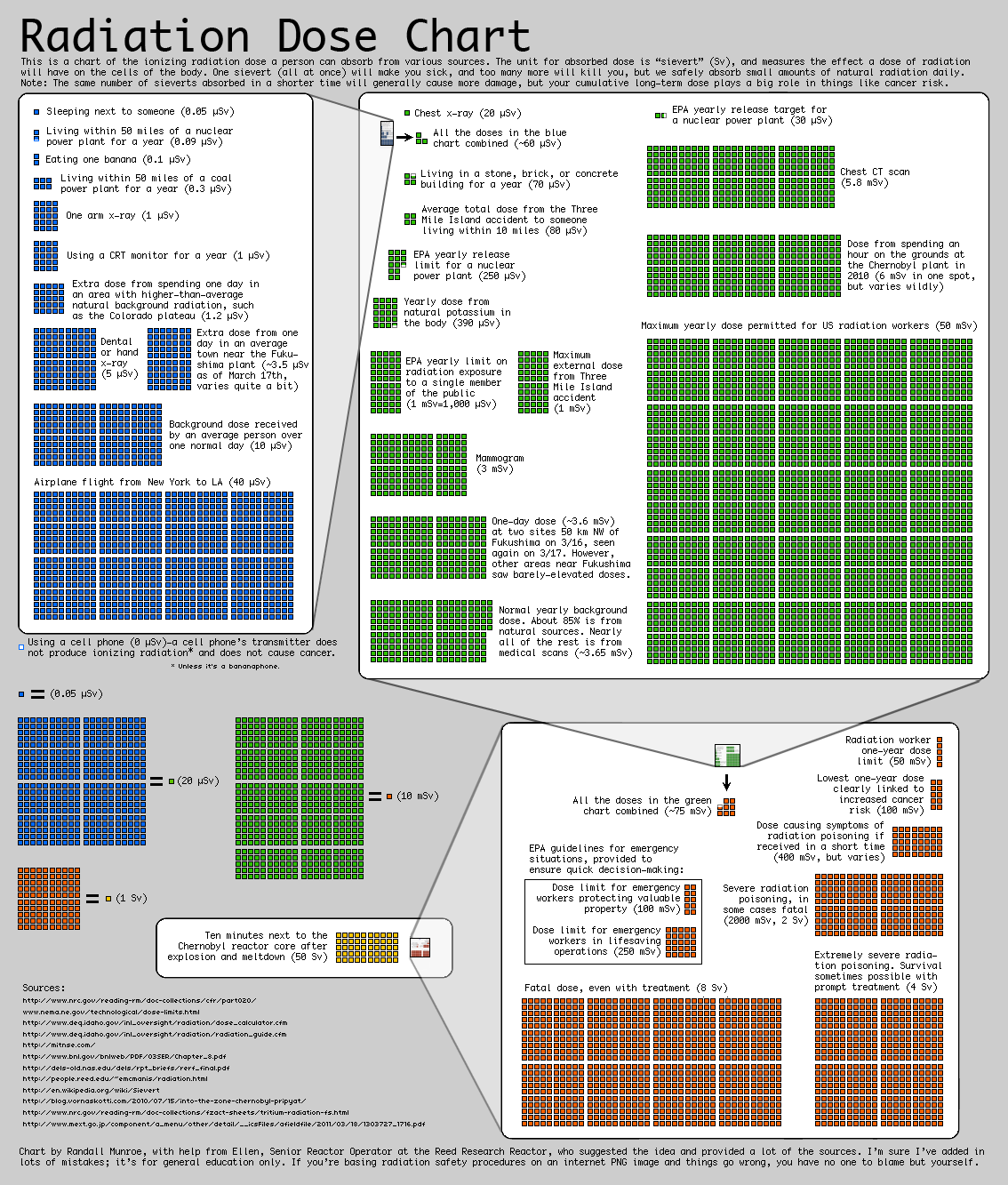
In the comments, Eric links to a brilliant chart by XKCD that puts radiation exposure in perspective. Humans seem to be particularly bad at understanding orders of magnitude, and this demonstrates it pretty well. However, I'm posting it not only because I like it but also because my liking it does absolutely nothing to convince anyone of anything. I suspect a lot of people who do not love charts would look at this image and feel their eyes glazing over pretty quickly. It is enlightening, but aside from the banana joke is not rhetorically compelling. This is not a criticism; the chart is not meant to do that job. But it is something for people who care about sustainability to think about: you can't change the world with charts alone.
(2011, March 24). Fear and Clothing: How Our Sense of Risk Endangers Us. Retrieved from https://www.buildinggreen.com/blog/fear-and-clothing-how-our-sense-risk-endangers-us
About the pajamas, since some incidents (in the '60s? '70s?), federal law has required that children's pajamas either be flame-retardant or fit snugly -- which is pretty darn tight. Good regulation or not? I don't have the numbers.
My main concern for nuclear power generation is the waste generated. After 50 years of producing the waste, we still don't know how to safely dispose of it. Just continuing to store it at the site is not a long term solution but it is a l-o-n-g t-e-r-m problem.
I completely agree with you, Jerry. Unfortunately, it doesn't seem to get people's attention like the possibility of meltdown does. I think serious optimism bias comes in here: people assume it's safely stored and don't really want to hear otherwise, perhaps.
Eric, I am going to add that XKCD chart above, because it's actually the thing that inspired this post.
Paula, you ask "How might we appeal to people's visceral understanding of danger while ensuring we remain true to the facts?"
In terms of nuclear accidents, there is nothing more visceral than watching the news coming out of Japan today. But it's at least as important to get your facts straight.
You claim that a nuclear reactor meltdown is "a vanishingly remote possibility" and that "assuming we are vigilant, the worst-case scenario is apparently preventable even if you have a major earthquake and a tsunami".
First, it's clear to the NRC that there's been a partial core meltdown at one or more of the Fukushima nukes, that the owners have been ill-prepared and so-far unable to prevent significant releases of radiation, and we don't yet know what the short or long-term consequences might be. It's also a misguided assumption that the US nuclear industry will be "vigilant", since investigations have turned up widespread fraud in safety testing – including of back up generators required to operate the cooling systems in the event of a loss of primary power (as happened in Japan).
Second, you ignore the fact that there have been five partial core meltdowns in the US since the start of the nuclear age and that, in testimony before Congress following the Chernobyl disaster, NRC Commissioner James K. Asselstine stated "...given the present level of safety being achieved by the operating nuclear power plants in this country, we can expect to see a core meltdown accident with in the next 20 years." And NRC Commissioner James Asselstine stated that "While we hope that their occurrence is unlikely, there are accident sequences for U.S. plants that can lead to rupture or bypassing of containment in U.S. reactors which would result in the off-site release of fission products comparable or worse than the releases estimated by the NRC staff to have taken place during the Chernobyl accident."
This was well before the NRC began extending operating licenses for obsolete nuclear power plants of the same reactor type which just ruptured in Japan. So, before you dismiss anti-nuclear activists of using unfounded scare tactics, you might get your facts straight.







Add new comment
To post a comment, you need to register for a BuildingGreen Basic membership (free) or login to your existing profile.