Kempthorne Takes over Department of Interior

News Brief

Kempthorne Takes over Department of Interior

In May 2006, the U.S. Senate confirmed Dirk Kempthorne to succeed Gale Norton as head of the Department of the Interior, which manages 20% of all land in the U.S. Kempthorne, who has served in the U.S. Senate and as governor of Idaho, has worked to open national lands to logging, mining, and drilling; the League of Conservation Voters (LCV) gave Kempthorne a lifetime score of 1%. However, one of Kempthorne’s first actions was to release a National Park Service management plan that reverses a Bush administration effort to weaken environmental safegaurds and reaffirms a core committment to land protection.

Published December 31, 1969

(2006, July 9). Kempthorne Takes over Department of Interior. Retrieved from https://www.buildinggreen.com/departments/newsbrief

Add new comment

To post a comment, you need to register for a BuildingGreen Basic membership (free) or login to your existing profile.

Study Links Bisphenol-A to Cancer

News Brief

Study Links Bisphenol-A to Cancer

A study published in the journal

Cancer Research in June 2006 links bisphenol-A (BPA)—used to make the hard, clear plastic polycarbonate as well as most epoxies—to cancer. BPA, which mimics the human hormone estrogen, altered the structure of genes in rats’ prostate cells when they were exposed to low doses of the chemical, the study found. The changes affect how DNA sequences turn on and off, making subjects more susceptible to cancer later in life. More startling, the changes are believed to be passed on to future generations.

Published December 31, 1969

(2006, July 9). Study Links Bisphenol-A to Cancer. Retrieved from https://www.buildinggreen.com/departments/newsbrief

Add new comment

To post a comment, you need to register for a BuildingGreen Basic membership (free) or login to your existing profile.

Resurrected 7 World Trade Center Earns LEED Gold

News Brief

Resurrected 7 World Trade Center Earns LEED Gold

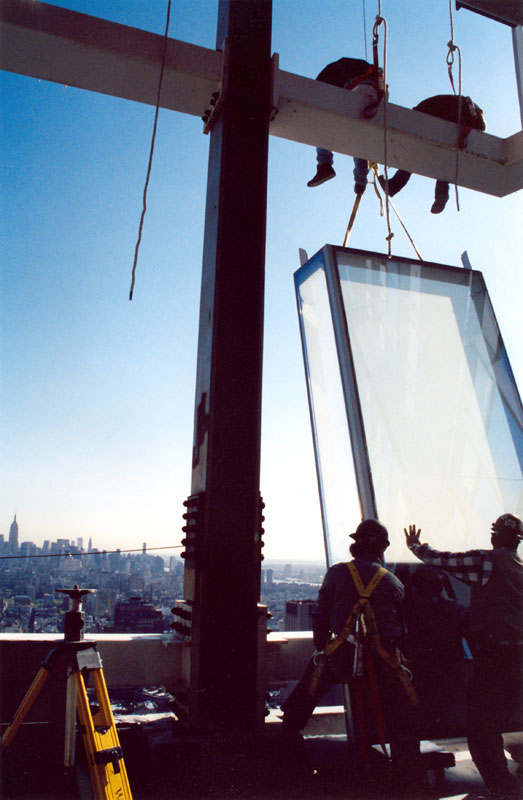
New York City’s first office tower to earn LEED® certification from the U.S. Green Building Council (USGBC), 7 World Trade Center has earned a Gold rating in LEED for Core and Shell (LEED-CS). USGBC President and CEO Rick Fedrizzi congratulated the project team, noting that the building “will help us use the language of architecture to build a very different kind of skyline, one whose value is measured not just in beauty but also in operational efficiency, in environmental sensitivity, and in improved health for those lucky enough to occupy the space.” Reconstructed following its collapse on September 11, 2001, 7 World Trade Center reopened in April 2006.

Published December 31, 1969

(2006, July 9). Resurrected 7 World Trade Center Earns LEED Gold. Retrieved from https://www.buildinggreen.com/departments/newsbrief

Add new comment

To post a comment, you need to register for a BuildingGreen Basic membership (free) or login to your existing profile.

AIA Announces Call for Presentations

News Brief

AIA Announces Call for Presentations

The American Institute of Architects (AIA) will accept presentation proposals for its 2007 national convention and design exposition, themed “Growing Beyond Green,” through July 1, 2006. The conference will be held May 3-5, 2007, in San Antonio. Details are online at www.aia.org/conted_convention/. For more on AIA’s commitment to green design, see

EBN

Vol. 15, No. 1.

Published December 31, 1969

(2006, June 7). AIA Announces Call for Presentations. Retrieved from https://www.buildinggreen.com/departments/newsbrief

Add new comment

To post a comment, you need to register for a BuildingGreen Basic membership (free) or login to your existing profile.

Jane Jacobs, Champion of Dense, Diverse Cities, Dies

News Brief

Jane Jacobs, Champion of Dense, Diverse Cities, Dies

Jane Jacobs, an advocate for dense and lively cities best known for her 1961 book The Death and Life of Great American Cities, died April 25, 2006, at age 89. While Jacobs did not have formal architectural training, she had an inside view of urban renewal projects from an editorial post at Architectural Forum magazine and a keen appreciation of the urban life she observed from her perch in the Greenwich Village neighborhood of New York City. With a fresh, narrative perspective, she challenged the convention of replacing dense slums with high-rises surrounded by open space and freeways. Jacobs called for multi-use districts; short blocks; buildings variable in age, condition, and use; and dense population. Critics and champions were many, but all would probably agree with The New York Times’ 2003 assessment, citing Jacobs’ eye-opening critique of modern architecture, that called the book’s publication “one of 20th-century architecture’s most traumatic events.”

Published December 31, 1969

(2006, June 7). Jane Jacobs, Champion of Dense, Diverse Cities, Dies. Retrieved from https://www.buildinggreen.com/departments/newsbrief


Add new comment

To post a comment, you need to register for a BuildingGreen Basic membership (free) or login to your existing profile.

World Trade Center Dust Claims First Confirmed Victim

News Brief

World Trade Center Dust Claims First Confirmed Victim

Detective James Zadroga’s January 5, 2006, death of respiratory failure is the first to be officially blamed on exposure to dust from the September 11, 2001, collapse of the World Trade Center. “It is felt with a reasonable degree of medical certainty that the cause of death in this case was directly related to the 9/11 incident,” according to the coroner’s report. Zagroda, 34, did not smoke and had no history of asthma, but spent 450 hours in recovery efforts at the Trade Center site, according to an April 14, 2006, New York Times article. “I cannot personally understand that anyone could see what I saw in the lungs, and know that the person was exposed to Ground Zero, and not make the same link I made,” Dr. Gerard Breton, who performed the autopsy, told The New York Times.

Published December 31, 1969

(2006, June 7). World Trade Center Dust Claims First Confirmed Victim. Retrieved from https://www.buildinggreen.com/departments/newsbrief
Add new comment

To post a comment, you need to register for a BuildingGreen Basic membership (free) or login to your existing profile.

Brockton, Massachusetts, Breaks Ground on Solar Brightfield

News Brief

Brockton, Massachusetts, Breaks Ground on Solar Brightfield

Groundbreaking ceremonies for what is projected to be New England’s largest photovoltaic energy array occurred in Brockton, Massachusetts, in time for Earth Day in April 2006. The Brockton “Brightfield” project will transform a brownfield, the former site of the Brockton Gas Works, into a 425-kilowatt renewable energy plant run by the city. The site is being developed by Global Solar Energy, Inc., and will use 1,395 ASE300 (310 watt) modules manufactured by Billerica, Massachusetts-based Schott Solar, Inc. The $3 million project, planned for September 2006 completion, is being paid for by the city of Brockton, the Massachusetts Renewable Energy Trust, the U.S. Department of Energy, and the U.S. Environmental Protection Agency.

Published December 31, 1969

(2006, June 7). Brockton, Massachusetts, Breaks Ground on Solar Brightfield. Retrieved from https://www.buildinggreen.com/departments/newsbrief

Add new comment

To post a comment, you need to register for a BuildingGreen Basic membership (free) or login to your existing profile.

Chicago to Erect Wind Turbines on Daley Center

News Brief

Chicago to Erect Wind Turbines on Daley Center

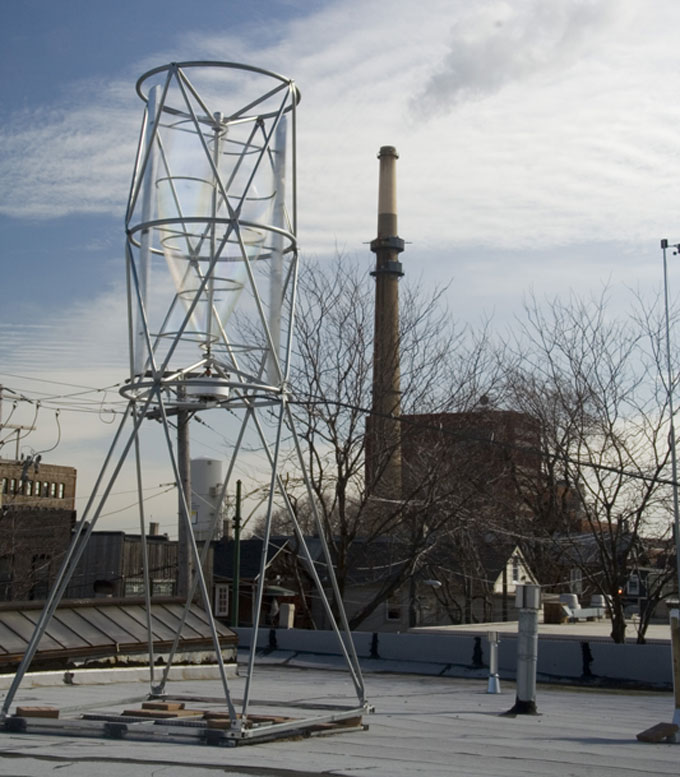
Chicago Mayor Richard M. Daley has announced that four wind turbines will be erected on the roof of the Richard J. Daley Center. The machines, Aeroturbines, were invented by Bil Becker, a professor of industrial design at the University of Illinois at Chicago, and manufactured by Aerotecture International, Inc., based in Chicago. The turbines are silent, self-regulating, vibration-free, and safe for birds, according to the Department of Environment. Aerotecture is online at www.aerotecture.com.

Published December 31, 1969

(2006, June 7). Chicago to Erect Wind Turbines on Daley Center. Retrieved from https://www.buildinggreen.com/departments/newsbrief

Add new comment

To post a comment, you need to register for a BuildingGreen Basic membership (free) or login to your existing profile.

Solar Trough Power Plant Opens in Arizona

News Brief

Solar Trough Power Plant Opens in Arizona

Arizona Public Service Company (APS) has announced the opening of the state’s first solar-thermal power plant, and the first built in the nation in 17 years. Built by Solargenix Energy, LLC, of Raleigh, North Carolina, the plant features over 100,000 ft2 (9,000 m2) of parabolic-trough mirrors—looking like several rows of mirrored half-pipe—that focus sunlight on pipes filled with mineral oil (see EBN Vol. 13, No. 5). The superheated oil vaporizes a second fluid through heat transfer, and the vapor spins a turbine to generate 1 MW of electricity, enough to power 200 homes. Energy storage capacity allows the fully automated plant to supply the energy when it’s needed. The plant is the first solar trough system to use an organic Rankine cycle power block for generation; this configuration is more typical of geothermal or biomass plants and allows for generation at lower temperatures. Construction of the $6 million plant began in June 2004 and ran for 15 months. Solargenix is currently constructing a 64 MW solar thermal power plant in Boulder City, Nevada, expected to be the largest of its type when finished next year (see EBN Vol. 14, No. 12). Solargenix is online at www.solargenix.com. Read more on Solargenix and solar thermal technology in EBN Vol. 13, No. 5.

Published December 31, 1969

(2006, June 7). Solar Trough Power Plant Opens in Arizona. Retrieved from https://www.buildinggreen.com/departments/newsbrief

Add new comment

To post a comment, you need to register for a BuildingGreen Basic membership (free) or login to your existing profile.

Maine Offers Mercury Thermostat Recycling Incentive

News Brief

Maine Offers Mercury Thermostat Recycling Incentive

In April 2006, Maine became the first state to offer a financial incentive for recycling building thermostats that contain mercury and the first state to mandate thermostat recycling for homeowners. Previous laws banned the sale of new mercury thermostats and required recycling by wholesalers. A minimum $5 incentive will be offered for each thermostat turned in, and all manufacturers that have sold mercury thermostats in Maine must develop a recycling program or risk being banned from the market. The Product Stewardship Institute (PSI) mediated the new law, shaping a consensus among the Thermostat Recycling Corporation, the Natural Resources Council of Maine, the Maine Department of Environmental Protection, and the Environmental Health Strategy Center. According to PSI, Maine is one of a dozen states regulating disposal of mercury thermostats. Details are online at www.productstewardship.us.

Published December 31, 1969

(2006, June 7). Maine Offers Mercury Thermostat Recycling Incentive. Retrieved from https://www.buildinggreen.com/departments/newsbrief

Add new comment

To post a comment, you need to register for a BuildingGreen Basic membership (free) or login to your existing profile.