Grocery Store Earns LEED Gold

News Brief

Grocery Store Earns LEED Gold

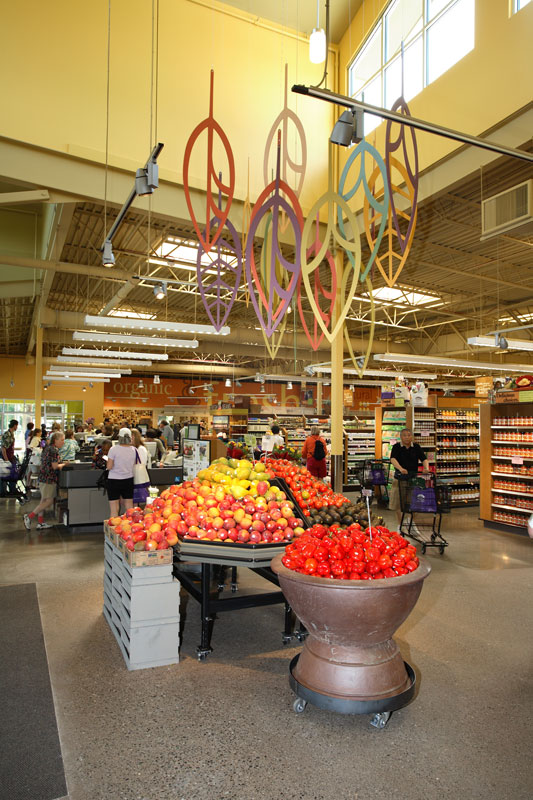
The Redmond, Washington, branch of Seattle-based PCC Natural Markets became the first grocery store to achieve a Gold certification in any of the U.S. Green Building Council’s LEED rating systems. The store, certified under LEED for Commercial Interiors, features 28 skylights that bring daylight into the store and reduce general lighting electricity use to an anticipated 0.21 watts/ft2 (2.25 W/m2), an 86% reduction compared with a base case building in minimal compliance with Washington State code requirements; electricity use for accent lighting is expected to be 37% lower than code. Waste heat from the refrigerators is used for space and water heating, and overall energy savings are expected to be 50% compared with a code-compliant store. Recycled-content materials were used throughout, as were finishes with low levels of volatile organic compounds. More information is available at www.pccnaturalmarkets.com/locations/rd.html.

Published December 31, 1969

(2007, August 30). Grocery Store Earns LEED Gold. Retrieved from https://www.buildinggreen.com/departments/newsbrief

Add new comment

To post a comment, you need to register for a BuildingGreen Basic membership (free) or login to your existing profile.

Canadian Building Organizations Abandon Cross-Promotion Plan

News Brief

Canadian Building Organizations Abandon Cross-Promotion Plan

The Canada Green Building Council (CaGBC) and the Building Owners and Managers Association of Canada (BOMA Canada) have discontinued negotiations towards a cooperative relationship. According to Nancy Grenier, manager of communications for CaGBC, the two organizations had been pursuing a relationship in which they would promote each others’ products: CaGBC’s LEED rating systems and BOMA Canada’s GoGreen and GoGreen Plus certification programs. CaGBC’s LEED systems are currently focused on new construction, with most existing building certifications going to BOMA’s programs or to the U.S. Green Building Council’s LEED for Existing Buildings rating system. GoGreen was developed by the British Columbia chapter of BOMA Canada, and GoGreen Plus is BOMA’s implementation of the Green Globes assessment tool for existing buildings. While CaGBC fully supported GoGreen Plus as a robust, third-party-verified certification system for existing buildings, said Grenier, it had some reservations about GoGreen, and the two organizations could not come to agreement on the issue. Both parties agreed to end the negotiations and will look for other ways to collaborate on green building issues.

Published December 31, 1969

(2007, August 2). Canadian Building Organizations Abandon Cross-Promotion Plan. Retrieved from https://www.buildinggreen.com/departments/newsbrief

Add new comment

To post a comment, you need to register for a BuildingGreen Basic membership (free) or login to your existing profile.

New Version of Cradle to Cradle Certification Program Released

News Brief

New Version of Cradle to Cradle Certification Program Released

McDonough Braungart Design Chemistry (MDBC) has released a draft of the version two criteria for its Cradle to Cradle (C2C) product certification program. The most significant changes to C2C, which certifies an array of consumer and building products based on MBDC’s environmental philosophy, are a new “Basic” level of certification and increased stringency for the previous entry level, Silver. According to MDBC’s Jay Bolus, the intent behind the new level is to show manufacturers that “you’re in the game but there are some things in your product that we find unacceptable at Silver, Gold, and Platinum levels.” Bolus also noted that Gold has become more achievable through a reduction in renewable energy requirements. A comment period is expected to run through summer 2007. For more information, see

EBN

Vol. 16, No. 2, and www.c2ccertified.com.

Published December 31, 1969

(2007, August 2). New Version of Cradle to Cradle Certification Program Released. Retrieved from https://www.buildinggreen.com/departments/newsbrief

Add new comment

To post a comment, you need to register for a BuildingGreen Basic membership (free) or login to your existing profile.

Treated Wood Susceptible to Rot, Says Study

News Brief

Treated Wood Susceptible to Rot, Says Study

A study published in

Forest Products Journal in June 2007 found that wood treated with copper azole or alkaline copper quaternary compound (ACQ) to both above-ground and ground-contact levels is prone to damage from brown-rot fungi. Both chemicals were introduced to replace chromated copper arsenate for residential use several years ago (see

EBN

Vol. 15, No. 8) and together are the current industry standard. Test samples treated with both chemicals lost 20%–60% of their mass due to rot; the study concludes that wood treated to current standards may not be adequately protected. While gathering samples for the study, researchers found that wood treated to higher-retention ground-contact levels was not available at many lumberyards, suggesting that many consumers are using lower retention treated wood in ground-contact applications, creating even greater risk for rot.

Published December 31, 1969

(2007, August 2). Treated Wood Susceptible to Rot, Says Study. Retrieved from https://www.buildinggreen.com/departments/newsbrief

Add new comment

To post a comment, you need to register for a BuildingGreen Basic membership (free) or login to your existing profile.

New Energy Star Specification for Home Plans

News Brief

New Energy Star Specification for Home Plans

The U.S. Environmental Protection Agency (EPA) is currently drafting a new specification for home plans called Designed to Earn Energy Star. EPA expects to complete the specification by the end of 2007, after two rounds of comments from stakeholders. The current version of the specification requires home plans to be accompanied by information on the energy efficiency of mechanical systems, windows, lighting fixtures, and the building envelope, among other home features. Once the specification is complete, architects and designers will be able to sign a partnership agreement with EPA that will allow them to use the Energy Star logo on plans for houses that meet the specifications. Those interested in the program should contact Zak Shadid, operations coordinator for the Energy Star Homes program, at shadid.zachary@epa.gov or visit www.energystar.gov/homes/.

Published December 31, 1969

(2007, August 2). New Energy Star Specification for Home Plans. Retrieved from https://www.buildinggreen.com/departments/newsbrief

Add new comment

To post a comment, you need to register for a BuildingGreen Basic membership (free) or login to your existing profile.

USGBC Hits 10,000-Member Mark

News Brief

USGBC Hits 10,000-Member Mark

The U.S. Green Building Council (USGBC) announced in July 2007 that it had reached a total of 10,000 member companies, signaling large growth in the previous year. The 2007 figure represents a growth of 2,800 members over 2006 numbers; USGBC gained a total of 4,800 members between 2002 and 2006. Member companies include architects, manufacturers, engineers, facilities managers, trade associations, and other building professionals. More information on USGBC membership is available at www.usgbc.org/membership/.

Published December 31, 1969

(2007, August 2). USGBC Hits 10,000-Member Mark. Retrieved from https://www.buildinggreen.com/departments/newsbrief

Add new comment

To post a comment, you need to register for a BuildingGreen Basic membership (free) or login to your existing profile.

Design Guide for IAQ in Development

News Brief

Design Guide for IAQ in Development

Six organizations have joined forces to create a design guide focused on indoor air quality (IAQ) in nonresidential buildings. The U.S. Environmental Protection Agency initially decided to fund a design guide and reached a cooperative agreement with the American Society of Heating, Refrigerating, and Air-Conditioning Engineers. A memorandum of understanding, signed in May 2007, brought four other organizations onto the project: the U.S. Green Building Council, the Building Owners and Mangers Association, The American Institute of Architects, and the Sheet Metal and Air-Conditioning Contractors’ National Association. Slated for release in 2009, the guide, which will be followed by a professional development course, will describe an integrated process for achieving good IAQ in buildings.

Published December 31, 1969

(2007, August 2). Design Guide for IAQ in Development. Retrieved from https://www.buildinggreen.com/departments/newsbrief


Add new comment

To post a comment, you need to register for a BuildingGreen Basic membership (free) or login to your existing profile.

Third-Largest Power Plant Goes On Line

News Brief

Third-Largest Power Plant Goes On Line

Nevada Solar One, a 64-megawatt solar-thermal power plant in Boulder City, Nevada, became fully operational in June 2007. The plant, among the largest in the world, features parabolic-trough mirrors that focus sunlight on tubes filled with a synthetic oil, heating it to over 700°F (370°C). The hot oil flows to a central plant, where it passes through a heat exchanger, generating the steam that drives a turbine to create electricity. The energy produced on the 300-acre site will power about 15,000 average homes and will be delivered primarily during peak demand times—summer afternoons and evenings. Acciona Solar Power is online at www.acciona.com; for more on parabolic-trough collectors, see

EBN

Vol. 13, No. 5.

Published December 31, 1969

(2007, August 2). Third-Largest Power Plant Goes On Line. Retrieved from https://www.buildinggreen.com/departments/newsbrief
Add new comment

To post a comment, you need to register for a BuildingGreen Basic membership (free) or login to your existing profile.

SIPs Accepted into Residential Code

News Brief

SIPs Accepted into Residential Code

Until recently, builders using structural insulated panels (SIPs) had to work with an architect or engineer to prove the technique was equivalent structurally to those spelled out in the International Residential Code. In May 2007, the International Code Council (ICC) adopted prescriptive specifications and installation details for SIPs into the code, eliminating the need for this extra engineering. The specifications describe material requirements for SIPs as well as construction details for single- and double-story buildings. Written by the Structural Insulated Panel Association and APA - The Engineered Wood Association, the specifications were originally rejected by ICC but were later accepted after changes were made to expand the number of materials that can be used in the foam core of SIPs. The specifications are published in the 2007 supplement to the code, which is available at www.iccsafe.org/cs/codes/2007-08cycle/2007Supplement/.

Published December 31, 1969

(2007, August 2). SIPs Accepted into Residential Code. Retrieved from https://www.buildinggreen.com/departments/newsbrief

Add new comment

To post a comment, you need to register for a BuildingGreen Basic membership (free) or login to your existing profile.

House of Representatives to be Carbon Neutral

News Brief

House of Representatives to be Carbon Neutral

A report released in June 2007 details plans to move the U.S. House of Representatives to carbon-neutral operation by the end of 2008, to reduce energy consumption in House facilities by 50% from 2006 levels by 2017, and to “make House operations a model of sustainability.” The initiative, headed by Speaker Nancy Pelosi (D–CA) and Majority Leader Steny Hoyer (D–MD), calls for the House to achieve carbon neutrality by purchasing electricity from renewable sources, purchasing carbon offsets on the Chicago Climate Exchange, and switching the fuel for the Capitol power plant from coal to natural gas. The funding for these steps is outlined in an appropriations bill passed by the House and currently making its way through the Senate. In addition to these steps, the report outlines strategies for reducing energy consumption in the House by using more energy-efficient equipment in buildings and improving the efficiency of the Capitol power plant; legislation to fund these actions has yet to be introduced. The full report is available at www.speaker.gov (click on “greening the capitol”).

Published December 31, 1969

(2007, August 2). House of Representatives to be Carbon Neutral. Retrieved from https://www.buildinggreen.com/departments/newsbrief

Add new comment

To post a comment, you need to register for a BuildingGreen Basic membership (free) or login to your existing profile.