With constant news of habitat destruction and species extinction being reported all around us with a political system attacking remaining protections, it can be overwhelming to approach how we can help to mitigate ecosystem and native species loss. It may feel small to think about our own actions and hand in species recovery and restoration, but it may be one of our most visible tools against these forces. The places we live in can be enough to offer refuge to native plants and animals. We just have to be able to reintegrate the right native plant species, hosts to many declining insect and animal species, to an area once filled with them.
Although vast landscapes and large gardens of restored native woodland, shrubbery and plants are ideal settings for thriving native species populations, even one native host plant species contained in a deep pot sitting in the balcony of an apartment could be enough to help native pollinators survive. Especially in urban settings with multi-housing units and dense quarters, miniature native gardens that could even consist of a few pots could offer a much needed place of recovery for native species. This feature explores how we can build native gardens at various scales to protect and help restore native species, and takes a look at some of the leading examples of landscape architecture incorporating native plantings.
Carbon Storage and Other Natural Benefits of Native Gardens
Native gardens can offer much more than just a blooming scene to beautify a landscape or provide privacy, although they are very adept at doing that. When you add native plants to a landscape, garden bed or any other type of built environment, you also store more carbon, enrich the soil, prevent erosion and reduce flooding as well as help to restore the local ecosystem.
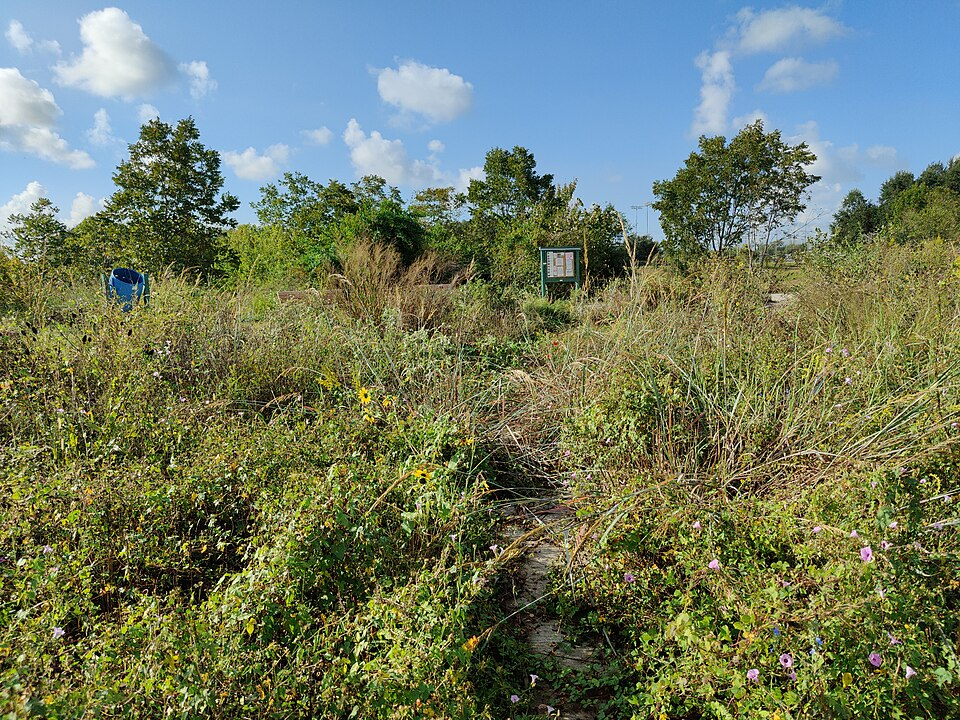
A small prairie garden in Houston, Texas, Willow Waterhole Greenway.
Photo: Evan Carroll
Planting a native garden or other landscaping can be one of many tools to combat climate change. One way this is expressed is through carbon sequestration and storage into native plants and their root systems. Carbon from the atmosphere is absorbed into the plants and permanently stored in their vascular tissue and roots systems. Although this is not the complete solution to increased carbon in the atmosphere and climate change, it can be a helpful and conscious way to immediately mitigate it in your area.
Managing a native garden, lawn or other landscape can be much less carbon intensive than traditional lawns or annual plants and can even reduce pollution. This is because native lawns should not need additional fertilizers and herbicides, and require significantly less to no mowing, reducing the carbon emissions necessary to maintain the landscape. Many erroneously overuse herbicides in their landscapes when they are rarely ever necessary, native plantings are able to avoid the use completely. Since gasoline-powered lawn equipment such as trimmers, mowers and more contribute to five percent of the total air pollution in the United States, any way to decrease your contribution to this can help greatly. Even just replacing part of your lawn with native alternatives or a native garden could reduce that impact and reduce the need for additional fertilizers and pesticides that might be necessary in traditional landscapes.
The long root systems of most native perennial plants establish into the soil and amend it by reaching down into the earth and distributing and harnessing nutrients. These extensive roots hold the soil into place and provide protection from erosion such as high winds and storms. All types of soil can be aided and amended by their native plant counterparts due to their coevolution and adaptations over time. Nutrients are able to be transported naturally through their extensive root system that are native to the area and the soil they reside in, as opposed to soil being unpenetrated by shallow root systems of something more typical, like a non-native lawn or a type of non-native annual flowering plant.
Flooding is a major issue that can be greatly mitigated or eventually fixed in many cases with the installation of native plants and landscapes like native rain gardens. Implementing French drains with native gardens planted on top into landscapes have become a more frequent practice of reducing and preventing flooding into nearby buildings or reducing flooding in another type of landscape. They can even mimic a more natural creek as opposed to other solutions, like concrete flood diversions. This will have the added benefit of beautifying the community, including local residences and commercial buildings.
Plant Guide:
Timing
Most of the nation is said by many to be cleared for outdoor gardening after Mother’s Day, which fell on May 10 this year. Although, if you are worried about a late frost, you can use helpful websites like the Old Farmer’s Almanac Planting Calendar and Guide 2026 by zip code or general area to ensure your garden is safe.
When gardening with native plants, it is important to not wait too long to plant them after the last frost date in your general area. This is because summer heat can dry them out before they have a chance to establish their root systems. Especially if you have native plants in pots waiting to be transferred in the soil, they can dry out by the time summer heat comes in if kept in their containers.
This year might be one of the best years to start a native garden if you are also worried about drought. The National Drought Monitor has shown that for 2026, many places that are usually known for their periods of drought are seeming to be clear. Most of California and the Midwest are showing no to slight drought conditions this year. This can help if you are constrained by watering your garden, as it usually takes about two years of regular watering to establish a native garden before becoming mostly self-manageable after the third year.
If planting a native garden is not feasible before the summer heat comes this year, you can always wait for the fall, which is another optimal time to plant native plants. Autumn is when temperatures drop again, which can be favorable for establishing roots of natives before the winter comes. Native plantings also technically require less weeding in that year since you will not be establishing the garden the whole summer, and the plants should still come back in the spring.
Despite these best practices, whatever time is right for you is the best time to plant a native garden, even if you have to water a little more frequently if you start in the hotter part of the summer. Once you have the right date to plant your native garden, choosing a place or gathering the best materials for your plants is the next step.
Placement
You can place a garden or a single plant in pretty much any area, but the type of plant and individual land needs vary greatly depending on your area in the world. Certain soil types, delineation of land and other factors come into play when selecting an appropriate area for constructing a garden for your landscape. A simple balcony or patio can be filled with pots or containers of native plants and can also be an effective garden for native pollinators and other native species in your local ecosystem.
A balcony, patio or porch is elevated when you add plants, especially native ones, since many plants that are usually placed on a porch may be non-native and not as helpful to the local ecosystem. Even if the plants will be treated like they are basic patio plants and discarded at the end of the growing season, they could help pollinators and other local fauna in that season by providing food, shelter or any other source of recovery for species and possibly spread their seed for future generations to be populated outside of that specific balcony.
While smaller pots of native plants can be helpful to local native species, larger gardens that are planted into the earth can be far more effective in supporting restoration efforts. When it comes to planting a native garden into the earth, soil type opens you up to new opportunities of native species to help reintroduce or encourage in your area. Placing your plants in the right areas is very important for their development, for the availability of other native species, as well as for your own enjoyment.
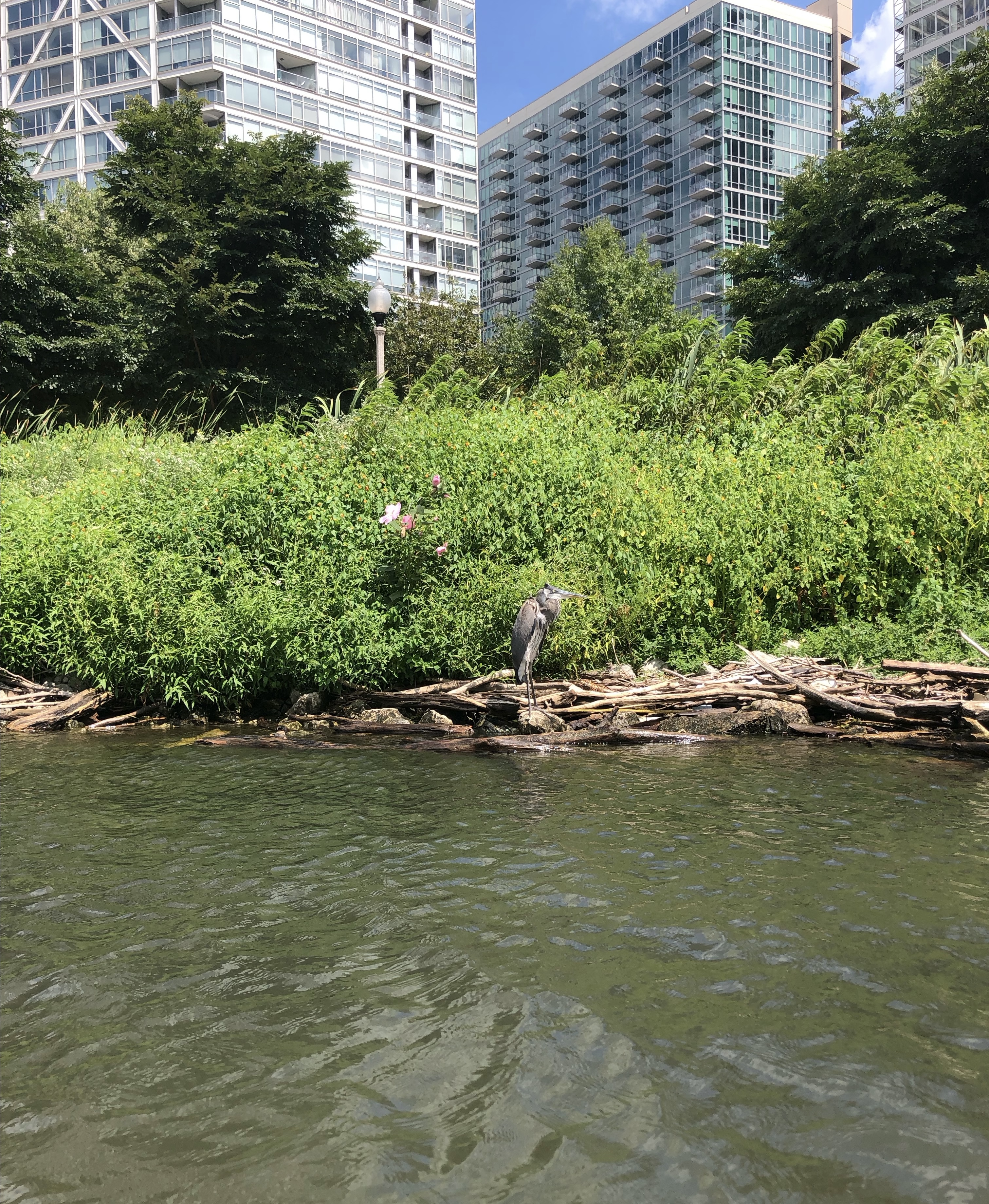
Great blue heron standing near native plantings along the Chicago River.
Photo: Zachary Sabitt
Knowing whether you have sandy, silty, clay, loamy, chalky, or peat soil is important for selecting the types of native plants to keep in your garden. Having information on this and the greater soil chemistry can also be helpful as well to determine which plants are native or would thrive in your area. Both can be achieved by testing your soil, which can be done in many different ways, like with a small soil probe that would get you about 6-8 inches of a core of your soil to sample. Maps of the ecoregions in your area can help you understand what should be present in the area and where you might like to place your plants and garden as well.
When planting your native garden or other landscape in the earth, you should not need to amend the soil because you should be selecting native plants that are adapted to the soil. If your soil has been stripped and might be a bit barren with use, is compacted, or has any other issue, this should be addressed before establishing your native plants in the earth. This may be done by soaking the garden bed or other landscape prior to planting, and clearing it of invasive species or other undesirable plants prior to planting.
Dense planting is preferred if establishing sprouted native plants into the earth, although there should be enough clearance between each plant based on their relative projected matured size. Soil amendments, like mulch, should not be necessary, but can be helpful in some cases and areas if planting sparingly with more space around each native plant.
Selecting Native Plants of Your Region for Your Garden or Other Landscape
There can be so many different plants to choose from when selecting native plants for your area. If you are overwhelmed by choices, placing your garden should have keyed you into what might have been thriving natively in your type of landscape and how you can select plants like them that also thrive. For example, if you placed your garden in a shady area, be sure to not pick any native plants that are adapted for full sun from your area. This might seem like common sense, but it can become an afterthought when you are in the native plant nursery or online and there are many plants that may seem similar with widely different requirements. It might not specify the sun tolerance on the tag of your native plant when you buy it; or it might not have any tag or descriptor at all beside possibly the name of the plant, and tags can oftentimes be confusing or incorrect.
This is why it is also very important to source your plants from the correct places, or else you risk receiving a different plant than what you anticipated and possibly introducing more invasive plants to your area. There are many online vendors or other sellers that claim to sell native species, but instead might sell non-natives or invasives in their place. Reputable online organizations include Prairie Moon Nursery andNWF founded Garden for Wildlife. Supporting local vendors can be the best way to support local native plant species while supporting your local economy as well as personally ensuring you are gathering the correct plants for your garden.
To help gather your selection of plants, it is important to understand what is fully available to you in your region. Online vendors like the Garden for Wildlife have quizzes to help you with coming up with native plants to choose in your local region, but they might not have the full list of plants available to you in your local ecosystem. To understand all the native plants that populate your local ecosystem, you can look them up by your state, zip code or general region.
Educational institutions like the University of Texas at Austin have vast plant lists that endeavor to cover every native plant per state or ecoregion in North America. Looking up your local ecological center’s native plant list recommendations may be very helpful in selecting plants for your garden as well.
Doing the proper research is very necessary for ensuring that you are actually restoring native species to your region and don’t accidentally introduce a similar species to your area (or the worst case scenario, an invasive species). For example, there are a variety of milkweed plants that are native to the U.S., but many belong to select regions and may not be native to select states or to the U.S. at all. Many people plant Tropical Milkweed, Asclepias curassavica, everywhere in the U.S., including the Great Plains due to its beautiful blooms, but it is not native to the United States and is only native to South America. These people probably would benefit from planting Butterfly Weed, Asclepias tuberosa, which has an extensive native range in the U.S. (and looks very similar to tropical milkweed).
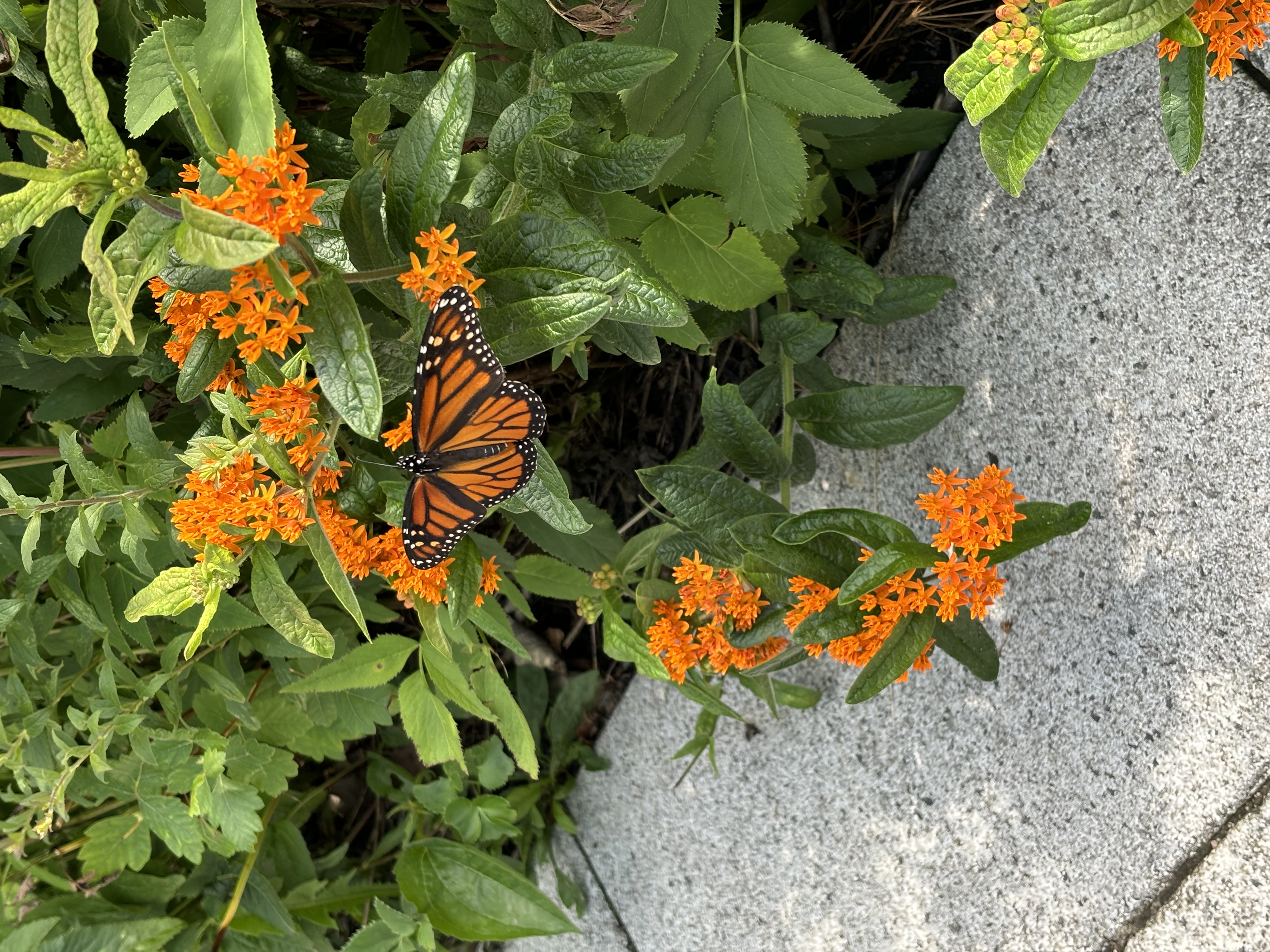
All native species: A monarch butterfly (Danaus plexippus) on top of a bloom of butterfly weed (Asclepias tuberosa) in an urban native garden at Museum Campus in Chicago, Illinois.
Photo: Elene Drosos
While further research is definitely needed for your specific local region’s best native plants for your landscape, there are many native plants that are generally available to plant within the American gardening community. Swamp Milkweed (Asclepias incarnata), Black-Eyed Susan (Rudbeckia hirta), Common Yarrow (Achillea millefolium), Wild Bergamot or Bee Balm (Monarda fistulosa) and many more flowering plants are native to, and could use help in climbing their numbers in, most of the United States.
Some native plants for your state are listed below to help you get started (make sure to search if they are right for your specific ecoregion, soil and more, even if native to your state, they might not be native to the specific region of your location in the state):
Wyoming: Prairie Smoke (Geum triflorum), Wyoming Indian Paintbrush (Castilleja linariifolia), Big Sagebrush (Artemisia tridentata)
It is important to search the native range of your specific species of plant you wish to establish in your landscape with various sources. A plant may be native to your state, but not native to your region or local ecoregion within the state. On another note, many plants listed above are also native to other states and ranges in the United States and beyond.
If possible, it is more beneficial for the environment and for the resilience of your native landscape to plant a variety of native plants, and not just one species. This is because different species have different tolerance and vulnerabilities to pathogens or pests. A variety of native species in your landscape can help ensure that they survive for multiple seasons and beyond, as well as contribute more to the greater biodiversity and health of your ecosystem.
A whole garden or landscape could get wiped out before it could have the chance to be established if too much of one species is in an area. This is because one species may be very susceptible to a disease or other factors like excess drought that may be present, possibly killing all the plants before they have a chance to establish. Having a diverse array of native plants, which are more similar to their existence in less disturbed natural settings, can increase the chances of your native garden or landscape being more resilient to the establishment period in which it may be more susceptible to negative factors.
Adaptive Plants
A way to check for the best plants that are native to and can survive in your landscape beside the previous methods, which may also be helpful to select to retain adapted non-invasive plants, is to look for your local Plant Hardiness Zone through the USDA for each plant. An adapted plant is one that is not native to your local area, but has been researched to be non-invasive and in some cases helpful to the remaining fauna in an environment that might have been heavily urbanized.
It may prove difficult to switch to a fully native garden in one season. Adapted plants can be useful to leave in a garden that is transforming to a fully native garden in due time. Instead of completely removing all types of flora due to their non-nativeness, a slow switch to replacing adapted plants with native plants or adding all native plants can allow for local fauna to still have adequate support and for humans to enjoy, without barren spaces in a changing environment.
Some adapted plants could also mainly be kept purely for human enjoyment, with a possible added support to local species. An example of this is tulips in America. Many people like to adorn their environments with these early- and short-blooming plants due to their aesthetic impact. They may fill a void of color that has been missing in some areas for whole sub-zero winters, and may be the only sort of plants in an area like an urban setting. Taking tulips away from the people might be more troublesome than also just adding an equal or greater amount of native species in the same garden.
Adding Signage and Art and Making the Garden Your Own
Although an area is beautified by the act of restoring it to its original or close to its original native functioning with thriving native species alone, adding signage, pathways, art and other creative flourishes to a natively planted or restored area can beautify and elevate it even higher. In urban areas or locally frequented areas like schools, signage can be especially important in informing the public about restoration efforts.
Signs can help inform the public about the act of native gardening and why it is important to adopt in their own landscapes. This educational route can be very effective in informally spreading awareness about and accessibility of native gardens, lawns and other landscapes. Installing art can also help to guide the public to your native garden or other landscape.
Integrating artistic elements into your native landscape can possibly reach an even wider audience of people who may not notice signage or be familiar with native plants in general. Art can draw people in and compel them to adopt the same practices of gardening with native plants that enrich the landscape in conjunction with the art piece. Since signage can be less visible, larger art installations can lead people to reading posted signage, which reaches more of the community. A sense of belonging to the native landscape can also be greater felt with a personal human connection to art like visual and performing arts in the native environment.
Managing Your Native Garden
After the initial planting of your native garden, plants need to be watered more frequently in order to maintain and grow their root system. Although there is not one simple way to water, and watering your plants varies by conditions of your garden and the weather conditions, this should be about two weeks to a month of a few waterings per week. This is increased if there is drought and decreased if there has been rain as well as dependent on if you have a shade or sun garden, among other factors.
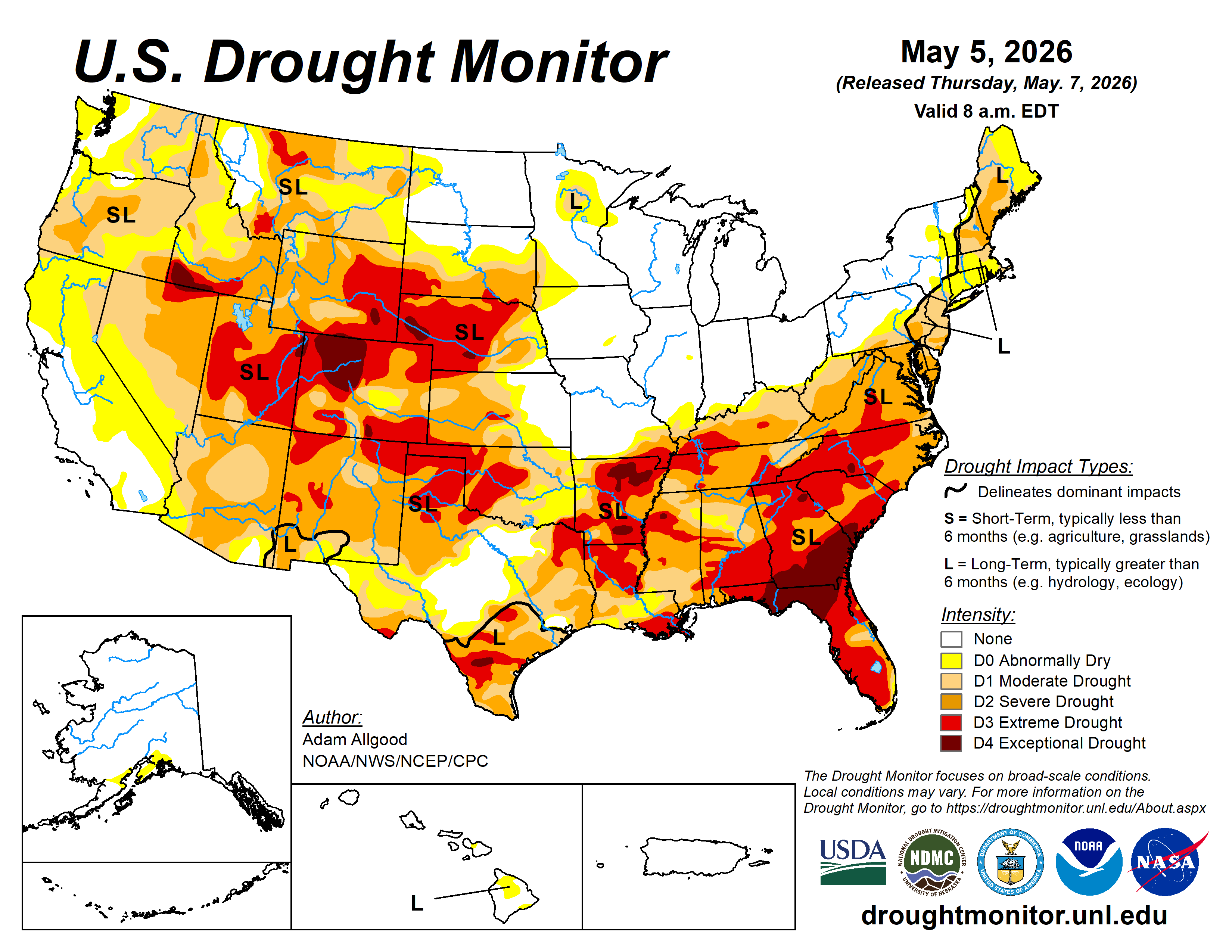
Most of the Midwest and California are experiencing none to a D0 abnormally dry intensity of drought, and D4 exceptional drought intensity is predicted for parts of Georgia, Florida, Arkansas, the Great Plains states and elsewhere as of May 12, 2026.
Photo: The National Drought Monitor
Normally, a native garden should be deeply watered once to twice a week in order to establish a good root system after the initial planting in the first few years. In a drought year, the amount of waterings would need to be increased in order to account for the loss of water due to excess evaporation. This can be very hard in water-constrained areas. Although for now most of California and the Midwest are the main areas without a drought warning, be sure to check in on the National Drought Monitor to keep up with watering in the first two to three years of establishment of your garden.
In the first few years, when your native plants are establishing, the garden should be pulled of other non-desirable plants such as invasive species or weeds. After the first few years of establishing your native garden, the amount of weed pulling and the need for watering should decrease greatly. This process will happen gradually each year as well, with waterings decreasing in frequency after the first year and every year after. It is important to not overwater as your garden is establishing, as with some species around the world, overwatering can lead to increased pathogens and plant death.
In order to maintain the upkeep of your native garden after the initial few years of establishment, if it is in a front lawn or other place that could potentially require a more “cleaned-up” style, infrequent undesirable plant pulling and watering could be desirable. Particularly when in high temperatures or a drought with long periods of no rain where you could experience increased water evaporation, an occasional watering of your native garden or native lawn could help it not go into dormancy.
In nature, some plants that could comprise your native garden or lawn may go into dormancy or not come up in periods of drought, in order to conserve leafing energy for when rain comes. Infrequent waterings of about twice a month in these periods of drought could help your native garden or lawn stay out of dormancy and keep your landscape looking fresh. Practices like drip irrigation are one of the best ways to water in these times of drought due to their direct transfer of water to the roots, limiting evaporation.
Leading Designs in Native Landscape Architecture
Native landscape architecture has been growing in recent years, with many exceptional designs that encourage habitat restoration and human connection to the environment. There are numerous firms offering native landscaping for various conditions like rain, shade and sun, and play gardens that feature a variety of native species. Below are three examples of native green building that may inspire you in your own undertaking of native landscape architecture.
The Wild Mile in Chicago, Illinois
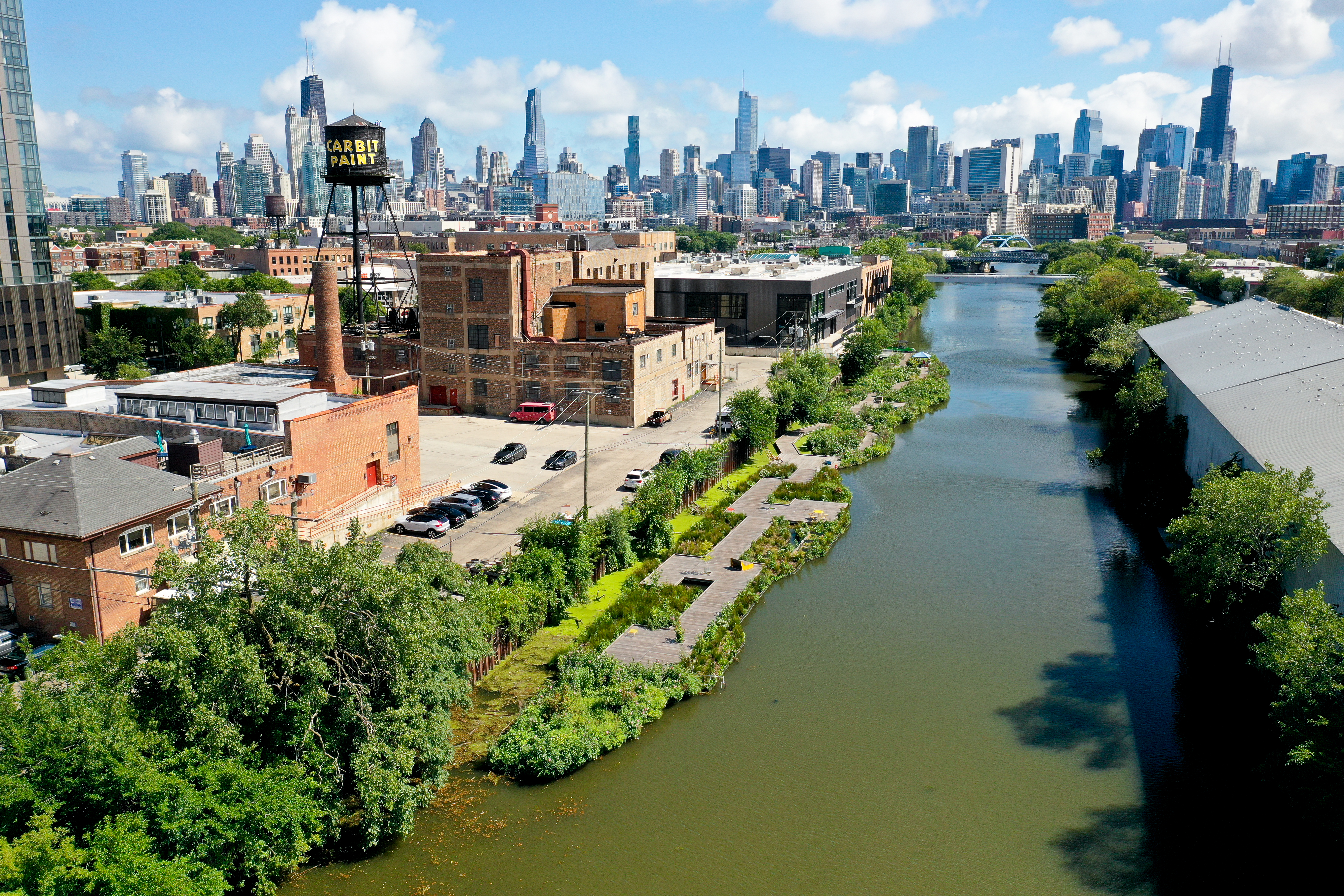
The Wild Mile on the North Branch of the Chicago River.
Photo: Sage Rossman, Urban Rivers
The Wild Mile is an Urban Rivers project spanning over a decade-long period which has been gradually and strongly enriching the Chicago River and the people who live near it. Urban Rivers, in partnership with the City of Chicago’s Department of Planning and Development, community groups and other organizations, have installed the “world’s first floating eco-park” on the North Branch of the Chicago River.
This park and floating wetland, featured in BuildingGreen Issue 2, is in the process of spanning a mile-long restored area all on the water. Urban Rivers has expanded and maintained this flourishing ecosystem through constant research and development of their floating structures and their impact on the local environment. They have reintroduced native mussel species, on top of packing the floating wetlands with native plant species specifically adapted to this setting.
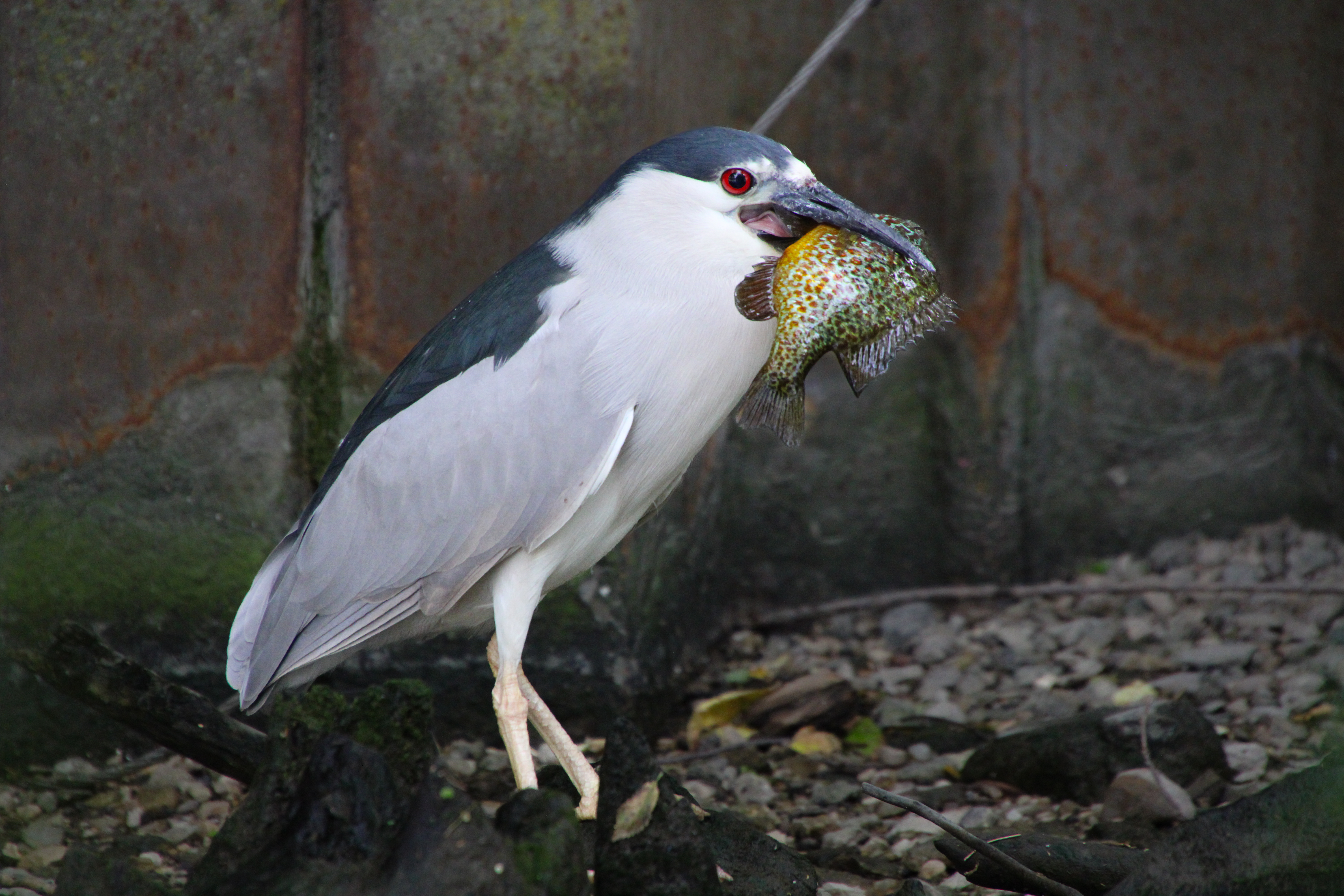
Black crowned night heron with a pumpkinseed sunfish in its beak.
Photo: Sage Rossman, Urban Rivers
The current area can be accessed (by ramp) behind the Recreational Equipment, Inc. (REI) store in Lincoln Park, leading down to a floating wetland that can be walked on and enjoyed as a park. There are benches available along a pathway that extends to the floating park. Be prepared to see a variety of native blooming plants as well as grasses, shrubs, trees and other flora, along with many native animals like beavers, river otters, ducks, black crowned night herons, great blue herons and many more native species.
Metropolitan Park in Jacksonville, Florida
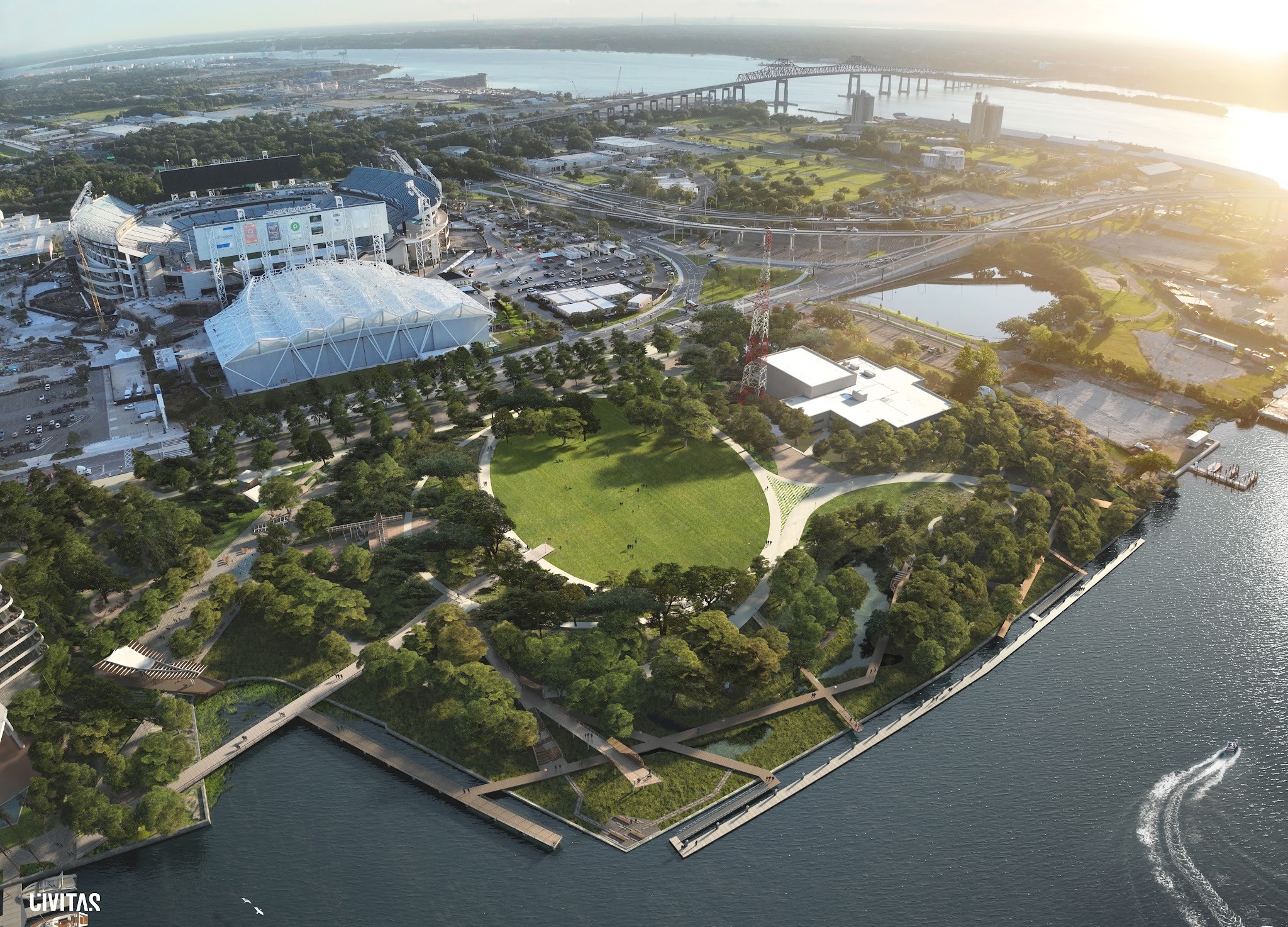
The revitalization of Metropolitan Park, made by the City of Jacksonville in partnership with the design firm Civitas, has plans to start construction in the coming months. This park will introduce a much needed restoration effort and an increased human connection to nature in an area with wide diversity and rare species to protect.
Planned design for the Metropolitan Park in Jacksonville, Florida.
Photo: Cevitas Recent designs have proposed a “living edge” to consist of native plantings for 100 feet along the St. Johns River. Cevitas is planning to establish a “sponge-like landscape” with native plants that will act as storm surge protection as well as helping to restore other native species populations. Ecological restoration and integrity will be maintained with elevated boardwalks, gathering decks and an expanded community center.
Human connection to nature will be enriched in this park, especially by the design taking inspiration “from the Gullah Geechee tradition of basket weaving—a cultural reference important to the Out East neighborhood and its descendants—as it weaves together spaces, geometries, and materials to unify what was previously a fragmented park,” according to the design plan. Connectivity to the community will be more achievable as well since the park will be close to a large number of frequented attractions, like the Jacksonville Jaguars’ home stadium.
The High Line in New York
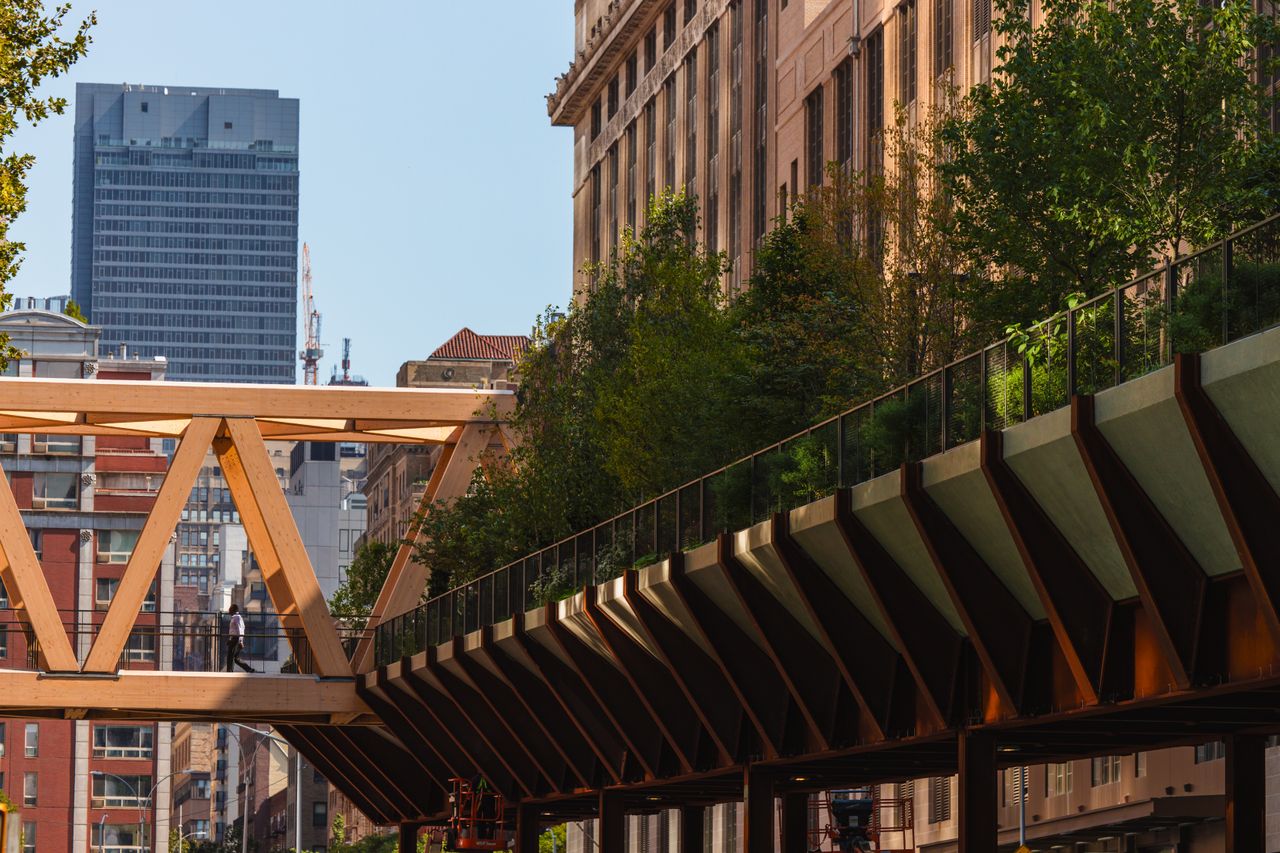
This natively planted landscape is deemed the “park in the sky.” The High Line on Manhattan’s West Side is a public park on a transformed railroad that boasts a wide variety of native species to the region and has been a beautiful and relatively recent addition to the city.
A section of The High Line Park.
Photo: Brent Singleton, Pexels
The High Line was founded by Friends of the High Line in 1999, a nonprofit organization made to advocate for revitalization and preservation of native wildlife in the area. It was officially rezoned into a park in 2006 and was designed by James Corner Field Operations; design studio Diller Scofidio + Renfro; and planting designer Piet Oudolf. The first section of the park opened to the public in 2009.
Since its opening, art was introduced through the High Line Art program managed by the High Line nonprofit, and every year new artworks are commissioned. More zoning was approved for the extra additions to the park that have been expanding every few years since. Now it is a 1.45 mile-long native public park, home to more than 500 native plants and tons of community programming to connect the city to nature.
LEED in Native Landscapes
Most recently in LEED v5, focus has shifted to three areas: ecological restoration and conservation, quality of life and decarbonization. Native gardening and establishment of other native landscapes can help in improving the ecological restoration and conservation of the built environment. Native plantings may also help fulfill many aspects of quality of life and decarbonization as well as environmental restoration and conservation sections to earn credits toward LEED certification.
Native gardens, lawns and other landscapes established in the built environment have been shown to aid in the restoration and conservation of local ecosystems and native species, especially in urban areas where there may be less biodiversity in general, let alone native biodiversity. Your native landscape may help fulfill the Sustainable Sites Biodiverse Habitat, Enhanced Resilient Site Design and Heat Island Reduction Credits in LEED v5, among many others.
For example, to earn a possible 2 points and achieve the Sustainable Sites Heat Island Reduction Credit in LEED v5, planting native gardens is the only way to achieve some of the options for receiving points. If choosing to install a vegetated roof, native or adaptive plants are the only kinds of flora that can be planted. Many choices like these in how projects earn credits are ways that LEED v5 is encouraging restoration and ecological resilience.
Native Gardens and Landscapes for the Future
The Olmstedian theory, although greatly beneficial in many ways—like its purpose of connecting the community regardless of class—can be a very closed-off mindset for landscaping. One vein of this theory employs the Pastoral theme of neat and vast lawns among other introduced non-native plants that are meant to mimic the scenery of England. The United States has a much different range of landscapes and should not be dominated by this main manner of landscaping our public or private environments.
North America has an incredibly diverse landscape with wide ranges of topography, hydrology, ecoregions available for native species of all varieties. A monocrop of lawns dominating our yards does not give justice to the native landscapes that are capable of flourishing in our environments, and encourages the collapse of native biodiversity that keeps our ecosystems healthy. Reintroducing native plantings and restoring our native ecosystems is healthy for the physical environment as well as our collective connection to nature.
Human connection to nature lacks and withers without the natural connection to our native habitats. We can sense a misplacement of natural entities to our local ecosystems. The overrun invasive vines like kudzu that take over large swaths of the United States clearly choke out our native flora and fauna. It is easily visible by the human eye.
We can restore our own connection to native nature that has been replaced with non-native and invasive species among heavy urbanism. It is possible to join urbanism with native ecosystems and human presence through building together and with the native environment in control. Human physical and mental health can be replenished through this reconnection to native wildlife by joining them purposefully together. Although Olmsted championed unbreaking swaths of turf, he also was one to incorporate adapted and native plantings into his landscapes as they seemed to fit into the environment. We can be guided by this principle with native plants and his assertion: “The quality of beauty in scenery lies largely in the blending in various degrees of various elements of color, texture and form and often more largely than in anything else in the obscurity and consequent mystery, giving play to fancy, of parts of the field of vision.”
Drosos, E. (2026, June 11). Native Gardening for Urban and Rural Resilience. Retrieved from https://www.buildinggreen.com/feature/native-gardening-urban-and-rural-resilience