
Op-Ed
I appreciated reading your fairly comprehensive article on environmental impacts of various heating fuel options (“Heating Fuel Choices: Weighing the Alternatives”, EBN,
Vol. 2, No. 6). You uncovered several of the complexities inherent to evaluating the costs and benefits of fuel options as determined by... Read more
News Brief
The Commonwealth of Massachusetts is planning a large-scale center for conferences, environmental education, and recreation on 1,040 acres on Mt. Greylock in Adams. The proposed $6.5 million center will feature state-of-the-art environmental technologies and design strategies. Requests for Expressions of Interest (RFEI) are available by calling... Read more
Product Review
In 1992 The Glidden Company surprised the interior paint world by offering a latex paint without any volatile organic compounds (VOCs). VOCs in paints have been implicated in indoor air quality (IAQ) problems and environmental illness cases. There has been a strong trend toward lower VOC formulations, spurred in part... Read more
News Brief
Green Builder Program, City of Austin, Environmental & Conservation Services Dept., 206 E. 9th Street, Suite 17.102, Austin, TX 78701; 512/499-3500; 512/499-2859 (fax). Three-ring binder format, 440 pages, $25 postpaid.
The Sustainable Building Sourcebook was written to provide background information for... Read more
News Brief
for Treating Wastewater
by Gerald Steiner, P. E. and James Watson, P. E.; 42 pages, free. Tennessee Valley Authority, May 1993. TVA, 1101 Market Street, Chattanooga, TN 37402. Fax orders: 615/751-7479.
Despite its cumbersome title, this publication will prove invaluable to anyone considering a constructed... Read more
Product Review
The Cycle II™ line from the Major Paint Company (the manufacturing arm of Standard Brands Paint Co.) contains at least 12% recycled paint collected from consumers and 38% in-house waste from washing machinery. The remaining 50% is virgin material. Cycle II is available in flat, semi-gloss, and primer formulations in about a dozen colors ranging... Read more
News Brief
by Joseph M. Tibbets. 1989, Southwest Solaradobe School, P.O. Box 153, Bosque, NM 87006. $20.35. Paperback, 196 pages.
The Earthbuilders’ Encyclopedia is the most comprehensive reference we’ve seen on the various construction techniques that fall under the umbrella of earthbuilding, especially adobe and... Read more
Op-Ed
The Vinyl Institute’s letter on PVC (EBN
Vol. 2, No. 5) is without substance or merit. The Institute ignores the economic benefits of product substitution and the significant environmental problems of PVC. In truth, PVC is a cheap, chlorinated product that rarely lives up to its claims of durability and threatens... Read more
Product Review

•urethane-reinforced... Read more
News Brief
American Institute of Architects’ Committee on the Environment, 1735 New York Ave., NW, Washington, DC 20006; 800/365-ARCH, 202/626-7300.
Last winter and spring the American Institute of Architects’ Committee on the Environment organized a series of three video teleconferences entitled “Building Connections.” The... Read more
News Brief
Trimax plastic lumber, which was featured in the EBN article “Recycled Plastic Lumber,” (Vol. 2, No. 4) will soon be manufactured in two additional locations. Trimax’s parent company, Polymerix, Inc., has licensed Environmental Recovery Systems of Somerset Inc. to make the fiberglass-reinforced lumber in Massachusetts. In a separate deal, John... Read more
News Analysis

Green Seal, a nonprofit environmental labeling organization, certifies products that cause significantly less harm to the environment... Read more
News Brief
The National Institute of Standards and Technology and the U.S. Green Building Council have jointly announced a Green Building Conference for February 1994 in Gaithersburg, Maryland. The conference will cover assessment methodologies and performance criteria for rating buildings, case studies, activities of various government and independent... Read more
News Analysis
The Good Cents® energy-efficient homes program used by nearly 300 utilities nationwide has announced the availability of new environmental rating features. The Good Cents Sustainable Homes™ program expands on existing energy efficiency criteria to rate new homes on a sustainability scale.
... Read more
News Brief
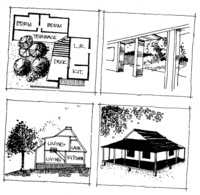
by National Park Service. September 1993. 118 pages. Limited copies available from the Denver Service Center, National Park Service, P.O. Box 25287, Denver, CO 80225; 303/969-2100. (No charge while initial printing lasts; then copies will be available from the Government Printing Office.)
... Read moreOp-Ed
I enjoyed your article on cellulose insulation in the September/October ‘93 issue of EBN. In general, I thought the article was very well done, but felt that your recommendations on the health concerns left a bit to be desired. First of all, your recommendation not to eat it is obvious, yet by stating it, you seem to... Read more
Product Review
Recycling leftover paint is an idea whose time has come. Paint disposal is one of the biggest headaches facing contractors and municipalities nationwide, and improper disposal can cause extensive environmental harm. Several municipalities and counties have run paint collection and re-use programs, often mixing together... Read more
News Brief
Resource Guide
Victoria Schomer, ASID, editor. PO Box 2386, Mill Valley, CA 94942. Spiral-bound, 230 pages. $40.
If you’ve ever wanted to look through the notebooks of an experienced “green” interior designer, this is your chance. Victoria Schomer has been compiling information on healthy building materials for... Read more
News Brief
A competition for designs that elegantly integrate photovoltaics into individual buildings and into the urban environment is being cosponsored by the International Energy Agency and the Netherlands Agency for Energy and the Environment. Prizes will be awarded in three categories: large-scale application in an urban area; single... Read more
Product Review
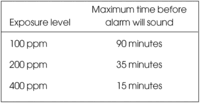
Carbon monoxide (CO) is a serious threat in many homes. Approximately 300 deaths per year from non-fire-related CO poisoning make it the leading cause of death by poisoning in the U.S. In addition to death from acute exposure, many people suffer the symptoms of low-level carbon monoxide poisoning—headaches, fatigue,... Read more


