
Op-Ed
RECs and carbon offsets lack credibility, and grid interactivity adds unnecessary complexity. That's why this standard leaves them out.
This is the fourth article in a five-part series introducing a comprehensive, universal carbon standard for buildings. Part One explains how “net zero” has failed us. Part Two introduces the six building blocks of a proposed low-carbon standard. And Part Three provides details on each of those six things.
Part Four (this one) explains... Read more
News Analysis
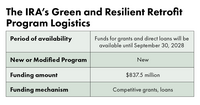
This program will administer grants and loans to owners or sponsors of HUD-assisted multifamily housing to improve its resilience and quality.
This article has been prepared for informational purposes only; it is not intended to provide, and should not be relied on for, tax, legal, or accounting advice. You should consult your firm’s tax, legal, and accounting advisors before engaging in any transaction.
Responsible agencyThe U.S. Department of Housing and Urban... Read more
News Analysis
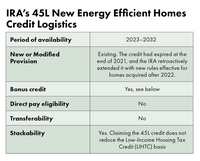
This provision offers a tax credit to homebuilders for the construction of new energy-efficient homes, including multifamily projects.
This article has been prepared for informational purposes only; it is not intended to provide, and should not be relied on for, tax, legal, or accounting advice. You should consult your firm’s tax, legal, and accounting advisors before engaging in any transaction.
Responsible agencyThe U.S. Department of the Treasury
Summary of... Read moreNews Brief
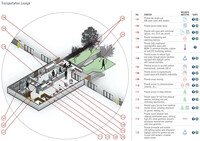
Behind every online order, there are people. A new study explores ways to ensure they have safe and supportive workplaces.
Have you ever thought about the chain of events you initiate every time you click “buy now” in the comfort of your home or office?
Several human beings leap into service to fulfill your order: pickers, packers, long-haul truckers, loaders, sorters, and delivery drivers. And the warehouses and distribution centers where most of them work... Read more
News Analysis

This provision offers a bonus credit to the Investment Tax Credit (ITC) for small-scale solar and wind projects located in low-income and environmental justice communities.
This article has been prepared for informational purposes only; it is not intended to provide, and should not be relied on for, tax, legal, or accounting advice. You should consult your firm’s tax, legal, and accounting advisors before engaging in any transaction.
Responsible agencyU.S. Department of the Treasury in partnership with... Read more
News Analysis
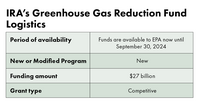
This program funds clean-energy projects, including building-scale technologies, primarily through grants to nonprofit financial institutions.
This article has been prepared for informational purposes only; it is not intended to provide, and should not be relied on for, tax, legal, or accounting advice. You should consult your firm’s tax, legal, and accounting advisors before engaging in any transaction.
Responsible agencyU.S. Environmental Protection... Read more
News Analysis
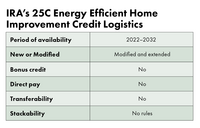
This program provides a tax credit to homeowners for energy efficiency improvements in residential homes.
This article has been prepared for informational purposes only; it is not intended to provide, and should not be relied on for, tax, legal, or accounting advice. You should consult your firm’s tax, legal, and accounting advisors before engaging in any transaction.
Responsible agencyU.S. Department of the Treasury... Read more
News Analysis
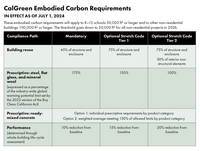
Whether you call it CalGreen, Title 24, or simply “the law,” its embodied carbon requirement is unprecedented in the U.S. We analyze the code and what might come next for other states.
California has become the first U.S. state to mandate reductions in embodied carbon, the greenhouse gas emissions associated with building materials and construction.
Both the development process and the compliance structure set important precedents for potential code changes in other states and even in national model codes.
... Read moreNews Analysis
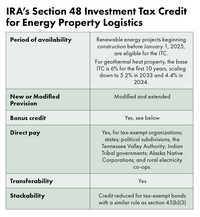
This program provides a tax credit for investment in renewable energy projects. It includes bonus credit for projects in energy communities and projects that use certain amounts of U.S.-manufactured products, including steel and iron.
This article has been prepared for informational purposes only; it is not intended to provide, and should not be relied on for, tax, legal, or accounting advice. You should consult your firm’s tax, legal, and accounting advisors before engaging in any transaction.
Responsible agencyThe U.S. Department of the Treasury
Summary of... Read moreFeature
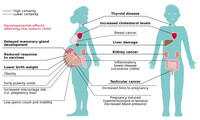
Per- and polyfluoroalkyl substances (PFAS) have been linked to negative health and environmental impacts. Getting them out of our building products is going to require work.
Design teams want their buildings to look their best and to continue looking that way for years to come. So they choose materials that are durable and resist dirt, stains, and weathering. And that synthetic, shiny surface that sheds dirt doesn’t have to be replaced as often, saving energy, time, and resources. Sounds like a great low-carbon... Read more
Op-Ed
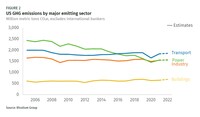
Here’s how we’re going to deconstruct “net zero” and rebuild it as a comprehensive standard that applies to every building.
This is the third article in a five-part series introducing a comprehensive, universal carbon standard for buildings. Part One explains how “net zero” has failed us. Part Two introduces the six building blocks of a proposed low-carbon standard. And Part Three (this one) provides details on each of those six things.
Part Four explains... Read more
News Analysis
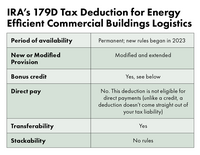
This provision offers commercial building owners and renters (and designers of properties owned by tax-exempt entities) a tax deduction for certain energy-efficiency improvements.
This article has been prepared for informational purposes only; it is not intended to provide, and should not be relied on for, tax, legal, or accounting advice. You should consult your firm’s tax, legal, and accounting advisors before engaging in any transaction.
Responsible agencyU.S. Department of the Treasury
Summary of... Read moreOp-Ed
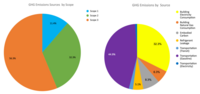
The building industry’s current net-zero-energy and net-zero-carbon standards got complicated for a reason, but they don’t have to stay that way.
This is the second article in a five-part series introducing a comprehensive, universal carbon standard for buildings. Part One explains how “net zero” has failed us. Part Two (this one) introduces the six building blocks of a proposed low-carbon standard. And Part Three provides details on each of those six things.
Part Four explains... Read more
Op-Ed
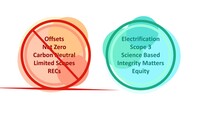
The building sector’s current “net-zero” standards are not credible, not scalable, and don’t eliminate emissions. There’s a better way.
This is the first article in a five-part series introducing a comprehensive, universal carbon standard for buildings. It explains how “net zero” has failed us. Part Two introduces the six building blocks of a proposed low-carbon standard. And Part Three provides details on each of those six things.
Part Four explains why we need to... Read more
Explainer
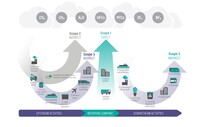
The GHG Protocol’s three emission scopes acknowledge the complexities of supply and demand while also encouraging sector-wide alignment, consistent transparency, and support for science-based decarbonization targets.
Most of this primer was first published as an explanatory sidebar for our news article SBTi: To Decarbonize, AEC Firms Must “Own” Clients’ Buildings.
The GHG Protocol’s Corporate Accounting and Reporting Standard defines three emission “scopes.” The higher the scope number, the less influence the company has over the emissions.
... Read more
Blog Post
Our guests reply to the Qs we didn’t get to during our July 26 event. Plus, here’s the recording if you missed it, and USGBC will host several v5 update sessions at Greenbuild.
What a pleasure it was hosting Sarah Talkington (LEED Steering Committee chair) and Keith Amann (past chair of the LEED Advisory Committee, past member of the LEED Steering Committee) for our recent LEEDuser coffee talk, What’s up with LEED v5?
Even better: Sarah and Keith generously agreed to answer some lingering questions we didn’t... Read more
News Brief
The group MEP 2040 is now offering letter-writing templates asking manufacturers for equipment that uses next-generation, low-GWP refrigerants.
Common refrigerants used to heat and cool buildings “can drive up to 75% of the embodied carbon emissions related to HVAC systems,” according to MEP 2040, a group of signatories committed to building decarbonization. The group recently issued a call to action to speed progress toward its 2040 net-zero target.
... Read moreProduct Review
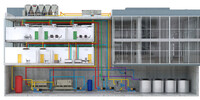
Combining water-source heat pumps and ice-based thermal storage creates a “battery” that can provide all-electric heating and cooling, even in cold climates. And it qualifies for IRA funding.
When we think of the future of all-electric buildings, two technologies tend to rise to the top: heat pumps and batteries. Heat pumps are now ubiquitous for providing heating and cooling, and lithium-ion batteries have become increasingly popular. Alone, the two technologies can work great, but each has limitations. There are... Read more
News Analysis
New decarbonization guidance, once finalized, would require electrification by 2025 and would increase accountability from design and construction firms for operations, refrigerants, and embodied carbon.
But less influence is not the same as no influence.
Read... Read more
News Brief

ZeroGuide, a free whole-life-emissions tool from NBBJ, is about education as much as it is about modeling. It’s also a gateway to more refined approaches.
It started as a way to strengthen carbon literacy among designers at NBBJ Design. Four years later, ZeroGuide has been released to the public for free with a dual mission: to support early design decisions for projects and to influence future projects.
Several widely respected data sources—including Cambium and PVWatts from the National... Read more


