
Explainer
News Brief
Energy Source™ Directory
Life has been a whole lot easier around the office since theEnergy Source Directory arrived. Assembled and published by Iris Communications, this is the most complete and most useful guide to specialized products and materials used in energy-efficient construction that we've seen. The 500-page directory is... Read more
News Analysis
A study published in the June 5, 1992, issue of
Science by researchers at the Lawrence Livermore National Laboratory and the Institute of Atmospheric Physics at the University of Arizona suggests that smoke emitted into the atmosphere from human activities may be having a significant effect in counteracting... Read more
News Brief
Carol Venolia, Publisher/Editor
If “progressive construction” can be defined as pushing the tools and techniques of conventional builders in the direction of less environmental destruction, then Building With Nature’s material goes beyond progressive, into the forefront of visionary thinking about construction. This bimonthly newsletter, now... Read moreExplainer
Product Review
Builders concerned about out-gassing of formaldehyde from medium-density fiberboard (MDF) have long used Medex in cabinets. This exterior-grade product, originally developed for highway signs, is considerably more expensive than conventional MDF or particleboard, however. Now Medite II fills the need for a... Read more
News Analysis
EBN Advisory Board member Mike Nicklas led an international delegation of renewable energy experts in promoting sustainable energy at the Earth Summit last month. He and others were negotiating for inclusion of renewable energy and energy conservation measures into agreements being worked out for the United Nations... Read more
Product Review

To the best of our knowledge, this product is now being marketed under the name Rauhsaser by Better Wall System of Kenora, ON.
CoverAge is a tacky name for a great product that all remodelers should know about. It is a paintable, textured wallpaper that’s made entirely of recycled paper (at... Read moreNews Analysis
The City of Austin’s Green Builder Program was one of 12 award recipients in the United National Local Government Honours Programme at the Earth Summit in Rio, and the only winner from the United States. “The purpose of the Honours Programme is to recognize innovative local approaches to... Read more
News Brief
At first glance,
An Environmental Handbook for Florida Contractors looks like it deals only with the environmental regulations that Florida contractors must contend with. And, indeed, the Handbook describes in detail the requirements for complying with regulations at the federal, state, and local levels. But the book goes much further,... Read more
Feature
Susan Maxman is the first AIA president to make sustainable design a priority.
Q.Where would you say architects as a group stand on environmental issues?
A.Architects tend to be reactive rather than proactive. It is important that we take the lead on these environmental issues. The architecture schools in particular tend to be conservative. They just aren’t... Read more
Feature
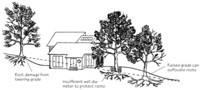
Carefully stake the building site and driveway, remove trees that are within the excavation area or too close, then erect a fence to keep heavy equipment off fragile soils and away from nearby trees.
Protecting trees and the local ecosystem when building on previously unbuilt land is a vitally important—yet often overlooked—part of environmentally responsible construction. Healthy trees and shrubs can reduce a home’s environmental impact and directly benefit homeowners in a number of ways:
•Enhancing comfort by shielding the house... Read more
News Brief
The American Institute of Architects convention in Boston this past June was the setting for a changing of the guard in the American architectural establishment. The Institute’s first woman president took the reins, the Committee on the Environment became its largest and fastest growing committee, and the first installments of the Environmental... Read more
Op-Ed
Introducing the first issue of our newsletter.
Buildings have a tremendous impact on the environment. In North America, buildings and the building industry account for about 30% of carbon dioxide emissions, 35-40% of ozone depletion, 20-30% of municipal solid waste, vast quantities of natural resource consumption, and dramatic loss of open space each... Read more
Feature
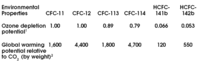
Ozone depletion and global warming are two of our most serious environmental problems—and foam insulation materials containing CFCs (chlorofluorocarbons) contribute significantly to both of these problems. The environmentally concerned builder or designer should make it a highest priority to avoid them. Even many of the non-CFC alternatives... Read more
Quiz
Welcome to the quiz portion of Seal, Tape, Gasket: A Sticky Search for Better Materials.
Learning Objectives
Upon completing this course, participants will be able to:
1. Choose the best means of achieving barrier continuity for any given application.
2. Assess a joint sealant's service life and product... Read more
Forum topic
Hi all,
I'm excited to announce that LHB (my 250-person multidisciplinary firm located in Minnesota and Wisconsin) is hiring a full-time Regenerative Design Leader. I thought this might be helpful for those of you looking for example job descriptions for your own postings, or if you are looking to make a move (we do have an office in... Read more
Forum topic
Have any of you relied on Green Badger for LEED documentation on projects?
I am familiar with the tool and know Tommy from my time in Atlanta, but have not used it on a construction project.
Have you found value? Thoughts?
Either way, they publish a pretty nifty "LEED v4 Construction Tool Kit" that may be useful for your... Read more
Forum topic
Hi SDLers: ESG Investing is mushrooming which is a very good thing. AIA National, for example, just switched over to 100% ESG investments. With it, there seems to be a growing number of "ESG-lite" options. I'm wondering if anyone among this informed group has recommendations on how to determine a quality investment approach. I'd appreciate any... Read more
Forum topic
Hello SDL Folks, with the 2023 Water Conservation Showcase (WCS) less than a month away we're really looking for help spreading the word. We've got a great lineup (www.waterconservationshowcase.com) and would love any direct emails to your contact lists that you'd be willing to send! Here is a link to the promotional partner toolkit with any... Read more


