
Blog Post
Standout Bathroom Water-Savers from the GreenSpec Guide
If you're looking to renovate a bathroom and save some water and energy in the process, check out some of these standout products from our GreenSpec Directory.
Niagara's Stealth toilet offers the performance of a pressure-assist model yet is as quiet as a conventional toilet.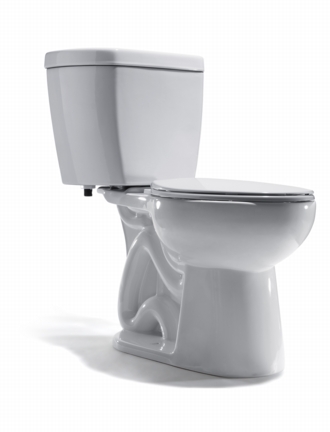
Saving water and energy with low-flow showerheads
Showers use up a lot of water, accounting for about 17% of all indoor residential water use, and old, inefficient showerheads not only waste water, they also waste the energy needed to heat that water. Early adopters of first-generation low-flow showerheads found that some fixtures worked so poorly that they had to spend more time in the shower rinsing off, offsetting any water savings. Fortunately, low-flow showerheads have evolved, and current WaterSense-labeled showerheads have to comply with performance standards for spray force and coverage. GreenSpec lists WaterSense showerheads that have a flow rate of 1.75 gallons per minute (gpm) or less, well below the federal standard of 2.5 gpm. Alson's Water Amplifying showerheads use only 1.6 gpm, incorporating an internal mechanism that controls the shape and velocity of the water droplets, increases heat retention, and delivers a spray that feels more like a standard shower, even at low water pressure --so that shampoo will come out before you drain the water heater.
Aerators: Inexpensive and effective
Another major water waster is the bathroom faucet, accounting for another 15% of a household's water consumption, according to EPA. WaterSense recommends new faucets consume no more than 1.5 gpm, but one of the simplest, least expensive ways to save water at the faucet is by replacing the aerator.
Neoperl water-efficient faucet aerators have flow rates as low as 1.0 gpm. You can purchase models made for both residential and commercial uses, with models that have a predetermined flow rate at a specified pressure and others that are pressure-compensating for installations where an even distribution of water between various points of use is needed, such as in multi-story hotels and dormitories. Neoperl's aerators cost less than a new faucet, and shipping burdens are minimal since they are made in the U.S.
Toilets, flushing water down the drain
The biggest water consumer in the house is, no surprise, the toilet, using about 30% of a household's water and more that 2 trillion gallons of water annually nationwide. If you have an old toilet, it's time to replace it, since some of the more ancient models use three gallons per flush (gpf) or more (the federal limit is now 1.6 gpf). But there are a lot of water-saving toilets on the market using technologies from traditional gravity flush to pressure- and vacuum-assisted models. For performance, WaterSense-labeled models have to be able to evacuate 250 grams using Maximum Performance (MaP) testing.
SUPPORT INDEPENDENT SUSTAINABILITY REPORTING
BuildingGreen relies on our premium members, not on advertisers. Help make our work possible.
See membership options »GreenSpec lists a number of toilet options , including dual-flush models from Caroma that use as little as 0.8 and 1.6 gpf for liquids and solids, and pressure-assist models from Kohlerthat use only 1.0 gpf.
Innovative technologies
Pressure-assist toilets have been around awhile and though Kohler uses technology that is quieter than many, the flush noise can still be startling with these toilets. Niagara put a new twist on "pressure-assist" with its ultra-quiet Stealth toilet. The Stealth uses a tank-within a tank system, like a pressure assist toilet, but instead of forcing water into the bowl at high pressure the Stealth pushes air into the trapway, creating an air bubble. This pushes the water in Stealth's bowl a little higher, which forms a large "water spot" that helps it stay cleaner, and when flushed, the vacuum is broken and the bowl contents are pulled down the trap, using only 0.8 gpf to remove 600 grams of waste! Like any ultra-low-flow toilet, you can't have too long a pipe run from the toilet to the main stack, but it's a slick product and a BuildingGreen Top-10 winner from 2010.
What if you don't want to use any water?
GreenSpec also lists the Waterless-brand Baja residential urinal. It's smaller than their commercial urinal but works on the same principle, using the company's EcoTrap system that employs a lighter-than-urine, plant-based oil (EcoBlue) as the sanitary trap. Though it uses no water, a residential urinal may not be for everyone, but we've had a similar system at the office for years and it works great.
For those looking for maximum water savings, the Baja residential waterless urinal uses a plant-based oil as the sanitary trap.
For those who truly want to maximize water savings, GreenSpec also lists composting systems, including Separett Villa, a Swedish-made, waterless urine-separating composting toilet distributed in the U.S. by Ecovita. This toilet captures urine and solids in separate areas, so the solids dry more quickly--leading to better composting and less odor. Like the Waterless urinal, composting toilets are not for everyone, and compost has to be used appropriately, but they can be a great option for camps, environmentally sensitive areas, or for those who can't justify 1.28 gpf.
That was a brief tour of some of our water-saving products. I'll address the relationship between water and energy a little more when we look at water-heating options in an upcoming blog. Till then...
Published June 9, 2011 Permalink Citation
Wilson, A. (2011, June 9). Standout Bathroom Water-Savers from the GreenSpec Guide. Retrieved from https://www.buildinggreen.com/news-article/standout-bathroom-water-savers-greenspec-guide



Add new comment
To post a comment, you need to register for a BuildingGreen Basic membership (free) or login to your existing profile.