

I guess "global weirding" is a good expression, because it expresses very well the fact that we no longer have the fixed weather patterns of the past - to the extent that our forefathers could predict almost to the day the changes of the seasons or, in other parts of the world, the onset of the monsoon.
Why not?
The simple answer is - however much the climate change skeptics may wish to play ostrich about it - man-made warming.
Without Humanity, the weather patterns of this planet would be governed almost entirely by solar radiation, the seasons, and the Earth's internal warming, with the occasional random disturbance of a volcano blowing its top. And, as the skeptics continually point out, these weather patterns show fluctuations associated with solar and other astronomical cycles.
The point is, however, that in the last century or so the weather's "weirdness" has been increasing by leaps and bounds, particularly in the last half-century, and changing much faster than the rates of cyclical changes of the past could explain.
Why?
Because there has been a global explosion in the production and use of disposable goods and gas-guzzling automobiles with planned obsolescence. This has required vast quantities of energy; but, typically, for every 4 units of energy produced at a power plant, another 6 units of energy in the form of heat has gone straight up the chimney to heat the atmosphere (while also adding to it the greenhouse gases CO2 and H2O). Not only that, but more waste heat was typically gotten rid of by dumping it into unsuspecting rivers, which then flowed into the sea, helping to warm the oceans.
When you drive your automobile, again around 4 units out of every ten produced by burning the fuel actually goes to drive the wheels (and, nowadays, all the power-hungry accessories which serve to distinguish one model from another), while the other 6 warm the atmosphere via the exhaust pipe or the radiator. But it isn't as simple as that: the 4 units that drive the wheels also all end up heating the atmosphere by pushing the car against wind resistance and tire friction heating the road.
Let's look at it another way.
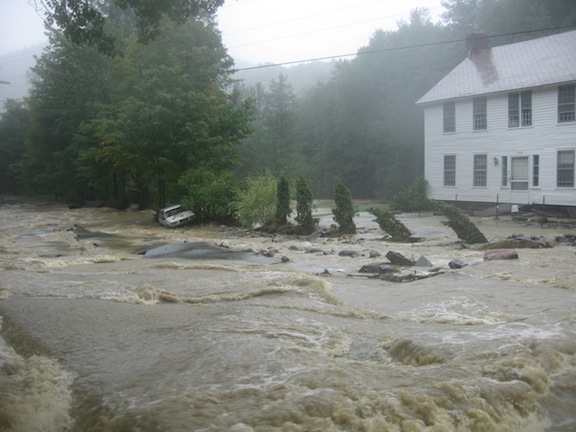
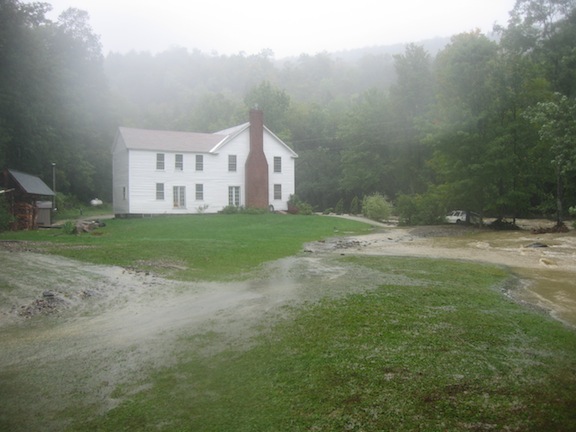
The East coast of the US, including Vermont, has just experienced extreme rainfall, as have many areas of the world in recent years. Without us humans, the weather could have been expected to be "normal", with natural cyclic variations as described above.
The rule of rainfall is that what comes down must first have somehow gotten up. The only way it can get up is through evaporation; and evaporation requires heat. Since the Sun hasn't suddenly started throwing out much more than average radiation and the Earth beneath our feet hasn't suddenly gotten hotter, there can be only one culprit for the increase in rainfall: us. QED (at least, I think so).
As for the weirdness or, if you prefer, instability, if you accept man-made warming, you only have to look at how the patterns of heat emission from industry and other human activity have changed over the years to see the explanation. In broad terms, industrialization started in Europe, spread to the USA, expanded rapidly there up to and through WW II, and has since accelerated rapidly in Asia, particularly in India and China - not least as a direct consequence of globalization. The corresponding injections of heat into the atmosphere have changed wind patterns, while hot water from rivers has affected ocean currents. And the patterns of emission are still changing. Throw in the effects of this overall warming on glaciers and the polar ice caps, with positive feedback from the resultant overall darkening of the Earth's surface leading to greater absorption of solar radiation, and it is easy to see why we should all be getting more than a little worried about what the future may hold for our offspring.
One final thought: all the advice in this article is good, logical and sensible - but it's only treating the symptoms, not curing the illness.



Add new comment
To post a comment, you need to register for a BuildingGreen Basic membership (free) or login to your existing profile.