By way of background, LED lighting (LED for "light-emitting diode") is the future of electric lighting.
I'm just back from Chicago, where I was attending the Greenbuild Conference of the U.S. Green Building Council. Despite the weak economy, some 27,000 architects, builders, developers, and manufacturers gathered for this 9th annual conference.
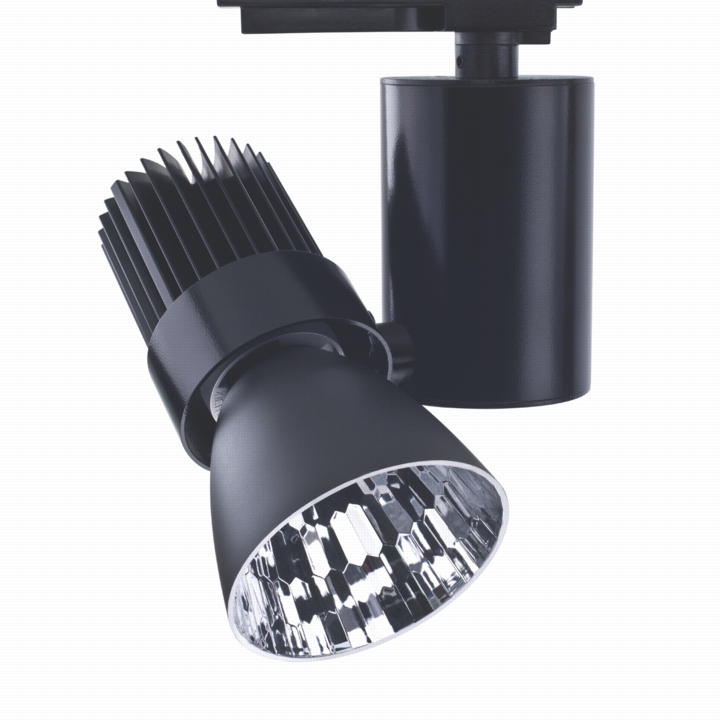
This LSI light fixture features the Xicato LED Spot Module, which provides heretofore unavailable light quality from an LED light source: a CRI up to 98 and excellent color consistency.
Photo: Lighting Services Inc.
At Greenbuild, I moderated an interactive session looking at "hype vs. reality" with LED lighting. Indeed, there is a lot of hype out there (more on that below), but the bottom line is that there are some amazing products coming onto the market.
By way of background, LED lighting (LED for "light-emitting diode") is the future of electric lighting. These highly concentrated light sources rely on semiconductor materials to convert electric current directly into light, without heating up a metal filament, as occurs with incandescent lights, or passing an electric arc through mercury gas, as happens with fluorescent, metal halide, and high-pressure sodium lights.
LED lighting has three primary advantages over other lighting sources: First, it's much more efficient than incandescent lighting. We refer to lighting efficiency as "efficacy" and measure it in lumens of light output per watt of electricity consumed. Incandescent light bulbs have efficacies of 10-15 lumens per watt, while compact fluorescent lamps (CFLs) come in at 50-70 lumens per watt (lpw) and tubular fluorescent lamps produce as much as 100 lpw. Most LED light sources today deliver 35-60 lpw, though a few exceed 80 lpw. Thus, even though it's often touted as more efficient than fluorescent lighting, most LED lighting today actually has lower efficacy than the best tubular fluorescent lights.
SUPPORT INDEPENDENT SUSTAINABILITY REPORTING
BuildingGreen relies on our premium members, not on advertisers. Help make our work possible.
Second, LEDs avoid the mercury that used in fluorescent, metal halide, sodium, and mercury-vapor lamps. Mercury is a highly toxic heavy metal; when older fluorescent, metal halide, sodium, or mercury vapor lamps are discarded, there is risk that the mercury in them can escape into the environment--especially if municipal solid waste is incinerated.
Third, well-engineered LED lights last a long time. They can last over 50,000 hours--50 times as long as standard incandescent bulbs, five to ten times as long as compact fluorescent lamps (CFLs), and two to four times as long as linear fluorescent lights.
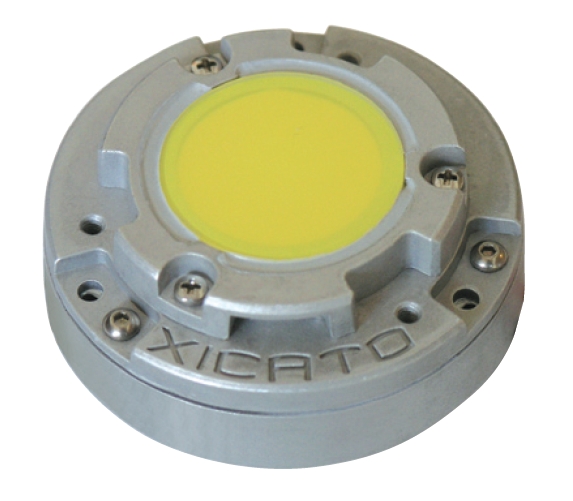
The Xicato LED Spot Module uses remote phosphor technology and a modular design to provide high-quality light and fast, easy assembly by fixture manufacturers. The LED module needs to be coupled with a heat sink, reflector, and LED driver, all of which are shown in the photo above.
Photo: Xicato
Challenges with LED lighting
Creating high-quality white light with LEDs is pretty hard. The first LEDs produced red or green light--these are widely used as indicator lights on stereo equipment and other electronics. To produce white light, manufacturers either combine colored LEDs in carefully balanced mixes (you might remember from high school physics that white is a combination of other colors), or they use phosphor coatings that absorb the colored light and reradiate white light. (Fluorescent lights also rely on phosphor coatings; these absorb the ultraviolet light given off by the electric arc and then "fluoresce" white light.)
In the session I moderated at Greenbuild, representatives from two of the leading companies in the LED lighting field talked about the state-of-the-art in LED lighting and the issue of hype vs. reality.
The Silicon Valley company Xicato is now producing a modular LED light source that relies on "remote phosphors" to achieve remarkably high-quality light. These Xicato light modules have a "color rendering index" (CRI) as high as 98 (on a scale of 100)--virtually the same as the highest-quality halogen incandescent lamps. They also produce remarkably uniform white light. White LEDs often vary from yellowish to white, and that variability is much lower with the specifications Xicato uses. The company sells the LED modules to fixture manufacturers, which then produce finished light fixtures that use this light source rather than halogen MR-16 lamps.
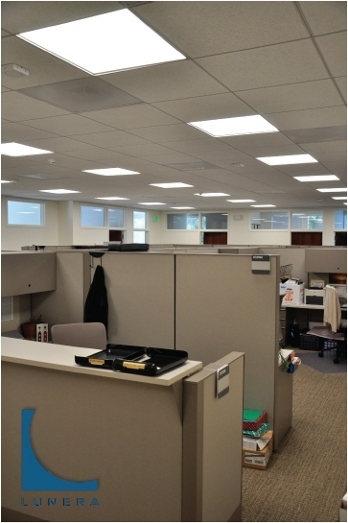
Lunera 2200 two-foot by two-foot lay-in ultra-thin LED light fixture for ceiling grid applications to provide area light.
Photo: Lunera
The other company represented in this conference session was Lunera, a manufacturer of a flat-panel LED light fixtures that can be installed in place of standard tubular fluorescent fixtures to provide general illumination. These fixtures are highly controllable, very uniform, and reasonably energy-efficient (though not as energy efficient as tubular fluorescents).
One of the most difficult things about choosing LED lighting today is the fact that you can't always trust manufacturer claims. Some manufacturers measure the efficacy of their lamps after they have just been turned on and before they heat up, yielding unrealistically high estimates of efficacy.
Some manufacturers also do a poor job at dissipating heat from LEDs. If you don't see aluminum fins on an LED light source, heat may build up shortening the life. I installed one reflector-type screw-in LED lamp several years ago that failed after less than two years--probably after no more than 1,000 hours of operation. This was likely due to heat build-up affecting the LEDs or the LED driver that delivers electricity to the LEDs.
The best way to ensure that an LED light source is going to achieve the manufacturer's claims about performance and durability is to look for evidence of independent testing. Some manufacturers have their products tested through the U.S. Department of Energy's CALiPER program and can provide measured test results. Energy Star labels on LED lights also provide evidence that the lights have been independently tested, though there are not yet many products carrying the new Energy Star label for LEDs.
Cost also remains an impediment with LED lighting. High-quality LED lights are pretty sophisticated, and you have to pay for that. Cheap LEDs, priced at less than about $20, may not perform well. Like computer chips used in computers, though, costs of LEDs are coming down--and will continue to do so. I fully expect that within ten years--maybe sooner--LED lighting will be cost-competitive with fluorescent lighting and provide better light quality.
(2010, November 23). LED Lighting Getting Better and Better. Retrieved from https://www.buildinggreen.com/news-article/led-lighting-getting-better-and-better
This was a surprisingly good review of LED lighting. Thank you for it.
I would like to add that the mercury pollution concerns about fluorescent are over blown and mostly been hyped by people either selling LED's or people who expect absolute zero pollution. "Most mercury vapor inside fluorescent light bulbs becomes bound to the inside of the light bulb as it is used." Energy Star has a nice pdf showing incandescent vs cfl for mercury pollution. And cfl's are "heavy" on mercury. http://www.energystar.gov/ia/partners/promotions/change_light/downloads/...
Absolute zero pollution is ideal but practically impossible. I try to let people know just how little mercury is used in lamps by saying if you ate an 8oz serving of fish, (at EPA safe limits) once a week for a year, you would consume as much mercury as exists in a new 32W T8 fluorescent tube. Turning off lights will reduce more mercury pollution than switching to LED's. And it's cheaper.
I agree with Buzz that the manufacturers should stop trying to make a square peg fit in a round hole. The LED performs better when not trying to force it into a system designed for another source. But from a sales and marketing point of view it's probably easier to sell a lamp then it is to sell a whole fixture. No electrician needed. I see the future of LED's for area lighting as a combination of panels and points. 2x2 diffuse panels in plenum ceilings is the most likely.
The LED cost comes from the heat management. LED fixtures with no heat management are cheap to buy as you say. Don't expect them to last 50k-100k hours. Also, designing a fixture that's not too glary takes time and money.
Yes the CRI is in need of an update. But any update is going to be bogged down in companies trying to skew it to their product. Fluorescent vs LED. That will take forever. Anything over 80 CRI I'm fine with.
While I appreciate the research that is being done on LED's, in my out-of-the-box opinion, all this is going in the wrong direction: the massive effort described above is wastefully being spent trying to duplicate the Edison bulb. Big deadend, big mistake. LED's offer the potential to think of lighting in a completely different way.
1. Why have a "bulb" at all? LED bulbs cost a fortune, which is a travesty as they are pointless replications of what Edison patented 131 years ago. The entire assumption of screwing a "bulb" into a localized "fixture" is not necessary. A glance at the strengths and weaknesses of a LED gives the conclusion that "bulbs" and "fixtures" are a clumsy application of what could be a very simple and effective technology. Light can be anywhere, in any shape or size, on any surface, or no surface at all.
2. LED's actually are extremely cheap and easy to make. They only become expensive and difficult when engineers attempt to duplicate the 131 year old incandescent bulb. I just purchased Xmas lights: 45.3 feet long, 350 LED's, 144 watts. $8.89. Target.
3. Keep in mind the constantly-cited "CRI" is totally arbitrary. While it keeps being held up as the gold standard, this standard is almost meaningless (a 99 cent incandescent purchased at K-Mart has a CRI of 100).
Instead of re-creating the past, let's create the future. Costs less, works better.





Add new comment
To post a comment, you need to register for a BuildingGreen Basic membership (free) or login to your existing profile.