Million Solar Roofs Bill Dies

News Brief

Million Solar Roofs Bill Dies

California’s Million Solar Roofs bill, which would have led to the addition of 3,000 megawatts of solar panels on one million roofs, including half of all new homes, died in assembly in September 2005. The bill would have made California the world’s third largest solar energy producer, behind Japan and Germany. After passing the Senate by a bipartisan vote of 30-5, the bill was slowed by the Assembly Appropriations Committee, which added three amendments in response to labor-union lobbying. The bill failed to receive a floor vote. “The derailment of one of the most popular and commonsense bills of the year is the new poster child for short-sighted partisan politics,” said Bernadette Del Chiaro of the nonprofit Environment California. Aids to Governor Schwarzenegger say he will ask the State Public Utilities Commission to establish parts of the derailed program, but the Commission lacks the authority to implement the entire plan.

Published December 31, 1969

(2005, October 1). Million Solar Roofs Bill Dies. Retrieved from https://www.buildinggreen.com/departments/newsbrief

Add new comment

To post a comment, you need to register for a BuildingGreen Basic membership (free) or login to your existing profile.

DOE Compares Energy Simulation Programs

News Brief

DOE Compares Energy Simulation Programs

The U.S. Department of Energy, together with the University of Strathclyde in Glasgow, Scotland, and the University of Wisconsin in Madison, has released a report titled

Contrasting the Capabilities of Building Energy Performance Simulation Programs. The report discusses 20 energy-modeling computer programs: BLAST, BSim, DeST, DOE-2.1E, ECOTECT, Ener-Win, Energy Express, Energy-10, EnergyPlus, eQUEST, ESP-r, HAP, HEED, IDA ICE, IES <VE>, PowerDomus, SUNREL, Tas, TRACE, and TRNSYS. Drawing from information provided by the program developers, the report compares the programs’ handling of a range of parameters, including daylighting, renewable energy systems, and climate data availability. The report is online at www.energytoolsdirectory.gov.


Published December 31, 1969

(2005, October 1). DOE Compares Energy Simulation Programs. Retrieved from https://www.buildinggreen.com/departments/newsbrief

Add new comment

To post a comment, you need to register for a BuildingGreen Basic membership (free) or login to your existing profile.

ASTM Publishes Sustainability Guide

News Brief

ASTM Publishes Sustainability Guide

ASTM International has published the

Standard Guide for the General Principles of Sustainability Relative to Building (E2432). “It is expected that the Guide will be referenced and used by federal, state, and local governments, architects, and others seeking to solidify and/or justify the tripartite—environmental, economic, and social—approach to building siting, design, operations, maintenance, and end-of-life issues,” according to Alison Kinn Bennet, chair of the task group that developed the standard. The six-page standard can be downloaded for $33.00 or ordered in hardcopy for $36.00 at www.astm.org.

Published December 31, 1969

(2005, October 1). ASTM Publishes Sustainability Guide. Retrieved from https://www.buildinggreen.com/departments/newsbrief

Add new comment

To post a comment, you need to register for a BuildingGreen Basic membership (free) or login to your existing profile.

AQS Tests Emissions from Material Installations

News Brief

AQS Tests Emissions from Material Installations

Air Quality Sciences, Inc., has developed a series of techniques to test product

assemblies, as opposed to individual products, in controlled environmental chambers. Examples of these assemblies include paint and wallboard; carpet, adhesive, and subfloor; and laminate, adhesive, and particleboard. “Sometimes emissions may be reduced,” notes AQS, “and yet, in some situations, new chemicals can be released resulting from interactions among the products.” Several state and federal agencies require emissions data on assemblies, and certification programs including Greenguard and Blue Angel certify installation packages. Details are at www.aqs.com.

Published December 31, 1969

(2005, October 1). AQS Tests Emissions from Material Installations. Retrieved from https://www.buildinggreen.com/departments/newsbrief

Add new comment

To post a comment, you need to register for a BuildingGreen Basic membership (free) or login to your existing profile.

Genzyme Achieves Platinum

News Brief

Genzyme Achieves Platinum

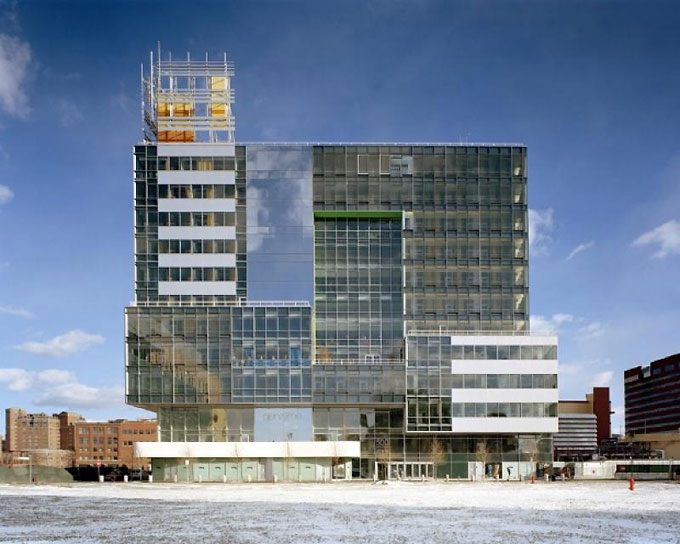
Genzyme Center, the world headquarters of the biotechnology company Genzyme Corporation, achieved 52 points in the U.S. Green Building Council’s LEED® for New Construction Rating System, earning a Platinum rating. Located in Cambridge, Massachusetts, the 344,000 ft2 (32,000 m2) building was designed by Behnisch, Behnisch & Partner with Next Phase Studios and House Robertson Architects. A full project description is included in the BuildingGreen Suite, at www.buildinggreen.com/hpb/.
Published December 31, 1969

(2005, October 1). Genzyme Achieves Platinum. Retrieved from https://www.buildinggreen.com/departments/newsbrief

Add new comment

To post a comment, you need to register for a BuildingGreen Basic membership (free) or login to your existing profile.

NYC Launches Lights Out New York

News Brief

NYC Launches Lights Out New York

The New York City Department of Parks and Recreation—together with the New York Department of Buildings, NYC Audubon, the Real Estate Board of New York, and BOMA New York—has launched

Lights Out NY, a voluntary program designed to reduce the number of migrating birds killed by flying into city windows at night.

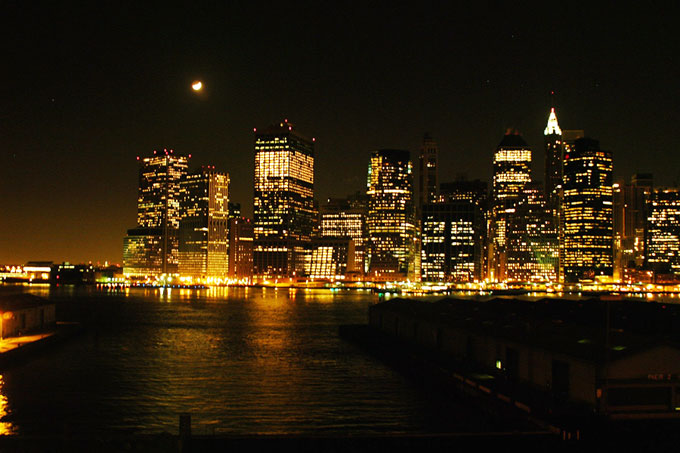
Lights Out NY encourages owners of tall buildings (40 stories or more) to turn off decorative lights on the upper stories from midnight until daylight through the end of October and asks tenants on upper floors to turn off lights or draw their blinds during the same time period. It also encourages owners of shorter buildings with extensive glass exteriors, especially those along the Hudson and East Rivers, to darken their buildings during that period. NYC Audubon estimates that 10,000 migratory birds, disoriented by lights, crash into New York City buildings during each fall and spring migratory season. Details about

Lights Out NY are online at www.nycaudubon.org. For more information on bird collisions with buildings, see

EBN

Vol. 14, No. 8.

Published December 31, 1969

(2005, October 1). NYC Launches Lights Out New York. Retrieved from https://www.buildinggreen.com/departments/newsbrief

Add new comment

To post a comment, you need to register for a BuildingGreen Basic membership (free) or login to your existing profile.

Keen Joins Stantec

News Brief

Keen Joins Stantec

Green engineering firm Keen Engineering has signed a letter of intent to join the professional design and consulting firm Stantec. “Joining Stantec will accelerate our vision of being a top-tier integrated building design firm promoting sustainable development,” says Keen president and CEO Kevin Hydes. According to Stantec president and CEO Tony Franceschini, “When Keen’s 163 LEED® accredited professionals are combined with our existing capabilities in building systems as well as architecture, interior design, and other related services, Stantec will have one of the largest sustainable design teams in North America with over 280 LEED accredited professionals.” The transaction is expected to close in October 2005. Details are at www.keen.ca and www.stantec.com.

Published December 31, 1969

(2005, October 1). Keen Joins Stantec. Retrieved from https://www.buildinggreen.com/departments/newsbrief

Add new comment

To post a comment, you need to register for a BuildingGreen Basic membership (free) or login to your existing profile.

Dane County Habitat Homes Earn Green Built Home Certification

News Brief

Dane County Habitat Homes Earn Green Built Home Certification

Green Built Home™, a voluntary green building program of the Wisconsin Environmental Initiative, in partnership with the Madison Area Builders Association, has been partnering with Habitat for Humanity of Dane County to certify all new Habitat homes as Green Built Homes. For 2005, all new Habitat homes will earn at least 112 points in the Green Built Home rating system, far exceeding the 60 points required for basic certification. The homes also comply with Energy Star® standards. “Green building saves homeowners money in the long term through reduced energy and maintenance costs and does not have to increase up-front costs,” says Nathan Engstrom, Green Built Home program director. For more on greening affordable housing, see

EBN

Vol. 14, No. 3.

Published December 31, 1969

(2005, October 1). Dane County Habitat Homes Earn Green Built Home Certification. Retrieved from https://www.buildinggreen.com/departments/newsbrief

Add new comment

To post a comment, you need to register for a BuildingGreen Basic membership (free) or login to your existing profile.

New York Passes Two Solar Energy Bills

News Brief

New York Passes Two Solar Energy Bills

New York Governor George Pataki signed two bills in August 2005 designed to encourage the use of solar energy. The first (S.4962-a) exempts the sale and installation of solar energy systems from state sales and compensating-use taxes and gives municipalities the option of extending the exemption to city taxes. The second bill (S.5252) expands the existing personal income tax credit for solar-electric generating equipment to include systems used for water heating and space heating or cooling. The credit is capped at 25% of the installed cost of the system, up to $5,000.

Published December 31, 1969

(2005, October 1). New York Passes Two Solar Energy Bills. Retrieved from https://www.buildinggreen.com/departments/newsbrief

Add new comment

To post a comment, you need to register for a BuildingGreen Basic membership (free) or login to your existing profile.

Oregon Expands Solar Energy Tax Credits

News Brief

Oregon Expands Solar Energy Tax Credits

Oregon Governor Ted Kulongoski signed a bill in September 2005 that expands tax credits for solar energy systems. The bill, which takes effect November 4 and expires in 2016, allows for tax credits of $3.00 per watt of installed solar electric output capacity. The credit is capped at half the cost of the installed system, up to $6,000. Additionally, the Energy Trust of Oregon, Inc., offers up to $10,000 for homeowners and $35,000 for businesses investing in photovoltaic systems. The Oregon State Legislature is online at www.leg.state.or.us (search for Senate Bill 31). The Energy Trust is at www.energytrust.org.

Published December 31, 1969

(2005, October 1). Oregon Expands Solar Energy Tax Credits. Retrieved from https://www.buildinggreen.com/departments/newsbrief

Add new comment

To post a comment, you need to register for a BuildingGreen Basic membership (free) or login to your existing profile.