Comment Period Opens on New LEED Energy Requirement

News Brief

Comment Period Opens on New LEED Energy Requirement

The U.S. Green Building Council (USGBC) has opened a public comment period on language requiring all projects using the LEED® Rating System to obtain a minimum of two points in its energy optimization section. Announced in November 2006, the proposal is part of USGBC’s focus on reducing greenhouse gas emissions resulting from buildings (see

EBN

Vol. 15, No. 12). The change would take effect immediately after it is ratified; if adopted, it will apply to all projects that register after that date for any of the four currently balloted LEED rating systems. The comment period runs through March 23, 2007. If the proposal is revised, a second comment period will occur; either way, USGBC membership will ultimately vote on the change. A related and more complex proposal, also announced in November, to require LEED buildings to reduce greenhouse gas emissions by 50%, is still being drafted. Comments can be submitted through USGBC’s website, www.usgbc.org.

Published December 31, 1969

(2007, March 6). Comment Period Opens on New LEED Energy Requirement. Retrieved from https://www.buildinggreen.com/departments/newsbrief

Add new comment

To post a comment, you need to register for a BuildingGreen Basic membership (free) or login to your existing profile.

First Carbon-Neutral Retail Product on Shelves

News Brief

First Carbon-Neutral Retail Product on Shelves

TerraPass, Inc., one of the more prominent companies providing consumers with an easy way to offset the greenhouse gas emissions of their air travel by buying carbon offsets, has partnered with a manufacturer and a retailer to bring that option to a retail product. A pressure washer made by Kärcher USA will be sold on the shelves of Sam’s Club through 2007, packaged with 285 pounds (129 kg) of carbon offsets from TerraPass. That amount of offsets is intended to balance two years of greenhouse gas emissions from use of the gasoline-powered pressure washer. The offsets are derived from projects such as renewable energy generation that displace greenhouse gas emissions. More partnerships are in the works, according to TerraPass’ chief environmental officer Tom Arnold, that will also focus on retail products.

Published December 31, 1969

(2007, March 6). First Carbon-Neutral Retail Product on Shelves. Retrieved from https://www.buildinggreen.com/departments/newsbrief

Add new comment

To post a comment, you need to register for a BuildingGreen Basic membership (free) or login to your existing profile.

DOE Adopts ARI Appliance Test Procedures

News Brief

DOE Adopts ARI Appliance Test Procedures

The U.S. Department of Energy (DOE) has announced a final rule on test procedures to determine the energy efficiency of several residential and commercial appliances. The new procedures are part of an effort by DOE to comply with the Energy Policy Act of 2005, which required the agency to create the procedures and set new efficiency standards for several consumer and commercial products (see

EBN

Vol. 14, No. 9). Drawn in part from existing procedures, the new tests are similar to those developed through Energy Star for consumer products, such as compact fluorescent lamps, and by the Air-Conditioning and Refrigeration Institute for commercial and residential mechanical systems.

Published December 31, 1969

(2007, March 6). DOE Adopts ARI Appliance Test Procedures. Retrieved from https://www.buildinggreen.com/departments/newsbrief

Add new comment

To post a comment, you need to register for a BuildingGreen Basic membership (free) or login to your existing profile.

Energy Star Streamlines SIP Home Inspection

News Brief

Energy Star Streamlines SIP Home Inspection

The federal Energy Star™ program has announced that homes built with structural insulated panels (SIPs) are no longer required to undergo a blower-door test to qualify for an Energy Star rating. Instead, homes built using SIPs for all exterior walls and roof construction can choose to qualify for Energy Star through a visual inspection by a Home Energy Rating System rater and a SIP manufacturer field inspector. Both inspectors must look at the joints between panels as well as other aspects of the construction to ensure that air infiltration will be suitably low. The inspection form is available at www.energystar.gov/home.

Published December 31, 1969

(2007, March 6). Energy Star Streamlines SIP Home Inspection. Retrieved from https://www.buildinggreen.com/departments/newsbrief

Add new comment

To post a comment, you need to register for a BuildingGreen Basic membership (free) or login to your existing profile.

Megacities Focused on Growth and Infrastructure

News Brief

Megacities Focused on Growth and Infrastructure

According to a report sponsored by MRC McLean Hazel, Ltd., and Siemens AG, decision makers in megacities (cities with populations over 10 million) are focused primarily on economic growth and transportation infrastructure. Over 500 experts in 25 cities were interviewed for the report, which found that, although city planners and officials are concerned about environmental issues, they are likely to ignore such concerns, especially in the developing world, in favor of economic growth. Fifty-five percent of respondents in developing countries said that their cities would sacrifice environmental concerns in favor of growth, compared to 14% of respondents in more mature cities. However, many respondents reported a focus on improving mass transit. The full report is available for download at www.siemens.com (search for “megacity challenges”).

Published December 31, 1969

(2007, March 6). Megacities Focused on Growth and Infrastructure. Retrieved from https://www.buildinggreen.com/departments/newsbrief

Add new comment

To post a comment, you need to register for a BuildingGreen Basic membership (free) or login to your existing profile.

MIT Report Emphasizes Geothermal Power Potential

News Brief

MIT Report Emphasizes Geothermal Power Potential

A report released by the Massachusetts Institute of Technology (MIT) suggests that power generation from enhanced geothermal systems (EGSs) could provide 100 gigawatts of electrical capacity within 50 years, or 10% of the current U.S. capacity. EGS uses forced water to fracture hot rock deep under the Earth’s surface, opening reservoirs that can then be used by a geothermal energy plant to heat water and create electricity. According to the report, a $300–$400 million investment over 15 years would be required to make the technology commercially viable. EGSs have received little recent attention or funding: the proposed 2008 federal budget eliminates geothermal research funding entirely. The report is available for free download at web.mit.edu/newsoffice/2007/geothermal.html.

Published December 31, 1969

(2007, March 6). MIT Report Emphasizes Geothermal Power Potential. Retrieved from https://www.buildinggreen.com/departments/newsbrief

Add new comment

To post a comment, you need to register for a BuildingGreen Basic membership (free) or login to your existing profile.

Forest Certification Growing, Says U.N. Report

News Brief

Forest Certification Growing, Says U.N. Report

The

Forest Products Annual Market Review for 2005-2006, released by the United Nations Economic Commission for Europe, describes an increase in the area of certified forest throughout the world and growth in chain-of-custody certifications. Certified forest area increased 12% from 2005 to 2006, with much of the certified forest concentrated in the Northern Hemisphere. Chain-of-custody certifications increased approximately 20% to reach 7,200 certifications worldwide. Only two bodies offer this type of certification: the Forest Stewardship Council and the Programme for the Endorsement of Forestry Certification Schemes (PEFC). PEFC is an international organization that recognizes several certification programs, including the Sustainable Forest Initiative, which is allowed to use PEFC chain-of-custody certifications for its participants. According to the report, governmental procurement policies, rather than end-user demand, are largely responsible for the growth in certified forest products.

Published December 31, 1969

(2007, March 6). Forest Certification Growing, Says U.N. Report. Retrieved from https://www.buildinggreen.com/departments/newsbrief


Add new comment

To post a comment, you need to register for a BuildingGreen Basic membership (free) or login to your existing profile.

Elevated Childhood Asthma Risk Near Freeways

News Brief

Elevated Childhood Asthma Risk Near Freeways

According to a study released by researchers at the Keck School of Medicine at the University of Southern California, children living within 1,600 feet (500 m) of a freeway had the functioning of their small airways reduced by 7% at age 18 when compared with those who lived at least 4,900 feet (1,500 m) away from a freeway. This reduction might present problems later in life, when lung function begins to decline. The study was based on data gathered from more than 3,600 children from Southern California who were tested for lung function over 13 years. According to Jim Gauderman, Ph.D., lead author of the study, there is much pressure in the Los Angeles area to build schools and homes near freeways, and “it’s important to keep health in mind.”

Published December 31, 1969

(2007, March 6). Elevated Childhood Asthma Risk Near Freeways. Retrieved from https://www.buildinggreen.com/departments/newsbrief
Add new comment

To post a comment, you need to register for a BuildingGreen Basic membership (free) or login to your existing profile.

LEED-ND Pilot Program Accepting Applications

News Brief

LEED-ND Pilot Program Accepting Applications

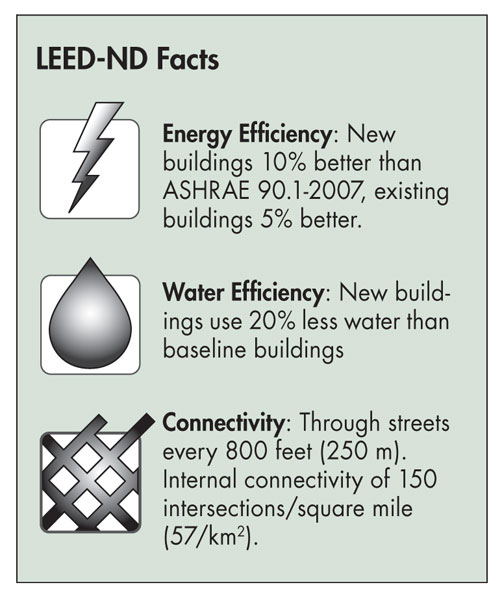
The pilot program for USGBC’s LEED® for Neighborhood Development (LEED-ND) rating system will accept applications for projects through April 6, 2007. Developed in collaboration with the Congress for the New Urbanism and the Natural Resources Defense Council, LEED-ND integrates green building principles with larger concerns, such as smart growth and new urbanism, at the neighborhood and city levels. The 106-point rating system offers credits for “smart location and linkage,” “neighborhood pattern and design,” and “green construction and technology.” Information on the pilot program and a downloadable version of the rating system are available at www.usgbc.org/leed/nd/.

Published December 31, 1969

(2007, March 6). LEED-ND Pilot Program Accepting Applications. Retrieved from https://www.buildinggreen.com/departments/newsbrief

Add new comment

To post a comment, you need to register for a BuildingGreen Basic membership (free) or login to your existing profile.

Communities by Design for 2007 Announced

News Brief

Communities by Design for 2007 Announced

The American Institute of Architects (AIA) Center for Communities by Design has selected five communities as recipients of technical assistance through the Sustainable Design Assessment Team (SDAT) program in 2007. The five communities—Tucson, Arizona; Culver City, California; Dubuque, Iowa; Central, Louisiana; and Albany, New York—will receive the services of architects, economic development experts, city planners, and other professionals as part of the program, which assists cities seeking to improve their sustainability. For more on SDAT, see

EBN

Vol. 14, No. 8 or www.aia.org/liv_sdat.

Published December 31, 1969

(2007, March 6). Communities by Design for 2007 Announced. Retrieved from https://www.buildinggreen.com/departments/newsbrief

Add new comment

To post a comment, you need to register for a BuildingGreen Basic membership (free) or login to your existing profile.
