
Blog Post
News Analysis

News Brief
The New York State Education Department and New York State Energy and Research Development Authority have released final guidelines for high-performance schools. Based on the Collaborative for High Performance Schools (CHPS) guidelines developed in California, the voluntary New York guidelines (called NY-CHPS) have been adapted to reflect state... Read more
News Analysis
In response to the rapidly growing thermoplastic polyolefin (TPO) roofing membrane market, the building products manufacturing giant Johns Manville is investing $30 million in a new TPO manufacturing facility in Scottsboro, Alabama. The plant will begin producing membranes for commercial and industrial applications in mid-2008, helping to... Read more
News Brief
EBN
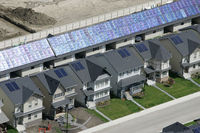
Vol. 14, No. 12), the largest residential development in North America to use solar seasonal storage is now fully operational. A government-funded demonstration project, Drake Landing Solar Community, in Okotoks, Alberta, is a 15‑acre (6-hectare) residential development composed of 52... Read more
News Brief
Several organizations have joined forces to create Minnesota GreenStar, a residential green building program. The program will consist of two rating systems, one for remodeling projects and the other for new construction. Corey Brinkema, executive director of the Green Institute, which led the effort to write the system, said that Minnesota... Read more
News Brief
Signed into law in October 2007, California Assembly Bill 715 requires manufacturers to phase in toilets using 1.28 gallons per flush (gpf; 4.85 liters per flush [lpf]) and urinals using 0.5 gpf (1.9 lpf). Starting in 2010, these high-efficiency toilets and urinals must represent 50% of a manufacturer’s offerings in the state, with that portion... Read more
News Analysis

News Brief

News Analysis
In a series of developments that may signal trouble for the composite decking industry, two industry leaders, TimberTech and Trex Company, appear to be hedging their bets by introducing new product lines made of virgin PVC. Popular in the residential market, PVC decking is considered more resistant to scratching, staining, and fading than... Read more
Product Review
News Brief
At a September 2007 meeting celebrating the 20th anniversary of the Montreal Protocol, government representatives agreed to an accelerated schedule for phasing out hydrochlorofluorocarbons (HCFCs), chemicals that damage ozone and act as greenhouse gases, used as refrigerants in air conditioners as well as in some foams. The accelerated schedule... Read more
News Analysis
MP Global has been awarded Indoor Advantage Gold certification for low emissions from Scientific Certification Systems (SCS) for all of its fibrous flooring underlayment and acoustical products. This certification uses small chamber testing to measure Chronic Reference Exposure Levels (CRELs) of a wide variety of airborne toxicants rather than... Read more
News Brief
Portfolio Manager, an online tool developed by the U.S. Environmental Protection Agency (EPA), has allowed companies to track energy and water use in their buildings, helping them earn the Energy Star label. That tool is now connected to EPA’s Emissions and Generation Resource Integrated Database (eGRID), which compiles emissions data from... Read more
News Brief
The U.S. Environmental Protection Agency (EPA) has released the latest standard for its WaterSense program (see
EBN
Vol. 15, No. 7), adding residential bathroom faucets to the list of products that can be certified. Qualifying faucets must have a flow rate of at least 0.8 gallons per minute (gpm; 3 liters per minute [lpm]) at 20... Read more
News Brief
In a report commissioned by the nonprofit organization CEOs for Cities, economist Joe Cortright finds that the average vehicular commute in Portland, Oregon, is four miles (6 km) shorter than the national median of 24.3 miles (39.1 km) for metropolitan areas. This difference adds up to $2.6 billion per year in savings on travel expenses and... Read more
News Analysis
The American Society of Landscape Architects (ASLA) has been working with the Ladybird Johnson Wildflower Center at the University of Texas–Austin since 2005 to research environmentally friendly landscapes for building sites, parks, and public areas. In 2006, the U.S. Botanic Garden joined the effort, and now the group is going public with its... Read more
News Brief

News Analysis

News Brief
Computer-aided design (CAD) is old hat, but now the Internet is offering manufacturers new opportunities to market to designers using CAD. Google’s 3D Warehouse allows manufacturers to create three-dimensional models of their products for use in its SketchUp design tool; many of these products are green. Whirlpool, for example, offers a group... Read more


