
Feature
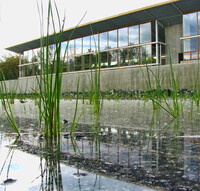
It’s the year 2060. A developer has gathered a group of designers to answer a request for proposals for a 250,000 ft2 building in Portland, Oregon, built entirely with natural materials and without mechanical systems, plumbing, or electric lighting. The developer represents a company that will profit from the ecosystem services the building... Read more
News Analysis
News Brief

News Analysis
News Brief
Florida developer Kitson & Partners has announced plans to build a new city powered entirely by solar energy. The proposed development, Babcock Ranch, would include 19,500 homes on 17,000 acres (6,900 ha)—much of which would remain protected green space—northeast of Fort Myers, Florida. A 75-megawatt photovoltaic plant, the largest in the... Read more
News Brief
Like a growing number of municipalities that are concerned about algae growth in freshwater reservoirs, Westchester County, north of New York City, has banned all phosphate-based fertilizers, effective January 2011. The law also imposes restrictions on all fertilizer use between April and December, effective in 2009, and prohibits most use of... Read more
News Brief
The factory in Electra, Texas, where Agriboard Industries has made straw-core structural insulated panels (SIPs) since 2000 (see
EBN July 2002) was destroyed by a wildfire on April 9, 2009, when strong, shifting winds burned 4,500 acres (1,800 ha) in Wichita County. The loss is estimated at $20 million. The company is now operating in... Read more
News Analysis
Cutting carbon, saving money, and creating green jobs were the leading themes in April 2009 announcements from Los Angeles, New York City, and Seattle. Each city plans to use federal stimulus funds for building retrofit programs.
The Los Angeles City Council unanimously approved an ordinance requiring that all city-owned buildings over 7,500... Read moreBlog Post
News Brief
A celebration of the life and work of Gail Lindsey, FAIA, will be held in Raleigh, North Carolina, on June 20, 2009. All are welcome to come to share memories of Gail and meet others whose lives were impacted by her (see
EBN Mar. 2009 for our memories). More details and contact information are available at www.celebratinggail.com or... Read more
Explainer
Keeping furnishings, appliances, and building materials from catching fire and burning up is important, but many flame retardants aren't good for us or the environment.
Keeping things from catching fire and burning up is a good idea, especially when those things are parts of our buildings or the furnishings we put in our buildings. Flame retardants—chemicals added to products either during manufacture or afterwards—are one of the ways we make products more resistant to igniting or burning (see EBN June 2004... Read more
News Brief
Biophilic Design has received the 2008 American Publishers Award for Professional and Scholarly Excellence in the Architecture and Urban Planning category.
The 2008 John Wiley & Sons book
Biophilic Design, edited by Stephen Kellert, Judith Heerwagen, and Martin Mador (with a chapter by
EBN executive editor Alex Wilson), has received the 2008 American Publishers Award for Professional and Scholarly Excellence in the Architecture and Urban Planning category. The book addresses... Read more
Product Review
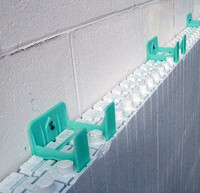
The R-etro System from Quad-Lock makes installing exterior foam for deep-energy retrofits easier and less expensive.
Achieving necessary reductions in greenhouse gas emissions will require almost every home in colder climates of the U.S. to undergo a deep-energy retrofit, often increasing wall insulation to R-30 or more and attic insulation to R-50. Although these retrofits are not technically challenging, they are extraordinarily expensive, running... Read more
Blog Post
Whenever we reduce water use, we also save energy. In fact, several of the most cost-effective energy saving strategies -- projects with the quickest "payback" -- are water conservation improvements that reduce hot water use. I'll cover some of these strategies here, but first I want to explain why even reducing our cold water use saves energy... Read more
Blog Post
Blog Post
Twice each month, BuildingGreen publishes an email news bulletin with current news and product information briefs. Sign up here — it's free. We will never share or sell your email address, and you may unsubscribe at any time.
Read the current bulletinBlog Post
Blog Post
Blog Post
Blog Post
It often surprises people to learn that with today's water-conserving dishwashers and typical practices for hand-washing, properly filled automated dishwashers use less water and energy. If you wash dishes by hand and leave the water running when washing or rinsing, hand-washing almost certainly uses more water. Even if you try to be miserly... Read more


