
News Analysis
The technical staff has been notified, and will try to correct this problem.
If you have a question or comment, please send
us feedback
News Brief
by John Carmody, Stephen Selkowitz, and Lisa Heschong.
W. W. Norton & Co., Inc., 1996. Softcover, 214 pages, $22.
Simply put, this is one of the best books on energy to come out in recent years. The authors have done a superb job of clearly and accurately describing the complex developments in window... Read more
News Brief
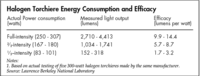
Not a Bright Idea
Halogen torchieres, those highly popular, low-cost, dimmable, standing light fixtures that provide brilliant uplighting, have turned out to be one of the worst lighting products available. First introduced in the 1980s but only gaining widespread use in the past few years, these 300- to 600-... Read moreNews Analysis
A plan including photovoltaics, extensive energy conservation measures, and reduced environmental impacts helped a team led by Lend Lease Corp. Ltd. and Mirvac Ltd. win the contract to build the Olympic Village for the year 2000 Games. The Village, which will likely support the largest residential PV system... Read more
Case Study
Lean and Green for a Municipal Office Building
Many commercial buildings that have received attention over the past few years for environmental features are beautiful, high-end corporate buildings, or attractive demonstration buildings for utility companies or environmental organizations. The Ridgehaven Building... Read more
News Brief
Submission deadline for the 1997
Quality Building Conference Design Competition is February 15, 1997. Prizes will be awarded to projects that incorporate cost-effective energy and resource conservation systems into their buildings. A range of categories will be judged, including both built and unbuilt projects. Awards will be presented... Read more
News Brief
Among the recipients of the first
Building Innovation in Home-ownership Awards was the Super-Insulated Straw Bale Affordable Housing Project of Tucson, Arizona. Project organizers receiving the award included Judy Knox and Matts Mhyrmann of Out On Bale, (un)Ltd., David Eisenberg of the Development Center for... Read more
Feature
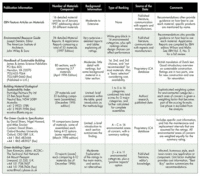
Choosing the right materials for a building is no easy task under any circumstances. Just meeting the conventional criteria, such as performance, cost, and aesthetics, can be a challenge; the addition of an environmental agenda further complicates the picture. The good news is that more tools and resources are becoming available to help... Read more
News Brief
The environmental labeling organization Green Seal is calling for comments on its proposed standards for environmentally preferable chillers. Among the criteria in the standard are choice of refrigerant, measures to limit refrigerant releases, and energy efficiency. Copies are available by calling Green Seal at 202/331-7337; the deadline for... Read more
News Analysis
The American Forest & Paper Association (AF&PA) has come under fire for its Sustainable Forestry Initiative because it does not include independent certification of forestry practices (see
EBN
Vol. 4, No. 3). The association’s just-issued first annual progress report on the Initiative, however, illustrates the delicate... Read more
News Brief
Interior Concerns Environmental Resources, Inc., 131 W. Blithedale Avenue, Mill Valley, California 94941; 415/389-8049, vschomer@interiorconcerns.org (e-mail). 40 pages, paperback, $10 postpaid.
This compact booklet is the first product of a new initiative by Schomer of Interior Concerns—regional directories of green design and construction... Read moreNews Brief
by Alex Wilson and John Morrill. ACEEE, Washington, DC, 1996. Paperback, 267 pages. $7.95 in stores ($11.95 postpaid from ACEEE, 2140 Shattuck Avenue, #202, Berkeley, CA 94704; 510/549-9914).
With publication of the new 5th Edition of this little book, over 100,000 copies are now in print! TheConsumer Guide to Home Energy Savings,... Read more
News Brief
has learned that Sierra Pine, Ltd. of Rocklin, California, is negotiating to purchase the U.S. operations of Medite Corporation, a manufacturer of formaldehyde-free medium-density fiberboard (MDF). It has been rumored for months that Medite was on the block, and
Panel World reported in their November 1996 issue that Medite’s... Read more
Case Study

The Prairie Crossing project, described below, was well underway as a leading-edge development before the Building Science Consortium was formed to redirect some of its strategies. The other two projects profiled below are unrelated to... Read more
News Brief
Mobil Corp. has sold its Composite Products Division to Trex Company, LLC, a corporation formed by four company managers. One of the new owners, Andrew Ferrari, Vice President of Sales and Marketing, told
EBN that the company direction will not change. A fifth production line at the company’s Winchester, Virginia, plant operates around... Read more
News Brief
Due to high demand, the Real Goods Institute for Solar Living in Hopland, California, has expanded its educational program offerings to year-round. A number of the offerings are related specifically to sustainable building, though the emphasis is on owner-builders. Programs include “Sustainable Building and Eco Design,” “Solar Electric Systems... Read more
News Analysis
Designers of the high-profile Audubon Headquarters in New York City, together with National Audubon Society scientists, took great pains to minimize the use of toxic and environmentally damaging building materials. Among the choices they made in renovating the 100-year-old building was to use undyed, 100% wool carpet throughout the space... Read more
Op-Ed
We’ve generally argued that for a good green design, it is necessary to get the environmental agenda on the table as early as possible in the design process. Every decision that is made along the way represents a commitment to a particular path and the closing out of other options. If too many decisions are made before bringing an environmental... Read more
News Brief
The September 2, 1996 issue of
Plastics News reports that the Center for Plastics Recycling Research at Rutgers University is shutting down due to budget cuts. This center has been instrumental in much of the research behind applications for recycled plastic lumber and recycled plastic marine pilings. The article describes the closing... Read more
News Brief
The New York State Energy Research and Development Authority (NYSERDA) has $1 million available to co-fund research and development work relating to high-efficiency lighting products. The maximum award per project is $250,000, and all projects should include a New York State manufacturer. Proposals are due by December 31st. For information... Read more


